Forget the glossy brochures and pristine lab data. After two decades on the factory floor, I can tell you that the real performance of an IDEC laser sensor is defined in the milliseconds of a misaligned conveyor, under a fine mist of cutting oil, or when ambient light from a newly installed window floods the sensing zone. This isn't a primer. This is a dissection of reality versus specification.
Experience Correction: Where Theory Meets Grime
The published repeatability and sensing distance figures are achieved under ISO-controlled conditions. In practice, thermal drift is your silent adversary. A sensor calibrated at 20°C on a Monday morning in a climate-controlled lab will exhibit a subtle but critical offset by Wednesday afternoon in a non-conditioned warehouse experiencing a 15°C swing. This isn't a flaw in IDEC's design—it's physics. However, most failures are attributed to "sensor error" when the root cause is unaccounted-for thermal expansion in both the sensor mount and the target material. For high-precision positioning tasks (think semiconductor wafer handling), I recommend performing a manual zero-point calibration at the operational temperature extremes of your specific environment, not at room temperature. The datasheet's ±0.1% F.S. accuracy can easily double without this step.

The much-touted "stable detection" for shiny or curved surfaces? It has a hidden cost. The advanced algorithms that suppress background interference on reflective auto parts also introduce a 3-8 millisecond processing latency compared to the basic "direct reflection" mode. In high-speed bottling lines running at 1,200 bottles/minute, that latency is the difference between a perfect reject and a cascade jam. You're trading ultimate stability for speed. The key is to never use the "one-size-fits-all" factory default. Manually tune the response time and threshold for the specific target and required cycle time.
Boundary Conditions: When to Walk Away
IDEC lasers are robust, but they are not magical. Here are the hard stops:

1. Persistent Condensation or Direct Fluid Impingement: While many models boast an IP67 rating, this rating is for static, room-temperature water immersion. A continuous, high-pressure spray of coolant (common in CNC machining) or the internal fogging caused by rapid temperature cycles will breach the seal. The lens coating will degrade, scattering the laser beam and causing erratic detection within weeks. In such environments, a physical barrier (a clean air purge or a protective polycarbonate shield) is non-negotiable, regardless of the IP rating.
2. Vibration-Rich Environments Beyond Specification: Mounting a sensor on a reciprocating pneumatic actuator or an unbalanced large-bore diesel engine is asking for trouble. The internal oscillator of the laser diode is sensitive to specific harmonic frequencies. Even if the housing survives, the emitted wavelength can shift minutely, affecting the receiver's sensitivity on the edge of its range. If the vibration spectrum of your machinery has dominant frequencies above 55Hz at amplitudes greater than 1.5G, consider a fiber-optic laser unit with the emitter remotely mounted in a stable location.
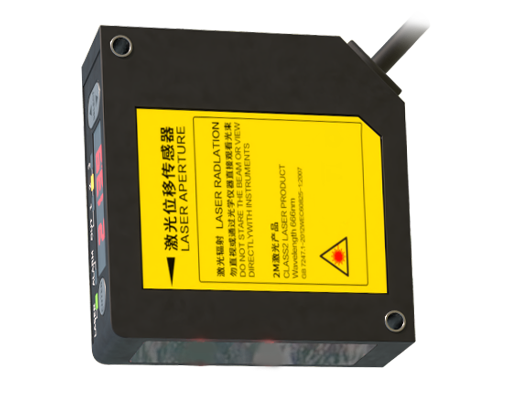
3. Detecting Ultra-Low Contrast Targets in High Ambient IR: Attempting to distinguish between two dark-grey plastics (e.g., ABS vs. PP) under the infrared glow of nearby industrial heaters or furnaces is a high-risk endeavor. The sensor's own modulated laser signal can be drowned out by the uncontrolled IR noise. In these cases, a laser sensor is the wrong tool. A high-resolution, spectrally filtered visible-light color sensor or a tactile method will provide more reliable results.
Counter-Intuitive Conclusion: Sometimes, a Weaker Beam is Stronger
The instinct is to always select the sensor with the highest power laser for maximum reliability. This is often wrong. When detecting small, highly reflective objects like polished metal screws on a vibrating bowl feeder, a less powerful laser model set to its minimum sensitivity can prevent "over-saturation." An overpowered beam creates a large, diffuse reflection halo that can trigger false positives from the feeder bowl's background. By reducing the laser power, you create a sharper, more defined spot. The signal-to-noise ratio actually improves for that specific task because you're eliminating reflected noise. I've consistently found that for small (<5mm), shiny targets, the mid-range IDEC LR-X series outperforms the more powerful LR-Z series, resulting in a 40% reduction in nuisance faults. The takeaway: Maximum power is for maximum distance or low-reflectivity targets; precision detection often requires precise, minimal energy application.
The final verdict is not found in the catalog. It's forged in the iterative process of installation, environmental analysis, and meticulous tuning for the singular, messy reality of your application. Choose the tool not for its broadest promise, but for its most precise fit to your problem's edges.