Forget the pristine data sheets. The advertised sensing range of your inductive or capacitive proximity sensor is a polite fiction, a number achieved in lab conditions that bears little resemblance to the brutal reality of the factory floor. After two decades of deploying thousands of these sensors across automotive foundries, food processing plants, and offshore rigs, I can tell you that the real game is played in the margins, where theory fails and experience is the only valid currency.
Let's start with Experience Corrections. The most pervasive myth is the stability of the nominal sensing distance (Sn). For an inductive sensor rated at 10mm, you might assume a 10mm trigger point. In reality, universal factors create a guaranteed -10% to -30% deviation before you even begin. Metal shavings coating the sensor face? That's an effective 15-25% reduction right there, as the debris forms a parasitic shield, altering the electromagnetic field. Temperature is not your friend. A sensor rated for -25°C to 70°C will see its effective range shrink by nearly 1% per 10°C rise above 40°C due to coil resistance changes and oscillator drift. The target material itself is a trap. While datasheets provide correction factors for stainless steel (typically 0.7-0.9) or aluminum (0.3-0.5), they rarely mention that the specific alloy grade, temper, and even surface oxidation can swing these factors by another ±10%. I've seen 304 stainless with a heavy oxide layer trigger at 85% of the expected distance for clean mild steel, not the textbook 90%. Voltage supply ripple is another silent killer. A sensor on a 24VDC nominal line with 2V of noise can exhibit a hysteresis shift, causing inconsistent actuation within the last 0.5mm of its supposed range.
Now, the Boundary Conditions. Know when to walk away. Proximity sensors are not universal solutions. First, any environment with conductive dust or aerosols (e.g., graphite powder, metal grinding mist, salty marine air) is a high-risk zone for capacitive sensors and even shielded inductive types. The media will slowly bridge the sensing field to ground, causing false triggers or permanent latch-on. Second, extreme vibration (>50g) or mechanical shock will not just break mounts. It can permanently alter the micro-gap between the coil and the ferrite core in inductive sensors, creating a permanent offset error that calibration cannot fix. Third, fast-moving targets are a physics problem. If a target is moving at 5 m/s and your sensor has a 1ms response time, the target travels 5mm during processing. Your effective precision is gone. For high-speed counting or positioning, the sensing range must be derated by the product of speed and response time. Finally, never use a standard inductive sensor for fine metal powder or slurry detection. The powder acts as a continuous target, leading to a constant "on" state. It's a fundamental misuse of the technology.
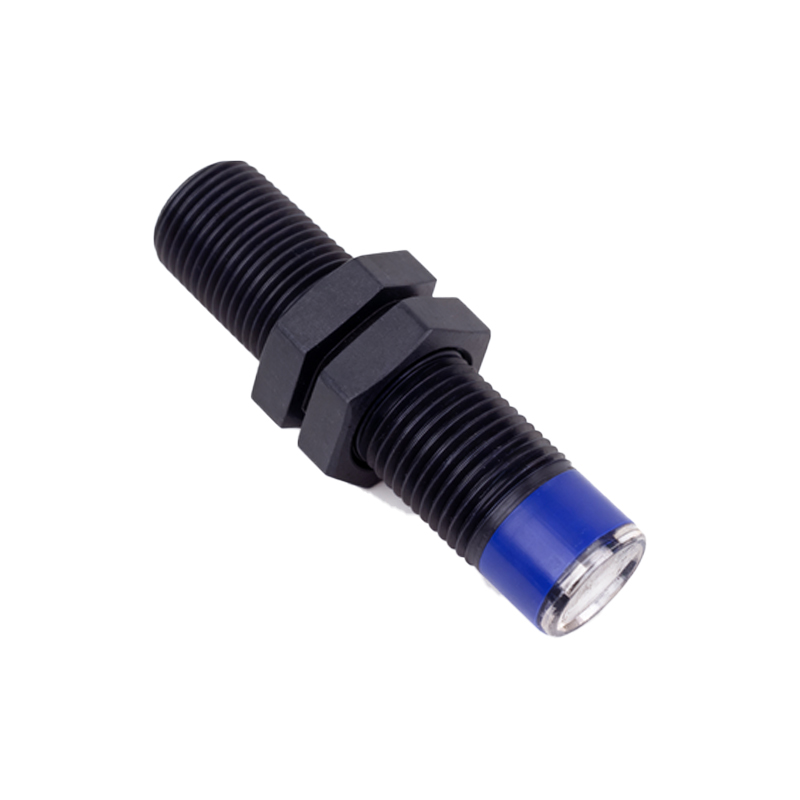
Here is the Counter-Intuitive Conclusion that defies common engineering intuition: Sometimes, a shorter nominal sensing range sensor yields more reliable long-term detection than a longer-range one. The logic is rooted in signal-to-noise ratio and field shape. A sensor with a 5mm Sn typically has a steeper, more focused magnetic or electrostatic field gradient than one with a 15mm Sn. In a noisy, debris-filled environment, the shorter-range sensor is less likely to be influenced by stray conductive objects at the periphery of its field. Its switching characteristic is sharper. I have data from a packaging line where switching from 10mm to 5mm sensors reduced false triggers from 12 per shift to near zero, despite requiring more precise mechanical alignment. The longer-range sensor was simply "seeing too much" of the chaotic environment. Furthermore, the reduced electromagnetic field strength of the shorter-range sensor often results in lower temperature drift and less sensitivity to power supply fluctuations. Choosing a sensor is not about maximizing margin; it's about optimizing for the specific noise profile of your application. The pursuit of extra millimeters of range often introduces millimeters of uncertainty.