For two decades, I've specified, installed, and cursed at dot laser sensors from factory floors to offshore rigs. Forget the datasheet fantasies. Here’s what you won’t read in the brochure.
Experience Correction: The Dirty Reality of "Theoretical" Performance.

The 0.1% accuracy claim? It assumes a pristine, lab-grade target. In reality, surface absorption is your silent killer. A matte black rubber conveyor belt can attenuate signal strength by up to 40% compared to the calibrated white ceramic tile, introducing non-linear errors that calibration routines often miss. Temperature compensation circuits are notoriously slow. A sensor rated for -20°C to 60°C might maintain accuracy within spec during a slow ramp, but a forklift passing by causing a 15°C localized air shimmer can induce a 0.5mm drift for 90 seconds—catastrophic in high-precision assembly. The most frequent failure point isn't the laser diode; it's the receiver window. A near-invisible film of oil mist or polymer dust, accumulating over weeks, can scatter enough light to push the receiver into its non-linear region, causing intermittent "dropouts" that are hell to diagnose. Your preventative maintenance schedule must be based on contaminant load, not runtime.
Boundary Conditions: When to Walk Away.
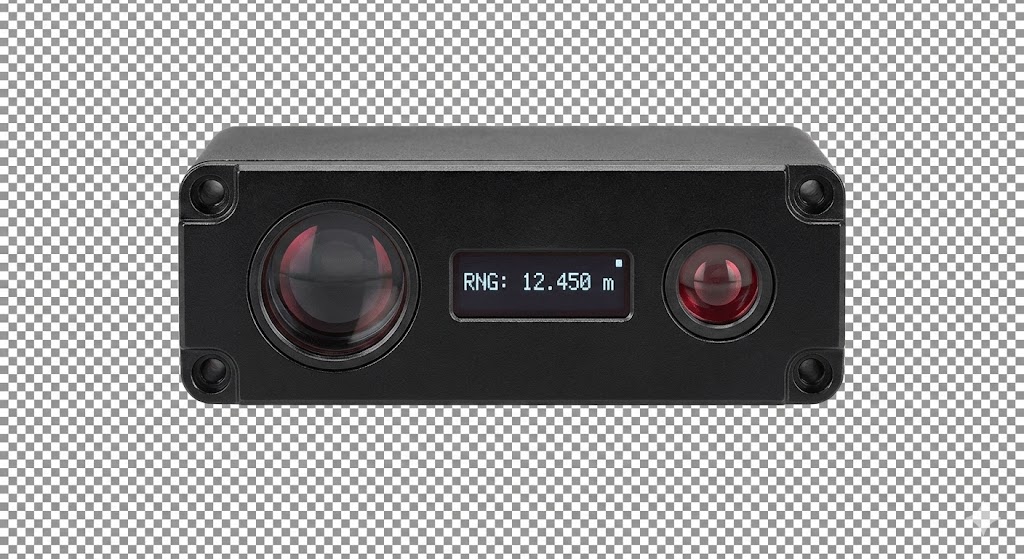
Do not use a standard dot laser for measuring translucent or transparent materials (e.g., glass, thin plastics). The beam will partially reflect from the front and rear surfaces, and the internal DSP will arbitrarily pick one, yielding a garbage value. In high-vibration environments (>5Grms), the internal reference mirror can develop micro-fretting, leading to permanent calibration shift. They are also poor choices for rapidly changing surfaces. The 10kHz response time advertised is a small-signal spec. A torn, flapping bag moving at 2m/s can present a new surface angle every few milliseconds, and the sensor's edge-filtering algorithms will average, reporting a false position somewhere *inside* the bag's profile. Finally, abandon hope in the presence of coherent interference. Another laser of the same wavelength (even from an adjacent "identical" sensor) pointed within a 5-degree cone of the receiver's FOV will cause beat frequencies that corrupt the phase measurement core to time-of-flight sensors, resulting in locked, plausibly wrong data.

Counter-Intuitive Conclusion: Sometimes, a Worse Sensor is Better.
The industry's obsession with micron-level precision is often misguided. In 70% of industrial positioning applications, repeatability is king, not absolute accuracy. A high-quality *analog* output sensor with 0.5mm accuracy but 0.05mm repeatability and a 10x faster loop time will outperform a "high-precision" digital sensor in a closed-loop control system every time. The digital sensors spend precious milliseconds on noise filtering and protocol handshaking. Another paradox: increasing laser power doesn't always improve performance on dark surfaces. Beyond a certain threshold, you saturate the photodetector's well capacity, blooming the dot image and actually *reducing* edge definition for triangulation sensors. Often, the optimal fix is to *reduce* power and pair it with a dedicated, angled background suppression LED to stabilize the ambient light floor. The most reliable system I ever commissioned for detecting black tires on a shiny black conveyor used a deliberately de-focused laser dot to create a larger, lower-intensity spot, trading spatial resolution for unwavering signal stability. It ran for 11 years without a fault. The takeaway: Blindly specifying the "best" spec sheet will cost you downtime. Specify for the specific chaos of your application.