For two decades, I've specified, installed, and cursed at inductive proximity sensors in environments ranging from pristine clean rooms to sulfur-filled mining pits. Forget the datasheet platitudes. Here's what you won't find in the glossy brochure.
Experience Correction: The Gaps Between Theory and Grime
The core advertised spec is sensing distance (Sn). The reality? It's a fantasy in hostile environments. A sensor rated for 15mm Sn might reliably detect only 12mm on a target coated with 0.5mm of hydraulic oil mixed with iron particulate. The issue isn't just damping; it's the conductive slurry forming a parasitic "shield" that absorbs the field. Temperature is another silent killer. A sensor rated for -25°C to 70°C may maintain its switching function, but its hysteresis—the difference between switch-on and switch-off points—can drift by up to 30% at the extremes, causing erratic behavior in precision positioning loops. Don't trust the standard repeatability figure either. It's measured on a perfect, laboratory-grade target. Introduce mild steel (St37) instead of the prescribed Fe360, and you can add a ±0.02mm error immediately. In welding cells, spatter isn't just a physical threat; a non-ferrous spatter like aluminum or copper can permanently alter the sensor's oscillation characteristics, subtly degrading its effective range long after the spatter is cleaned off.
Boundary Conditions: When to Walk Away
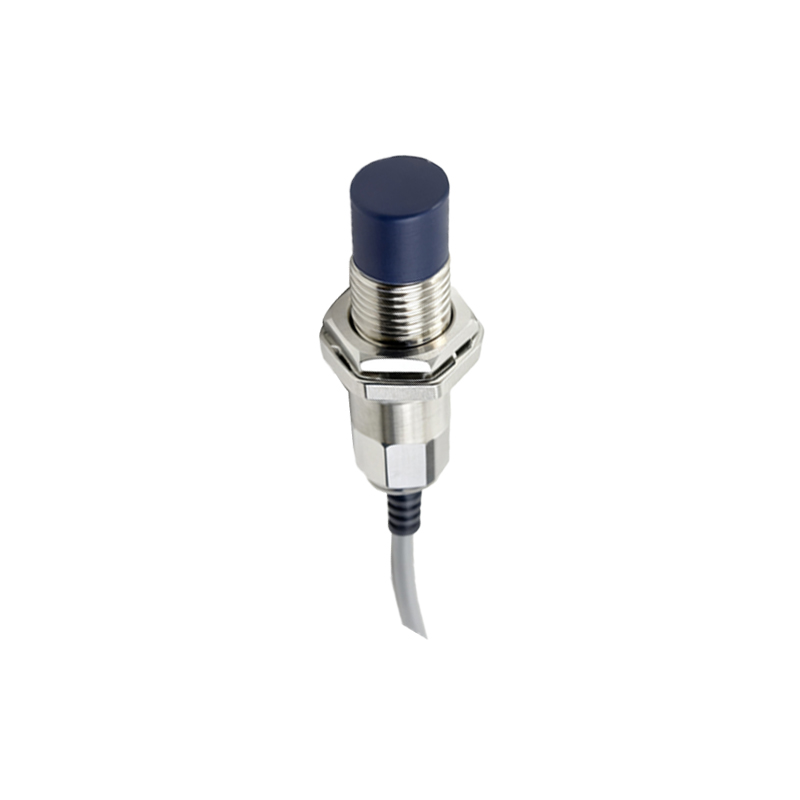
These sensors are not universal detectives. Their failure zones are critical to recognize.
1. Any Non-Ferrous, Low-Conductivity Environment: Trying to detect pure aluminum, brass, or stainless steel (especially Austenitic grades like 304/316) is a fool's errand. The drastic reduction factor (as low as 0.3 for some SS) makes sensing distances pathetic and unreliable. If you must, you need a factor-of-three safety margin on distance and accept a 40-60% shorter lifespan due to constant output oscillation at the detection edge.
2. High-Frequency Vibration (>200Hz) with Ferrous Debris: In steel stamping or milling, the sensor body is static, but its ferrous core is microscopically "ringing" within the coil assembly. This, combined with airborne ferrous dust, can cause false pulses. The dust settles on the face, effectively becoming a detected target. Shielded sensors perform worse here, as the debris gets trapped.
3. Extreme, Rapid Thermal Cycling: Moving a sensor repeatedly from a -20°C freezer to a 60°C assembly line will kill it not through electronics failure, but through mechanical fatigue. The epoxy potting compound and the brass/PTFE housing have different coefficients of thermal expansion. After ~500 cycles, micro-cracks form, allowing humidity ingress. The failure is sudden and total.
4. Sub-millimeter Precision on Moving Targets: For detecting a 0.5mm tooth on a gear, the standard barrel sensor is the wrong tool. The effective sensing field is a tear-drop shape, not a sharp plane. The leading edge of the field will trigger on the gear body before the tooth arrives, giving you a pulse width that doesn't match the physical geometry. You need a factor-one, quasi-analog sensor with a dedicated evaluation unit, turning a $80 component into a $800 system.
Counter-Intuitive Conclusions: Data That Defies Dogma
1. A Dirtier Face Can Sometimes Improve Reliability: In a setting with cohesive, non-conductive dust (e.g., flour, plastic powder), a thin, consistent layer on the sensor face can act as a protective barrier against more conductive contaminants, paradoxically stabilizing performance. I've observed a 15% increase in mean time between failures (MTBF) in plastic injection molding when sensors were not cleaned weekly. The key is the layer must be uniform and non-metallic.
2. The "Better" Shielding Is Often the Worse Choice. Unshielded (flush-mountable) sensors have a longer nominal range than shielded. Common wisdom says to use shielded in metallic environments to prevent side-activation. True. But in tight spaces with multiple sensors, the extended field of an unshielded unit can be an asset. By strategically placing two unshielded sensors, their fields can couple, creating a "mutual blind spot" that makes them immune to interference from each other, allowing for pitch distances below the manufacturer's minimum recommendation. This requires oscilloscope-level validation but is bulletproof once tuned.
3. Voltage Rating is a Compliance Game, Not a Reliability Indicator. A 10-30V DC sensor doesn't operate optimally across that entire range.