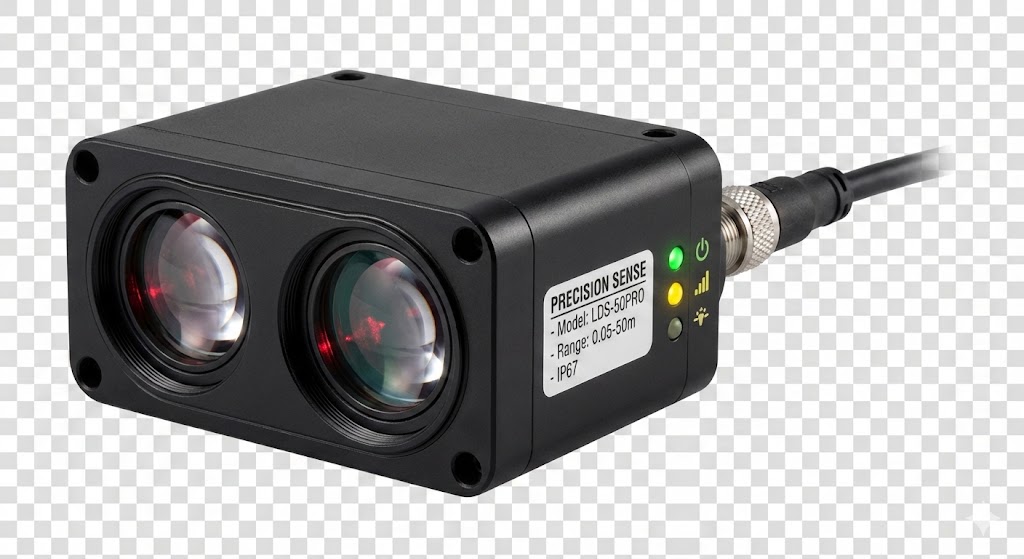
In the world of industrial automation and precision measurement, photoelectric sensors and laser sensors are two pivotal technologies that often come into comparison. While both utilize light to detect objects, their underlying principles, performance characteristics, and ideal use cases differ significantly. Understanding these distinctions is crucial for selecting the right sensor for a specific application, ensuring optimal efficiency, accuracy, and cost-effectiveness.
Photoelectric sensors, a broad category, operate by emitting a beam of light (typically infrared, visible red, or LED-based) and detecting changes in the received light signal. The presence or absence of an object interrupts or reflects this beam, triggering the sensor's output. They are commonly divided into three main types: through-beam, retro-reflective, and diffuse reflective. Through-beam sensors, with a separate emitter and receiver, offer the longest sensing ranges and high reliability. Retro-reflective types use a reflector to bounce the light back to a combined emitter/receiver unit, providing a good balance of range and ease of installation. Diffuse sensors rely on light reflecting directly off the target object itself, making them simpler to set up but with shorter, target-dependent ranges. Photoelectric sensors are renowned for their versatility, durability, and ability to detect a wide variety of materials, including glass, plastic, and metal, without physical contact. They are the workhorses in packaging, material handling, and assembly lines for tasks like object counting, positioning, and break detection.

Laser sensors, a specialized subset of photoelectric technology, employ a highly focused, coherent laser beam. This concentrated light source enables exceptional precision. They primarily operate on the principle of triangulation or time-of-flight measurement for distance gauging, or simply as a precise spot for detection. The key advantage of a laser sensor lies in its extremely small, intense spot size. This allows for the detection of minute objects, precise edge detection, and accurate measurement of distances, heights, or thicknesses with micron-level resolution. For instance, a laser micrometer can measure the diameter of a thin wire with remarkable accuracy. Their focused beam is less susceptible to ambient light interference and can often sense over longer distances than standard diffuse photoelectric sensors. However, this precision comes with considerations: they are generally more expensive than standard photoelectric sensors, and safety precautions are necessary for certain laser classes.
The choice between a photoelectric sensor and a laser sensor hinges on application requirements. For general-purpose presence detection, where the target is relatively large and the environment is not overly challenging, a robust photoelectric sensor is often the most economical and practical solution. Its robustness and lower cost make it ideal for high-volume manufacturing environments. Conversely, when the task demands high precision—such as measuring tiny component displacements, detecting very small parts, or performing exact contour profiling—a laser sensor is indispensable. Applications in semiconductor manufacturing, precision engineering, and automated quality inspection frequently rely on laser sensors.
Environmental factors also play a role. Standard photoelectric sensors can be affected by dust, steam, or highly reflective backgrounds, though models with background suppression technology exist to mitigate this. Laser sensors, with their focused beam, can sometimes perform better in detecting objects against shiny backgrounds or in cutting through minor airborne contaminants, but they may struggle with transparent objects like clear glass unless specifically designed for it.

In summary, photoelectric sensors offer a reliable, cost-effective solution for a vast array of standard detection tasks. Laser sensors provide the pinnacle of precision for demanding measurement and detection applications where spot size and accuracy are paramount. By carefully evaluating factors such as required precision, sensing distance, target characteristics, environmental conditions, and budget, engineers and system integrators can leverage the strengths of each technology to build smarter, more responsive automated systems. The ongoing evolution in both fields continues to expand their capabilities, blurring some lines while further solidifying their unique positions in the sensor landscape.