In the rapidly evolving landscape of industrial automation and precision engineering, intelligent laser sensors have emerged as a cornerstone technology. These sophisticated devices transcend the capabilities of traditional sensors by integrating advanced optics, high-speed processors, and intelligent algorithms into a single, compact unit. Their core function is to emit a focused beam of laser light and analyze the reflected signal to determine precise measurements such as distance, displacement, thickness, and presence, all without physical contact.
The fundamental advantage of the laser lies in its coherence and monochromaticity, allowing for exceptionally accurate and repeatable measurements over long ranges. An intelligent laser sensor builds upon this by embedding a microprocessor that not only captures raw data but also interprets it in real-time. This onboard intelligence enables features like automatic calibration, environmental compensation for temperature or ambient light, and sophisticated edge detection. For instance, in a high-speed bottling line, an intelligent laser sensor can not only detect if a bottle is present but also measure its fill level, check cap alignment, and identify label placement defects simultaneously, communicating this data directly to a PLC for immediate corrective action.
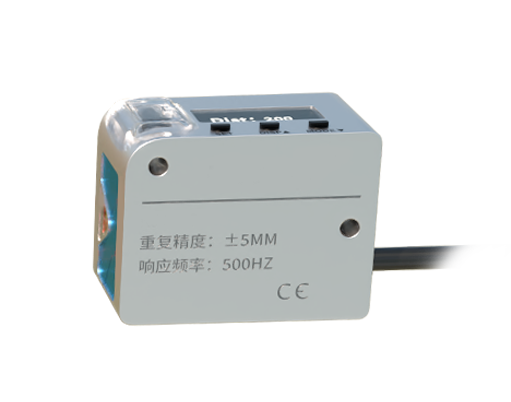
Applications span across diverse sectors. In manufacturing, they are indispensable for robotic guidance, weld seam tracking, and dimensional quality control of components with micron-level tolerances. The automotive industry relies on them for precise gap and flush measurement between body panels. In logistics, they facilitate automated sorting and warehouse management by reading codes and measuring parcel dimensions. Beyond industrial settings, they play a crucial role in emerging fields like autonomous vehicles for LiDAR-based navigation and in smart infrastructure for monitoring structural deformations.
The shift from standard laser sensors to intelligent versions represents a move towards decentralized processing. Instead of sending vast streams of raw analog data to a central controller, these sensors pre-process information, sending only actionable digital results. This reduces network load, increases system response speed, and enhances overall reliability. Modern intelligent laser sensors often come with integrated IO-Link or Ethernet connectivity, facilitating seamless integration into Industry 4.0 and IIoT frameworks. This allows for remote configuration, predictive maintenance alerts based on performance trends, and easy data aggregation for analytics.
When selecting an intelligent laser sensor, key specifications to consider include measurement range, resolution, spot size, response time, and environmental protection rating (IP class). The choice of visible red laser or Class 1 infrared laser depends on the application and safety requirements. Furthermore, the software interface and programmability are critical; users should be able to easily set measurement windows, tolerances, and logic outputs.
Looking ahead, the convergence of smarter algorithms, miniaturization, and reduced costs will continue to drive adoption. Future iterations may incorporate multi-spectral sensing or AI-driven pattern recognition directly at the sensor edge. As industries strive for greater efficiency, flexibility, and data-driven insights, the role of the intelligent laser sensor as a critical data acquisition and decision-making node will only become more pronounced. It is not merely a measuring device but an enabler of autonomous, precise, and interconnected industrial ecosystems.