Proximity sensors are widely used in industrial automation for detecting the presence or absence of objects without physical contact. Among the various output configurations, NPN output is a common and essential type, particularly in many global manufacturing systems. This article explains the fundamentals of NPN output in proximity sensors, its working principle, wiring methods, and practical applications.
An NPN output in a proximity sensor refers to a transistor-based switching mechanism where the sensor acts as a sinking device. In this configuration, the output transistor is an NPN type, which means it switches the load by connecting it to ground (0V) when activated. When the sensor detects a target object, the NPN transistor turns on, allowing current to flow from the load through the sensor to the ground. This creates a low signal (logic 0) at the output terminal relative to the positive supply voltage. Conversely, when no object is detected, the transistor remains off, and the output is in a high-impedance state, effectively disconnecting the load from ground.
The working principle relies on the sensor's internal circuitry. Typically, an oscillator generates a high-frequency electromagnetic field at the sensing face. When a metal object enters this field, it induces eddy currents, causing a change in oscillation amplitude. This change is detected by the sensor's circuit, which then triggers the NPN transistor to switch. For non-metallic objects, capacitive or inductive variants may be used, but the NPN output function remains similar—providing a ground path upon detection.
Wiring an NPN output proximity sensor involves connecting three wires: brown (positive), blue (negative or ground), and black (output). The brown wire is connected to the positive supply voltage (usually 10-30V DC), while the blue wire is linked to the power supply's negative terminal. The black output wire is connected to the load (e.g., a PLC input, relay, or indicator). When the sensor activates, the black wire sinks current to ground, completing the circuit and energizing the load. It's crucial to ensure proper polarity and voltage ratings to avoid damage. In contrast, PNP output sensors source current to the load, making NPN more common in systems where negative logic or ground-switching is preferred.
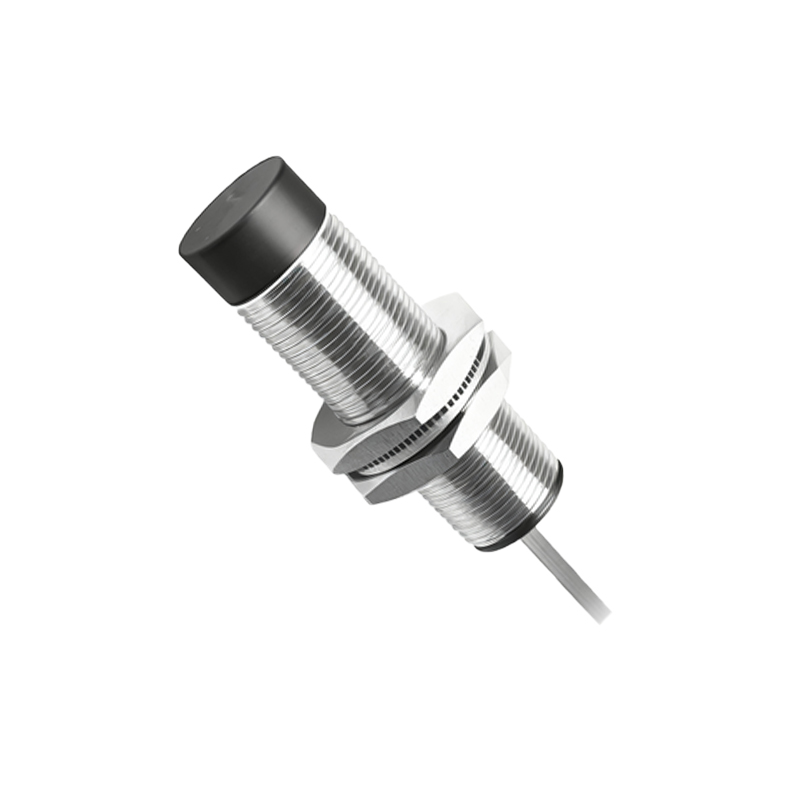
Applications of NPN output proximity sensors are extensive in automation. They are often used in conveyor systems to detect product presence, in robotic arms for position sensing, and in safety interlocks to monitor machine guards. Their sinking nature makes them compatible with many programmable logic controllers (PLCs) that accept low-level input signals. Additionally, NPN sensors are favored in regions like Asia and Europe due to historical electrical standards, though both NPN and PNP types are globally available. When selecting a sensor, factors such as sensing range, material type, environmental conditions, and output type must be considered to ensure reliable operation.
In summary, NPN output proximity sensors offer a reliable and straightforward solution for object detection in automated environments. By understanding their operation and wiring, engineers can effectively integrate them into control systems, enhancing efficiency and safety. As technology advances, these sensors continue to evolve, but the core principles of NPN output remain a cornerstone in industrial electronics.