Laser sensor technology represents a cornerstone of modern industrial automation, robotics, and measurement systems. This guide delves into the fundamental principles, various types, and practical applications of these precise and versatile devices, serving as an essential resource for engineers, students, and technicians.
At its core, a laser sensor is a device that uses a focused beam of light—Light Amplification by Stimulated Emission of Radiation—to detect, measure, or profile an object. The basic operating principle involves emitting a laser beam towards a target. The interaction of this beam with the target—whether through reflection, interruption, or scattering—is then captured by a receiver within the sensor. The received signal is processed to extract specific information, most commonly distance, presence, or displacement. The key advantages of laser light for sensing include its coherence, monochromaticity, and ability to be focused into an extremely fine point over long distances, enabling high-resolution measurements unattainable with conventional light sources.
Several distinct measurement principles define the major categories of laser sensors. Triangulation sensors are among the most common for precise distance and displacement measurement. The sensor emits a laser beam at a known angle onto the target surface. The reflected light is focused onto a position-sensitive detector, such as a CCD or PSD array. As the target distance changes, the position of the light spot on the detector shifts. Using simple trigonometric calculations, the sensor's electronics determine the exact distance. These sensors excel in applications requiring micron-level resolution for tasks like thickness gauging, contour profiling, and vibration analysis.
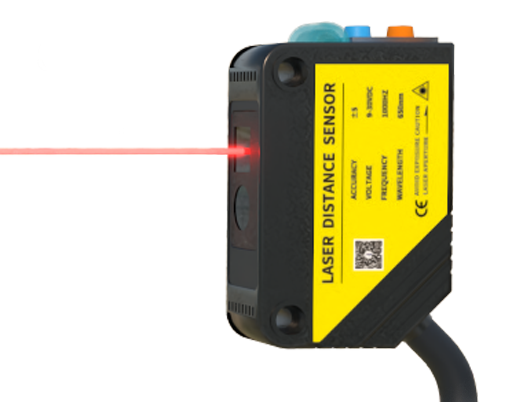
Time-of-Flight (ToF) laser sensors operate on a different principle. They measure the time it takes for a laser pulse to travel to the target and back. Since the speed of light is constant, the distance is calculated as Distance = (Speed of Light × Time of Flight) / 2. While traditionally offering slightly lower resolution than triangulation over short ranges, modern ToF sensors provide excellent performance for medium to long-range measurements (from a few centimeters up to several hundred meters) and are fundamental in applications like LiDAR for autonomous vehicles, bulk level monitoring, and large-scale surveying.
Laser contrast sensors are designed for reliable detection based on surface characteristics. They evaluate the intensity of the reflected light from a target. By teaching the sensor the light intensity values of a background and a foreground mark, it can reliably detect even low-contrast features, such as prints, engravings, or subtle color differences on packaging lines. Laser profile scanners (or line profilers) project a laser line onto a target. A camera captures the deformation of this line, and sophisticated software constructs a detailed 2D or 3D profile of the object. This is indispensable for quality control, weld seam inspection, and reverse engineering.
The application spectrum for laser sensors is vast and continuously expanding. In factory automation, they are ubiquitous for precise positioning of robotic arms, detecting minute parts on high-speed assembly lines, and ensuring consistent fill levels in bottling plants. The electronics industry relies on them for wafer inspection, solder paste measurement, and component placement verification, where tolerances are microscopic. Automotive manufacturers use laser sensors for body-in-white gap and flush measurement, paint thickness inspection, and aligning parts during assembly. Beyond manufacturing, they are critical in logistics for dimensioning packages, in agriculture for guiding autonomous harvesters, and in medicine for advanced imaging and surgical guidance systems.
Selecting the appropriate laser sensor requires careful consideration of several parameters. Resolution defines the smallest detectable change in measurement. Repeatability indicates how consistently the sensor can return the same value for a static target. The spot size determines the minimum feature that can be measured. Stand-off distance (the distance from the sensor head to the target) and measurement range are crucial for mechanical integration. Environmental factors like ambient light, dust, fog, and the target's surface properties (color, reflectivity, texture) must also be evaluated, as they can significantly impact performance. Many modern sensors incorporate intelligent features like integrated heating for harsh environments, digital interfaces (Ethernet/IP, PROFINET), and advanced software for data logging and analysis.
In conclusion, laser sensors are powerful tools that translate the physical properties of light into actionable data. Their evolution continues with trends towards miniaturization, higher speeds, embedded intelligence, and multi-sensor fusion. A solid understanding of their principles and capabilities, as outlined in this guide, is fundamental for leveraging their potential to enhance precision, efficiency, and quality across countless industries. Future developments will likely see them becoming even more integrated, cost-effective, and essential in the smart factories and autonomous systems of tomorrow.