In the realm of industrial automation, robotics, and advanced measurement systems, laser sensors have become indispensable tools. Their ability to provide precise, non-contact detection and measurement makes them superior to many traditional sensing technologies. However, with a variety of laser sensor types available, selecting the right one for a specific application can be challenging. This article provides a detailed comparison based on operating principles, key performance parameters, and typical use cases, aiming to offer practical guidance for engineers and system integrators.
The fundamental principle behind most laser sensors involves emitting a focused beam of coherent light and analyzing the reflected signal. The primary categories include laser triangulation sensors, time-of-flight (ToF) sensors, and laser contrast sensors. Each operates on a distinct method to gather data.
Laser triangulation sensors are renowned for their high precision at short ranges. They work by projecting a laser spot onto a target. The reflected light is captured by a receiver lens at a known angle, forming a triangle. Displacement of the target changes the position of the laser spot on the receiver's sensor, allowing for extremely accurate distance or height measurement. These sensors excel in applications like wafer inspection, precision assembly, and thickness gauging where micron-level resolution is required. Their main limitation is the limited measuring range, typically from a few millimeters up to about a meter, and they can be sensitive to the target's surface properties.

In contrast, Time-of-Flight (ToF) sensors measure distance by calculating the time it takes for a laser pulse to travel to a target and back. They are ideal for long-range applications, often capable of measuring distances from several meters to hundreds of meters. While generally less precise than triangulation sensors, modern ToF sensors offer good accuracy for tasks like vehicle navigation, bulk material level monitoring, and large-volume 3D scanning. Their performance can be affected by ambient light and the reflectivity of the target, but they provide a robust solution for mapping and presence detection over large areas.
Laser contrast sensors, sometimes called luminescence sensors, are designed for reliable detection based on color or material contrast rather than precise distance. They evaluate the intensity of the reflected light. A bright target reflects more light than a dark one, allowing the sensor to distinguish between different materials, labels, or marks. They are the workhorses in packaging, printing, and material sorting lines. Their setup is usually straightforward, and they are highly immune to environmental factors like vibration.
Beyond type, several critical parameters dictate sensor performance. Resolution, or the smallest change a sensor can detect, is paramount for measurement tasks. Repeatability indicates how consistently the sensor returns the same reading for an identical target position. Measurement rate or response time determines how fast the sensor can update its output, crucial for high-speed production lines. The laser spot size affects the minimum detectable feature and influences accuracy on rough or curved surfaces. Environmental factors such as ambient light, dust, fog, or temperature swings must also be considered, as they can interfere with the laser beam.
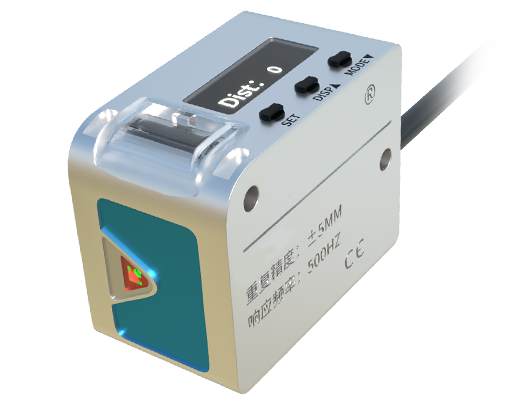
Selecting the appropriate laser sensor requires a clear analysis of the application's needs. For high-precision, short-range measurement of a stable object, a laser triangulation sensor is likely the best choice. For mapping a warehouse floor for an autonomous mobile robot (AMR), a ToF sensor (often in a LiDAR unit) is more suitable. For simply detecting a black mark on a white background on a conveyor, a reliable and cost-effective laser contrast sensor will suffice.
Furthermore, integration aspects are vital. Consider the required output interface (analog, digital, IO-Link, Ethernet), the physical mounting constraints, and the compatibility with existing control systems. The choice of visible red laser versus Class 1 infrared laser also matters for safety and application suitability.
In conclusion, there is no single "best" laser sensor. The optimal choice is a function of required precision, range, target properties, environmental conditions, and budget. Understanding the core differences between triangulation, Time-of-Flight, and contrast sensors provides a solid foundation for making an informed decision. By carefully matching the sensor's specifications to the application's fundamental requirements, engineers can ensure reliable performance, enhance system efficiency, and achieve the desired level of automation and quality control.