Introduction to Retroreflective Photoelectric Sensors
Retroreflective photoelectric sensors are essential components in modern industrial automation, designed to detect objects by emitting a light beam to a reflector and analyzing the returned signal. Unlike through-beam sensors, which require separate emitter and receiver units, retroreflective sensors integrate both in a single housing, simplifying installation and reducing wiring complexity. They operate using either modulated light or laser technology, ensuring reliable performance in dusty, humid, or high-vibration environments. These sensors are widely used in packaging, material handling, and assembly lines where precise object presence detection is critical. The key advantage lies in their ability to detect a variety of materials, including opaque, transparent, or reflective objects, with minimal alignment effort.
Polarized Retroreflective Sensors
Polarized retroreflective sensors employ polarized light filters to enhance detection accuracy, particularly for shiny or reflective targets. The emitter sends polarized light, which is reflected back by a special prismatic reflector that rotates the polarization angle. The receiver only responds to the rotated light, ignoring false reflections from nearby shiny surfaces like metal, glass, or plastic films. This design eliminates errors caused by background interference, making them ideal for applications such as detecting clear bottles in beverage lines or monitoring pallets in logistics. The typical sensing range varies from 2 to 10 meters, depending on the reflector size and environmental conditions. Engineers often choose these sensors for high-speed processes where false triggers could lead to downtime.
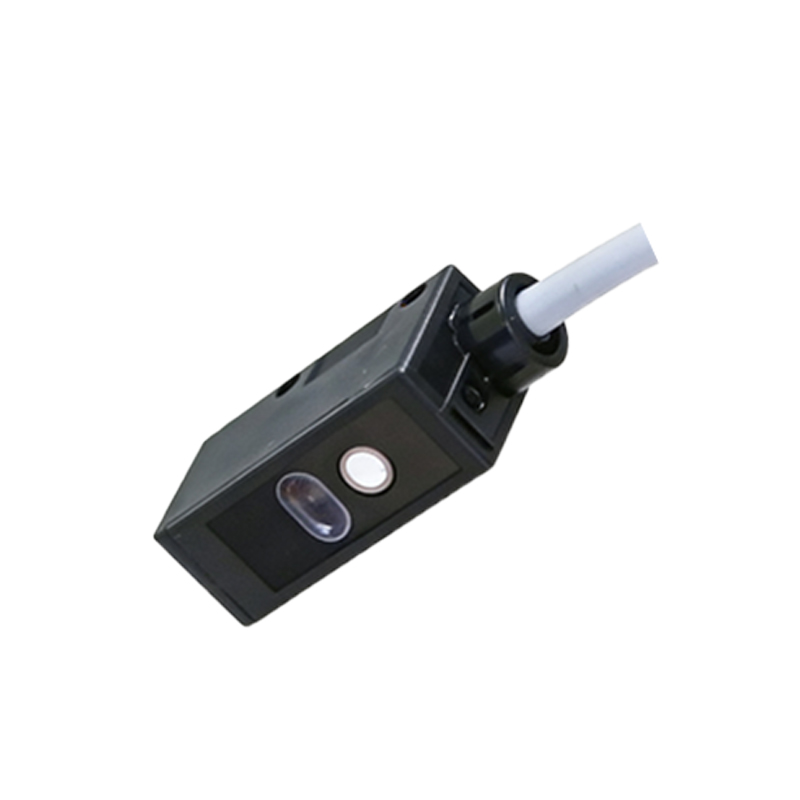
Non-Polarized Retroreflective Sensors
Non-polarized retroreflective sensors operate with standard light beams, relying on retroreflectors to return the signal without polarization filtering. They are simpler and more cost-effective than polarized versions, but they are prone to false detections from shiny objects or ambient light interference. These sensors are suitable for applications with minimal reflective surfaces, such as detecting opaque boxes in dark environments or monitoring conveyor belt jam-ups. The sensing range typically spans from 1 to 8 meters, with lower sensitivity to transparent or translucent materials. For instance, in a warehouse setting, non-polarized sensors can reliably detect cardboard cartons but may struggle with clear plastic wraps. Their straightforward design reduces maintenance needs, but careful installation is required to avoid cross-talk from nearby sensors.
Background Suppression Retroreflective Sensors
Background suppression retroreflective sensors incorporate advanced optics to distinguish between the target object and the background, such as a wall or floor. They use a focused beam with a precise cutoff distance, ensuring detection only within a set range. This feature is crucial for applications with moving machinery, where false triggers from stationary objects could cause safety risks. These sensors can detect objects with varying colors, textures, or reflectivity, as they focus on the light intensity change rather than polarization. The typical range is up to 5 meters, with high immunity to dust and dirt. For example, in automotive assembly, they are used to detect small parts on a moving conveyor without interference from metallic supports. However, they require more precise alignment compared to other types.
Laser-Based Retroreflective Sensors
Laser-based retroreflective sensors use a collimated laser diode for long-range detection with exceptional accuracy. The focused beam allows for narrow beam angles, enabling detection of small or distant objects, such as miniature components in electronics manufacturing. These sensors offer ranges exceeding 20 meters with reflectors, making them suitable for large-scale material handling systems. They are also effective in high-ambient-light environments, as the laser frequency filters out interference. Common applications include monitoring overhead crane positions or counting items on fast-moving lines. However, the higher cost and sensitivity to vibration require robust mounting and regular calibration. Engineers must ensure compliance with laser safety standards, especially in open industrial spaces.
Selecting the Right Retroreflective Sensor
Choosing the correct retroreflective sensor depends on several factors: object material, distance, environmental conditions, and cost. For reflective or transparent objects, polarized sensors are essential to avoid false signals. For long-range applications, laser sensors provide the best performance. Background suppression models are ideal for complex backgrounds, while non-polarized types offer budget-friendly solutions for simple tasks. Always consider the reflector quality and alignment tolerance—a misaligned reflector can reduce sensing range by up to 50%. Additionally, check the sensor’s response time to match your system’s speed; fast-switching sensors are critical for high-speed packaging lines. Regular cleaning of the lens and reflector ensures optimal performance, especially in dusty environments like cement plants or sawmills.
Common Installation and Troubleshooting Tips
Proper installation is key to maximizing sensor reliability. Mount the reflector at a 90-degree angle to the sensor beam, avoiding direct sunlight or intense artificial lights. Use a shielded cable for long runs to prevent electrical noise interference. During troubleshooting, check for lens contamination, reflector damage, or misalignment first—these cause over 80% of failures. If the sensor triggers erratically, reduce the sensitivity setting or switch to a polarized model. For multi-sensor setups, stagger the positions to prevent beam cross-talk. Always test the system with actual target objects under operating conditions, as static tests may miss dynamic issues like vibration or speed variations.