Introduction to M5 Through-Beam Photoelectric Sensors
M5 through-beam photoelectric sensors are compact, high-performance devices widely used in automated industrial environments. Their small form factor (M5 threaded housing) makes them ideal for space-constrained applications, such as conveyor systems, packaging machinery, and robotics. This article examines the key factors that influence their performance and reliability, focusing on environmental conditions, installation misalignment, and signal interference.
Environmental Factors: Dust, Moisture, and Temperature
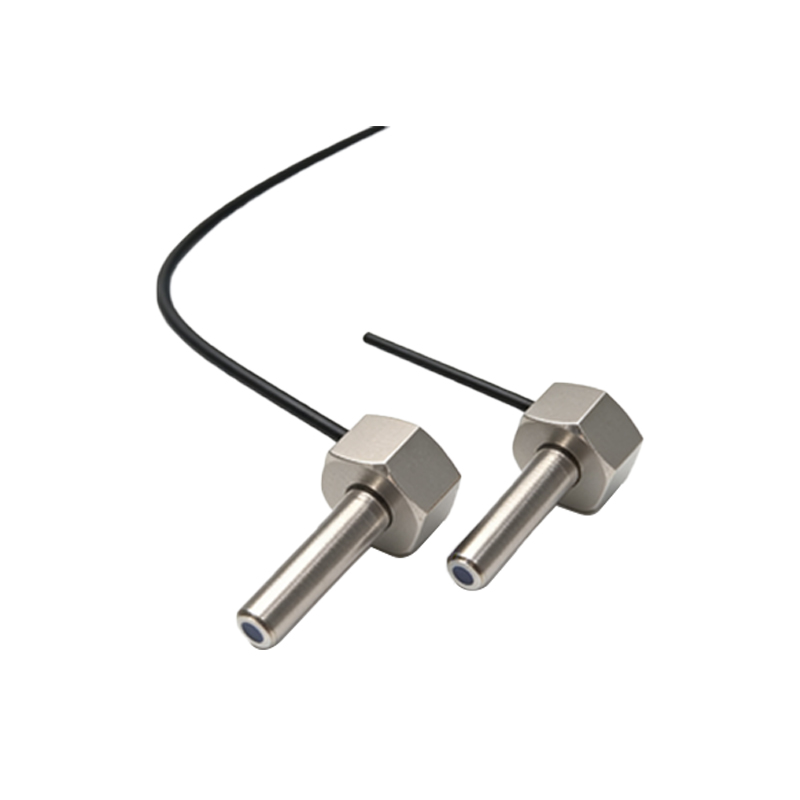
The most common impact on M5 through-beam sensors is environmental contamination. Dust accumulation on the emitter or receiver lens can attenuate the light beam, leading to false triggers or detection failures. In high-humidity or washdown areas, moisture condensation on the lens surface similarly reduces optical transmission. Temperature extremes beyond the rated range (typically -25°C to +55°C) may cause thermal drift in the LED output or photodiode sensitivity, resulting in unstable switching thresholds. For reliable operation, use IP67-rated enclosures and install protective shields or air purge systems in harsh environments.
Installation Misalignment and Beam Breakage
Precise alignment is critical for M5 through-beam sensors due to their narrow beam angle (usually 3-5 degrees). Even slight mechanical vibration or thermal expansion of mounting brackets can misalign the emitter-receiver pair, causing partial beam blockage. This leads to intermittent detection or reduced sensing range. To mitigate this, use rigid mounting brackets with vibration damping, and perform periodic beam alignment checks during maintenance. Additionally, beam breakage by foreign objects (e.g., metal chips or falling debris) can create unintended gaps, requiring redundant sensor arrays in critical safety applications.
Electrical Noise and Signal Interference
M5 sensors operate on DC power (10-30V) with NPN or PNP output configurations. In industrial settings, nearby high-power motors, inverters, or welding equipment can induce electromagnetic interference (EMI) on the sensor’s signal lines. This interference may cause false pulses or output chatter, especially if unshielded cables are routed close to power lines. Using shielded twisted-pair cables with proper grounding, and maintaining at least 15 cm separation from high-current conductors, significantly reduces noise impact. Additionally, adding a ferrite core near the sensor connector can suppress high-frequency transients.
Optical Interference from Ambient Light
While M5 through-beam sensors are designed with modulated infrared or red light to filter out ambient light, strong direct sunlight or high-intensity LED lighting can still saturate the receiver. This is more pronounced in outdoor applications or near glass windows. Some sensors offer automatic gain control (AGC) to adapt to changing ambient light levels, but in extreme cases, an optical hood or sunshade may be necessary. Testing the sensor under worst-case lighting conditions during installation is recommended.
Maintenance and Lifespan Considerations
M5 sensors have a typical lifespan of 50,000 to 100,000 hours, but lens contamination and thermal stress can accelerate degradation. Regular cleaning with a lint-free cloth and mild solvent (e.g., isopropyl alcohol) prevents optical degradation. For high-cycle applications (e.g., high-speed counting), selecting sensors with solid-state outputs (no moving parts) ensures longer mechanical life. Replacing sensors proactively after 70% of rated lifespan minimizes unexpected downtime.
Conclusion: Best Practices for Reliable Operation
To maximize the impact and reliability of M5 through-beam photoelectric sensors, engineers should prioritize proper environmental protection, precise alignment, electrical noise suppression, and routine maintenance. By addressing these factors, M5 sensors provide consistent, accurate detection in demanding industrial automation settings, contributing to improved system uptime and product quality.