Introduction to Optical Sensor Fundamentals
Optical sensors, also known as photoelectric sensors, are critical components in industrial automation, converting light signals into electrical outputs. For electrical engineers, mastering these devices is essential for designing reliable control systems. This article presents a series of exam questions covering operating principles, types, and practical applications. Each question is designed to test theoretical knowledge and troubleshooting skills. Engineers should understand concepts like emitter-receiver alignment, ambient light interference, and response time. These questions will help prepare for certification exams or on-site troubleshooting.
Question 1: Identify Sensor Types by Operating Principle
A plant uses sensors to detect transparent glass bottles on a conveyor. The sensor must ignore dust and surface reflections. Which type of optical sensor is most suitable? A) Through-beam B) Retro-reflective C) Diffuse reflective D) Fiber optic. Explain your choice. Answer: Through-beam sensors provide the highest reliability for transparent objects, as the emitter and receiver are separated, ensuring detection regardless of material transparency. Retro-reflective sensors may fail with clear surfaces due to beam polarization issues. Diffuse sensors rely on reflected light from the target, which can be inconsistent with glass.
Question 3: Troubleshooting False Triggering in High Ambient Light
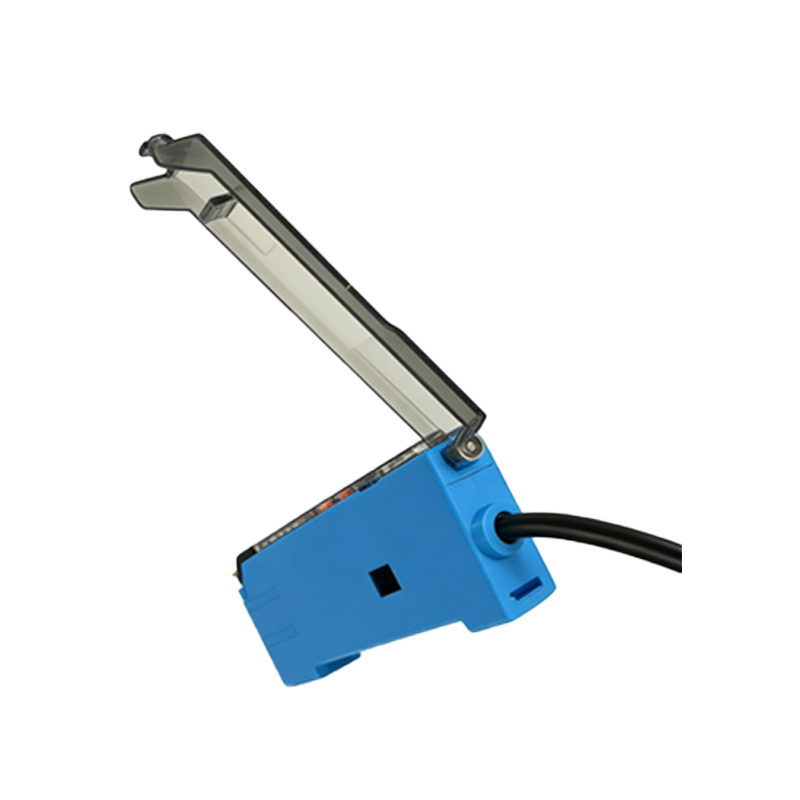
A retro-reflective sensor in a packaging line is falsely triggering when sunlight enters the detection area. List three mitigation strategies. First, install a sun shield or hood over the sensor to block direct sunlight. Second, use sensors with modulated infrared light and filters to reject ambient light. Third, adjust the sensitivity threshold or use a polarizing filter with the reflector. The correct approach involves combining physical shielding with electronic filtering. Engineers must also check reflective surfaces near the path that might scatter sunlight.
Question 2: Calculate Response Time for High-Speed Application
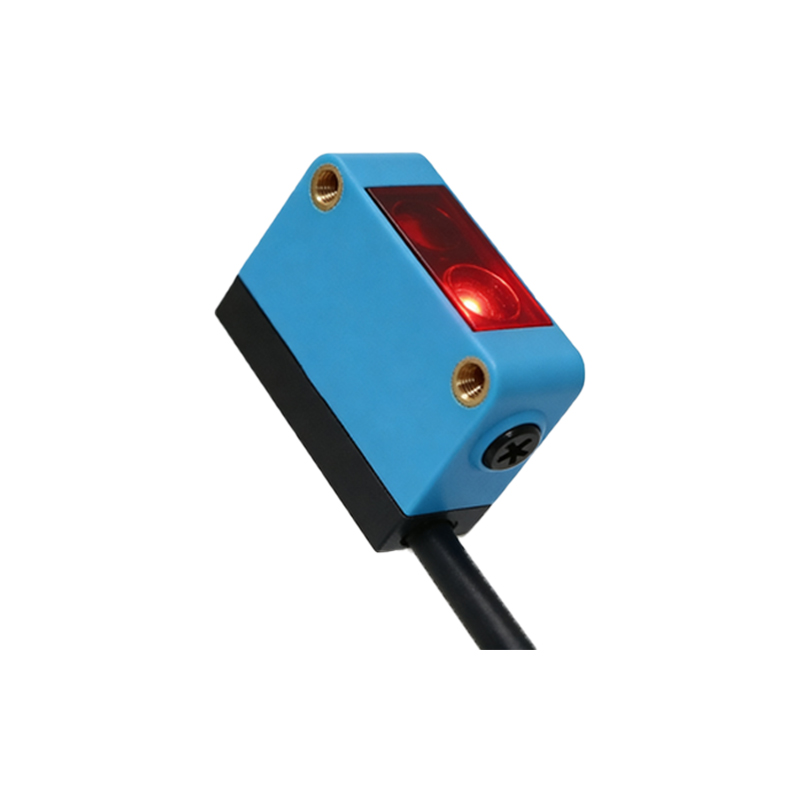
A sensor must detect objects moving at 2 meters per second. The object length is 50 mm. What is the maximum allowable response time to ensure at least one detection pulse? Formula: Detection time = Object length / Conveyor speed = 0.05 m / 2 m/s = 0.025 seconds (25 ms). The sensor’s response time must be less than this value. For robust operation, choose a sensor with response time under 10 ms. Factors include load capacitance and output type (PNP/NPN). Excessive response time leads to missed detections in high-speed sorting.
Question 4: Wiring and Output Configuration
A sensor has four wires: brown, blue, black, and white. Which colors correspond to power, ground, normally open (NO), and normally closed (NC) outputs? Brown is positive (24V DC), blue is ground (0V), black is normally open output (NO), white is normally closed output (NC). When wiring, ensure load is connected between output and ground for NPN sensors, or between output and positive for PNP sensors. Miswiring can damage the sensor or cause short circuits.
Question 5: Environmental Effects on Detection Distance
How does condensation on the sensor lens affect detection range? Condensation scatters emitted light, reducing effective range by up to 40%. For sensors rated at 2 meters, condensation may drop range below 1.2 meters, causing intermittent failures. Solutions include heating the lens, using sealed enclosures, or selecting sensors with automatic gain control. Engineers must consider humidity in food processing or outdoor installations.
Conclusion: Exam Preparation Tips
To ace optical sensor exams, focus on understanding the physics of light reflection and absorption. Practice calculating response times and interpreting datasheet parameters like hysteresis, beam angle, and protection ratings (IP67). Reviewing real-world scenarios—such as detecting dark objects on shiny backgrounds—will improve troubleshooting skills. Remember, these questions reflect typical challenges in industrial automation.