Introduction to Ruyuan Photoelectric Sensors
As an electrical engineer with extensive experience in industrial automation, I have consistently relied on Ruyuan photoelectric sensors for their reliability and precision. These sensors utilize light beams to detect the presence, absence, or distance of objects, making them essential in manufacturing lines, packaging systems, and material handling. Ruyuan offers a diverse portfolio tailored to various environments, from harsh industrial floors to cleanroom settings. Their product line includes through-beam, retro-reflective, and diffuse reflective types, each designed for specific detection ranges and target characteristics.
Through-Beam Sensors for Long-Range Detection
Ruyuan’s through-beam photoelectric sensors consist of separate transmitter and receiver units, providing the longest sensing distances, typically up to 30 meters. I have deployed these in conveyor systems where precise object counting is critical, such as in automotive part assembly. They excel in dusty or smoky conditions because the light beam penetrates contaminants effectively. Models like the RY-TB-1000 offer robust IP67 housings and fast response times, ensuring minimal false triggers. For engineers, this means reliable operation even in demanding applications like steel mills or lumber processing.
Retro-Reflective Sensors for Space-Constrained Areas
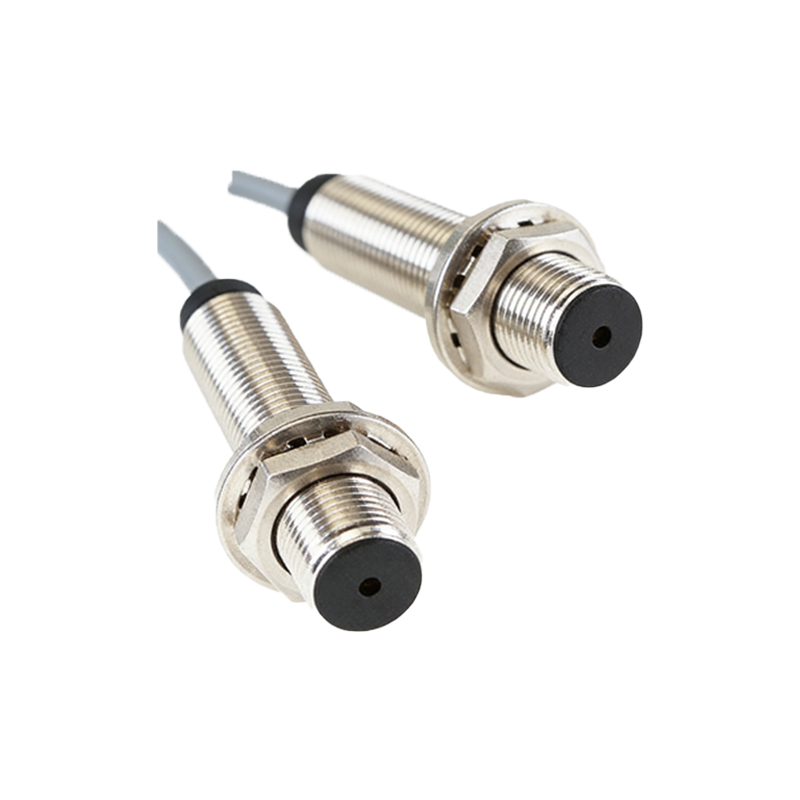
In tight spaces where mounting two units is impractical, Ruyuan’s retro-reflective sensors are ideal. They combine emitter and receiver in one housing, using a reflector to bounce the light beam back. I have used the RY-RR-500 series in packaging lines to detect clear plastic bottles, a challenging task due to transparency. These sensors feature polarized filters to ignore shiny backgrounds, reducing errors. With sensing ranges up to 10 meters and a compact M18 threaded design, they fit easily into existing machinery without major modifications.
Diffuse Reflective Sensors for Proximity Detection
For applications requiring detection of objects at short distances without a reflector, Ruyuan’s diffuse reflective sensors are the go-to choice. They rely on the target’s surface to reflect light back to the sensor. I often recommend the RY-DR-200 model for pick-and-place robots in electronics assembly, where it detects small components with high repeatability. These sensors have adjustable sensitivity, allowing fine-tuning for different materials like metal, plastic, or cardboard. Their background suppression feature further enhances accuracy, making them suitable for variable-height products.
Fiber Optic Sensors for Extreme Conditions
When dealing with extreme temperatures, high electromagnetic interference, or confined spaces, Ruyuan’s fiber optic photoelectric sensors offer unmatched flexibility. The remote amplifier separates the sensing head from the electronics, enabling operation up to 200°C. I have implemented these in furnace monitoring systems and precision measurement tasks. The fiber cables are immune to electrical noise, and the small sensing tips can be positioned in tight gaps. Models like the RY-FO-400 provide both through-beam and diffuse modes, catering to diverse industrial needs.
Conclusion and Selection Tips
Selecting the right Ruyuan sensor depends on your specific application parameters: distance, target material, environment, and response speed. For long-range and dirty environments, choose through-beam; for tight spaces, retro-reflective; for proximity detection, diffuse; and for extreme conditions, fiber optic. Always verify the sensor’s output type (PNP/NPN) and cable length to match your PLC or controller. Ruyuan’s catalog also includes laser-based sensors for high-precision tasks, such as the RY-LS-100 for sub-millimeter detection. By understanding these options, you can enhance system efficiency and reduce downtime.