In the world of automation, consumer electronics, and industrial safety, a small and often unseen component plays a critical role: the proximity sensor. Unlike a simple mechanical switch, a proximity sensor can detect the presence or absence of a nearby object without any physical contact. This non-contact operation is its defining feature, leading to high reliability, long operational life, and the ability to function in harsh environments where dirt, oil, or moisture would compromise a tactile switch.
At its core, a proximity sensor works by emitting a field or beam of electromagnetic radiation or by using an electrostatic field. It then looks for changes in the field or a return signal. The specific method defines the primary types of proximity sensors, each suited to different materials and applications.
Inductive proximity sensors are one of the most common types. They generate an oscillating electromagnetic field. When a metallic object enters this field, it induces eddy currents on the object's surface. These currents absorb energy from the sensor's oscillator, causing a measurable change in amplitude. The sensor's circuitry detects this change and triggers a solid-state switch. Inductive sensors are robust, ideal for industrial environments, and excel at detecting ferrous metals like steel and iron, though they can also sense non-ferrous metals like aluminum, copper, and brass at typically shorter ranges. You'll find them counting metal parts on assembly lines, confirming the position of machine tools, or as safety interlocks on guarded machinery.
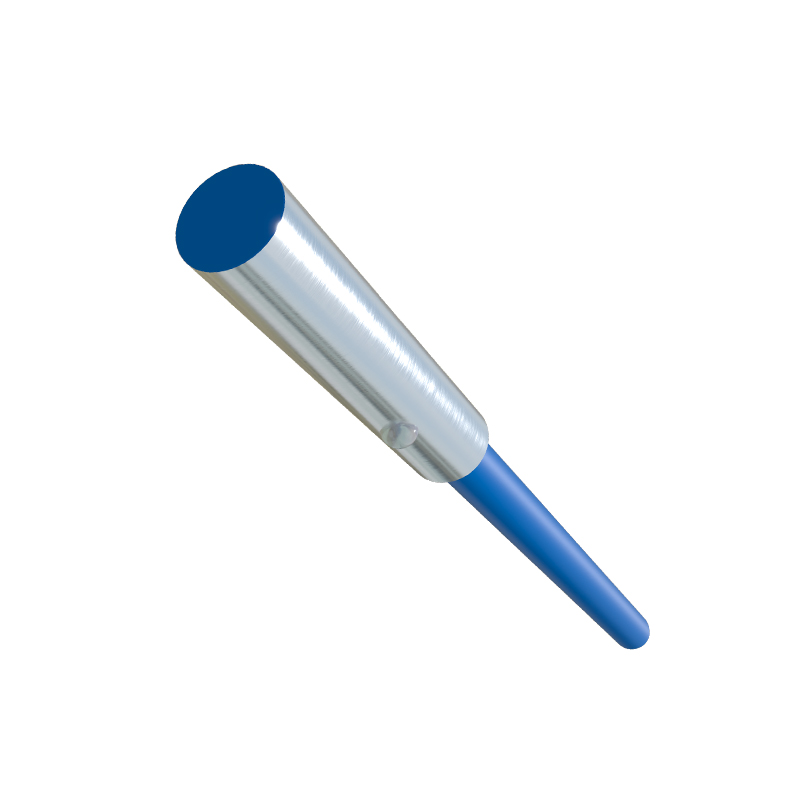
Capacitive proximity sensors operate on a different principle. They can detect both metallic and non-metallic objects, including liquids, powders, plastics, and wood. The sensor forms one plate of a capacitor, with the target object acting as the other plate. As the object approaches, the capacitance between the sensor and the object increases. An internal oscillator starts when this capacitance reaches a preset threshold, triggering the output. This makes capacitive sensors incredibly versatile. They are used for liquid level detection in tanks, monitoring material levels in hoppers (like grain or powder), and even as touch-sensitive buttons on consumer devices, where a finger changes the local capacitance.
Ultrasonic proximity sensors use sound waves beyond the range of human hearing. They emit high-frequency ultrasonic pulses and measure the time it takes for the echo to return from a target object. By calculating the time-of-flight, the sensor can determine not just presence but also the distance to the object. These sensors are excellent for detecting objects of virtually any material, as long as the surface is reasonably sound-reflective. They work well in challenging environments with dust, smoke, or fog, where optical methods might fail. Common applications include parking assist systems in vehicles, pallet detection in warehouses, and level measurement for bulk solids.
Optical proximity sensors, often called photoelectric sensors, use a light beam—typically infrared, visible red, or laser. They come in three main configurations. Through-beam sensors have a separate emitter and receiver; detection occurs when the object breaks the beam. Retro-reflective sensors use a single unit that emits light and receives its reflection from a dedicated reflector; an object is detected when it blocks this reflected beam. Diffuse sensors, the most common, have the emitter and receiver in one housing and detect light reflected directly off the target object. Optical sensors offer long sensing ranges and fast response times. They are ubiquitous in automation for object counting, bottle detection on filling lines, and as safety curtains. In smartphones, a small optical proximity sensor turns off the screen during a call to save power and prevent accidental touches.
When selecting a proximity sensor, several key parameters must be considered. Sensing range, the maximum distance at which the sensor can reliably detect a standard target, is paramount. The hysteresis, a small difference between the switch-on and switch-off points, prevents output chatter when an object is at the edge of the detection zone. Response time dictates how quickly the sensor can react to a passing object, crucial for high-speed applications. Environmental factors like temperature, potential for washdown, and exposure to chemicals will determine the required housing material and ingress protection (IP) rating.
The applications are nearly limitless. In manufacturing, they enable precision automation, robotics, and quality control. In automotive systems, they are integral to parking aids, collision avoidance, and occupant detection. In consumer electronics, they manage display functions and enable touchless gestures. In building automation, they control lighting and doors. Their silent, reliable operation makes modern conveniences and industrial efficiencies possible.
Understanding the different technologies—inductive, capacitive, ultrasonic, and optical—allows engineers, technicians, and enthusiasts to choose the right sensor for the task. By converting the physical presence of an object into a clean electrical signal without contact, proximity sensors remain a fundamental building block in our increasingly automated and interactive world.