1. Introduction to Photoelectric Sensors
Photoelectric sensors are critical components in modern industrial automation, utilizing light beams to detect the presence, absence, or distance of objects without physical contact. They convert light signals into electrical outputs, enabling precise control in manufacturing, packaging, and material handling systems. Their reliability, fast response, and versatility make them indispensable in harsh environments.
2. Classification by Detection Method
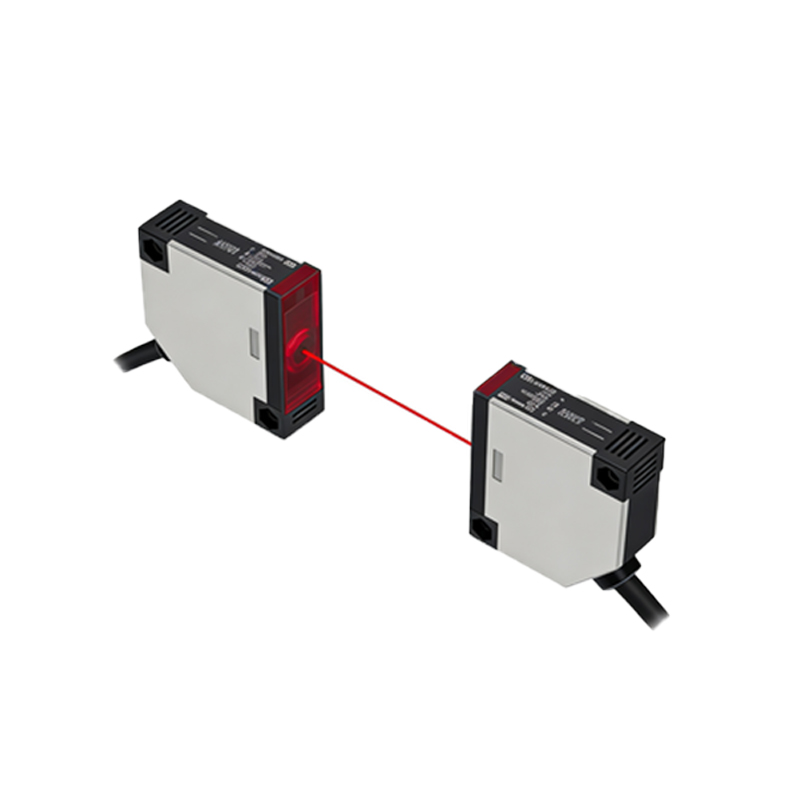
Photoelectric sensors are primarily categorized into three types based on how they detect targets:
- Through-beam sensors: Consist of a separate emitter and receiver. The object interrupts the light beam between them. They offer the longest sensing range (up to 30 meters) and high immunity to contamination, ideal for dusty or wet areas.
- Retro-reflective sensors: Combine emitter and receiver in one housing, with a reflector placed opposite. The object blocks the reflected beam. They provide a moderate range (usually up to 10 meters) and are easier to install than through-beam types but are less tolerant of transparent or highly reflective objects.
- Diffuse reflective sensors: Also single-housing, but detect light reflected directly by the target object. They have a shorter range (typically up to 2 meters) and are sensitive to object color and surface quality, making them suitable for close-range detection of non-reflective materials.
3. Classification by Light Source Type
The light source influences sensor performance:
- Visible red light: Common in general-purpose sensors, easy to align, and cost-effective. Ideal for most industrial applications.
- Infrared light: Invisible to the human eye, offering better penetration through dust or fog. Often used in long-range or harsh conditions.
- Laser light: Provides a highly focused, narrow beam for precision detection of small objects or fine gaps. Used in high-speed automation and quality control.
- Ultraviolet (UV) or special wavelengths: Applied in niche scenarios like detecting fluorescent markings or transparent films.
4. Classification by Output and Communication
Sensors vary by electrical output:
- Discrete (ON/OFF) output: Simple binary signal (NPN or PNP transistor) for presence detection. Common in relay logic or PLC inputs.
- Analog output: Provides a continuous signal (e.g., 4-20 mA or 0-10 V) proportional to distance or light intensity, for measurement or analog control.
- IO-Link communication: Enables bidirectional data exchange, parameter configuration, and diagnostics, enhancing smart factory integration.
5. Key Applications in Industry
Photoelectric sensors serve diverse roles:
- Object presence detection: On conveyor belts, sensors verify parts are present for processing or packaging.
- Counting: High-speed through-beam sensors tally items on assembly lines, such as bottles or cartons.
- Positioning: Laser sensors guide robotic arms to precise pick-and-place locations.
- Level monitoring: In hoppers, diffuse sensors detect material levels of powders or granules.
- Safety guarding: Light curtains (array of through-beam sensors) protect workers near hazardous machinery.
- Quality inspection: Sensors identify missing labels, broken seals, or incorrect part orientation in automated inspection stations.
6. Selection Considerations
Choosing the right sensor depends on:
- Environment: Dust, moisture, or ambient light (e.g., outdoor use may require infrared or high-gain sensors).
- Object properties: Color, transparency, surface reflectivity, and size dictate whether diffuse, retro-reflective, or through-beam is best.
- Range and speed: Long-range or high-speed applications favor through-beam or laser sensors.
- Cost and complexity: Retro-reflective sensors balance performance and installation ease for most general tasks.
7. Conclusion
Understanding photoelectric sensor classifications—by detection method, light source, and output—enables engineers to optimize automation systems for reliability and efficiency. As industry advances toward Industry 4.0, sensors with IO-Link and smart diagnostics will play a pivotal role in data-driven manufacturing. Proper selection based on application specifics ensures long-term performance and reduced downtime.