Working Principle of Photoelectric Sensors
Photoelectric sensors operate by converting light signals into electrical signals. They consist of a light emitter, typically an LED, and a light receiver, such as a photodiode or phototransistor. When an object interrupts or reflects the light beam, the receiver detects the change in light intensity, triggering an output signal. This principle enables non-contact detection, making them ideal for harsh environments where mechanical wear is a concern. The response time is critical, often in the microsecond range, ensuring high-speed applications like conveyor belt monitoring.
Key Types: Through-Beam, Retro-Reflective, and Diffuse
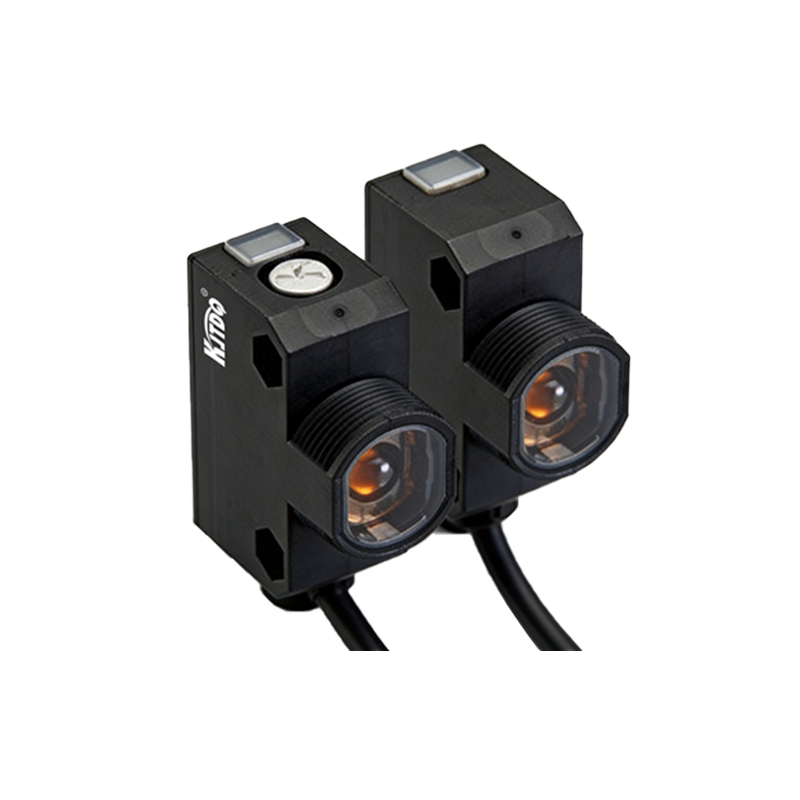
Through-beam sensors have separate emitter and receiver units, offering the longest sensing range, up to 30 meters. They are highly reliable for detecting opaque objects but require precise alignment. Retro-reflective sensors house both components in one unit, using a reflector to bounce the beam back. They are easier to install and work well for transparent objects. Diffuse sensors rely on the target itself to reflect light, with sensing distances typically under 2 meters. They are cost-effective for detecting irregular shapes but are sensitive to background reflections.
Critical Performance Parameters
Key parameters include sensing distance, response time, and ambient light immunity. Sensing distance varies by type, with through-beam achieving the longest range. Response time affects system speed; fast sensors (e.g., 1 ms) suit high-speed automation. Ambient light immunity is crucial for outdoor or bright factory environments. Modern sensors use modulated light to filter out interference from sunlight or artificial lighting, ensuring stable operation. Additionally, hysteresis prevents oscillation near detection thresholds, providing clean on/off signals.
Application Scenarios in Industrial Automation
Photoelectric sensors are widely used in packaging, material handling, and assembly lines. For example, in bottling plants, they detect bottle presence for filling or capping. In logistics, they monitor conveyor belt jams or count parcels. Their non-contact nature reduces wear, while IP67-rated enclosures allow use in dusty or wet environments. Advanced sensors with IO-Link communication enable remote diagnostics and parameter adjustment, improving maintenance efficiency. They also integrate with PLCs for real-time control in smart factories.
Selection Guidelines for Engineers
When selecting a sensor, consider the target material, distance, and environmental conditions. For transparent objects like glass, retro-reflective models are preferred. For long-range detection in clean areas, through-beam sensor is optimal. Avoid diffuse sensors in high-glare settings unless they have background suppression. Also, check output types: NPN or PNP for DC systems, and relay for AC. Ensure the electrical rating matches the load, and verify the cable length to avoid voltage drop. Proper selection minimizes false triggers and system downtime.
Advancements and Future Trends
Recent innovations include laser-based sensors for sub-millimeter precision and multi-point detection for object profiling. Smart sensors with built-in diagnostics reduce troubleshooting time. The trend toward Industry 4.0 drives integration with IoT, enabling predictive maintenance. For instance, sensors can alert operators when dirt accumulates on lenses, reducing unplanned stops. Additionally, miniaturization allows embedding in tight spaces, such as robotic grippers. These advancements enhance reliability and efficiency in modern electrical systems.