In the realm of industrial automation, robotics, and safety systems, the ability to detect the presence, absence, or distance of an object without physical contact is paramount. Among the various non-contact sensing technologies available, laser proximity sensors stand out for their exceptional precision, speed, and reliability. This article delves into the fundamental principles of how these sensors operate, explores their diverse applications across industries, and provides key considerations for selecting the right sensor for a specific task.
At its core, a laser proximity sensor functions by emitting a focused beam of coherent light—a laser—towards a target object. The sensor then analyzes the light that is reflected back. The most common operating principles are based on triangulation or time-of-flight measurement. In the triangulation method, the emitted laser beam strikes the target, and the reflected light is focused onto a position-sensitive detector, such as a CCD or PSD array. The position of the light spot on this detector changes depending on the distance to the target. By calculating this positional shift, the sensor's internal processor can determine the exact distance with high accuracy, often in the micrometer range. This makes triangulation-based sensors ideal for precise measurement tasks.
The time-of-flight principle, often used in longer-range sensors, measures the time it takes for a laser pulse to travel to the target and back. Since the speed of light is constant, the distance can be calculated directly from this time interval. While typically offering slightly lower resolution than triangulation sensors at short ranges, time-of-flight sensors excel in measuring over longer distances, from a few meters to several hundred meters, and are less sensitive to the target's surface color or texture.
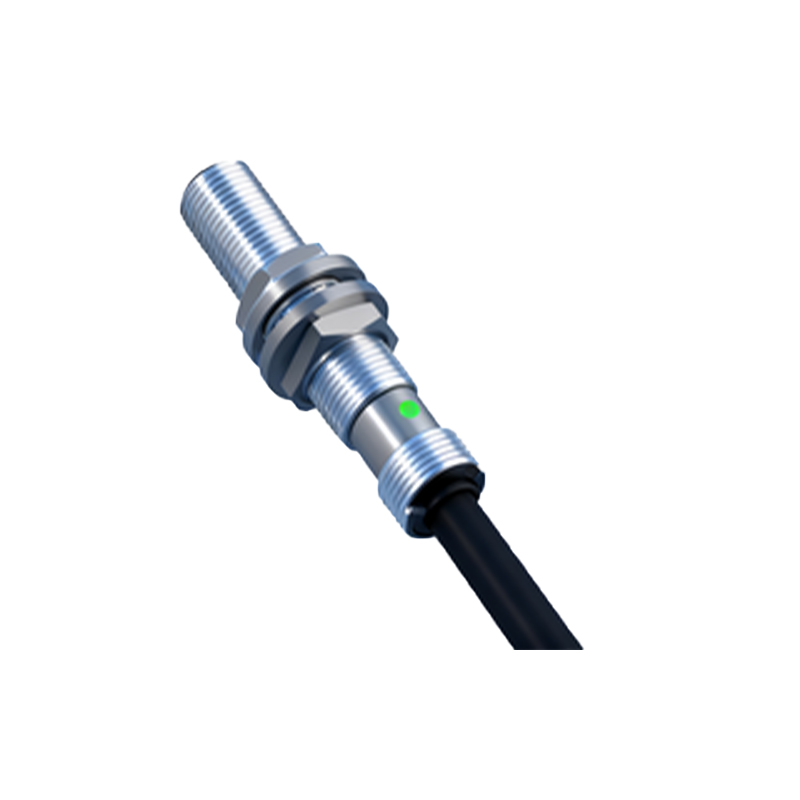
The advantages of laser proximity sensors are numerous. They offer very high measurement accuracy and repeatability. Their response time is extremely fast, enabling detection in high-speed processes. The focused laser beam allows for precise detection of small objects or specific points on a target. Furthermore, many models are relatively immune to ambient light interference and can work effectively on a wide variety of surface materials, though highly reflective or absorbent surfaces can pose challenges that may require sensor adjustment or special models.
The applications for laser proximity sensors are vast and growing. In manufacturing, they are used for precise positioning of components, thickness measurement, edge detection, and part profiling. Robotics relies on them for navigation, obstacle avoidance, and precise object handling. In the automotive industry, they contribute to assembly line automation and quality control. Beyond factory floors, they are integral to warehouse automation for pallet detection and dimensioning, in agricultural equipment for guidance systems, and in building security for perimeter monitoring. Their role in emerging fields like autonomous vehicles and advanced driver-assistance systems (ADAS) is also critical.
Selecting the appropriate laser proximity sensor requires careful evaluation of several parameters. The required sensing range and measurement resolution are primary factors. The size, color, and material of the target object must be considered, as they affect reflectivity. Environmental conditions such as temperature, humidity, and the presence of dust or vapors dictate the necessary ingress protection (IP) rating. The required output signal type—analog (e.g., 4-20mA, 0-10V) or digital (e.g., NPN/PNP, IO-Link)—must match the control system. Finally, physical constraints like sensor size and mounting options play a crucial role in integration.

In conclusion, laser proximity sensors are sophisticated instruments that provide a critical link between the physical world and automated control systems. Their combination of precision, speed, and versatility makes them indispensable in modern industrial and technological applications. By understanding their operating principles and key specifications, engineers and technicians can effectively harness their capabilities to enhance efficiency, ensure quality, and improve safety in countless processes.