Introduction to Low-Pass Filtering in Photoelectric Sensors
In industrial automation, photoelectric sensors are critical for detecting presence, distance, and object characteristics. However, these sensors are susceptible to high-frequency noise from ambient light flickering, electromagnetic interference (EMI), and mechanical vibrations. A low-pass filter (LPF) is a fundamental circuit design that attenuates noise above a cutoff frequency while preserving the desired signal. For engineers, selecting the right LPF topology and parameters ensures reliable detection in harsh environments, such as factory floors with variable lighting or high-speed machinery.
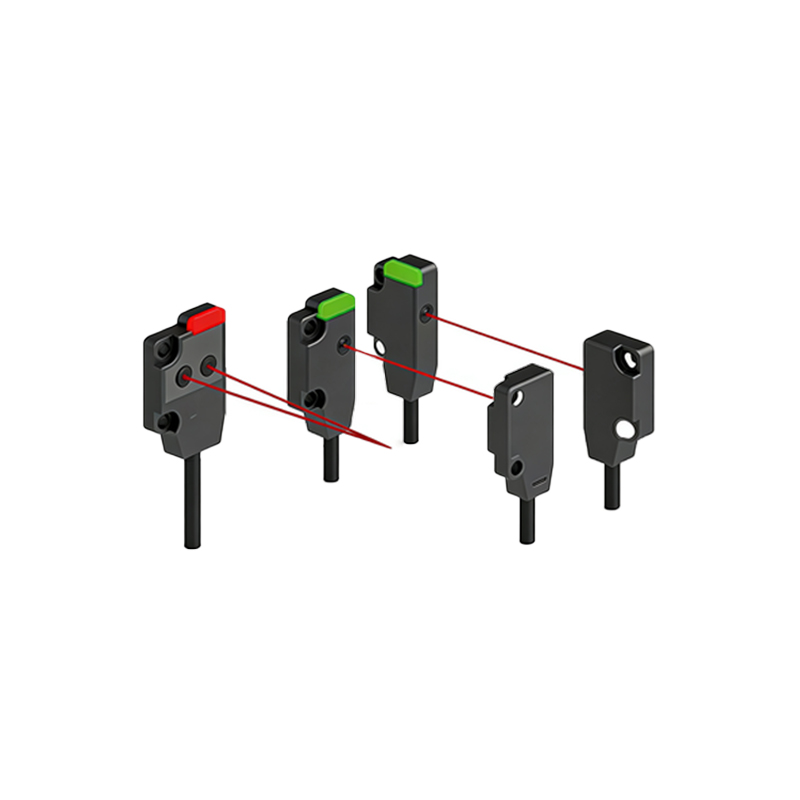
Understanding the Noise Sources and Cutoff Frequency Selection
The primary noise sources in photoelectric sensor outputs include 50/60 Hz power line hum, inverter-driven motor harmonics, and random shot noise from photodiodes. The cutoff frequency (f_c) must be carefully chosen: too low and it blurs fast-moving object signals, too high and noise passes through. As a rule of thumb, for static object detection, set f_c to 1/10 of the sensor’s switching frequency. For high-speed applications, use an adaptive filter or select an LPF with a steep roll-off, such as a second-order Butterworth filter, which provides -12 dB/octave attenuation.
Passive Low-Pass Filter Design: RC and LC Topologies
The simplest LPF uses a resistor (R) and capacitor (C) in series, with the output taken across the capacitor. For photoelectric sensors, an RC filter with f_c = 1/(2πRC) is cost-effective for noise below 1 kHz. However, RC filters suffer from loading effects when driving low-impedance loads. For higher frequencies or better stability, an LC filter (inductor L and capacitor C) offers sharper cutoff and lower insertion loss. When designing, ensure the inductor’s saturation current exceeds the sensor’s peak current, and use ceramic capacitors with low ESR for high-frequency bypass.
Active Low-Pass Filter Implementation with Op-Amps
Active filters using operational amplifiers (op-amps) provide gain, buffering, and adjustable cutoff frequency without bulky inductors. A Sallen-Key topology is common in photoelectric sensor signal conditioning. To design a second-order Butterworth LPF, use equal resistor values (R) and capacitors with C1 = 2C2 for a damping factor of 1.414. For example, with R=10 kΩ and C2=10 nF, f_c ≈ 1/(2πR√(C1C2)) ≈ 1.6 kHz. Always bypass the op-amp power pins with 100 nF and 10 µF capacitors to prevent power rail noise from coupling into the filter.
Digital Low-Pass Filtering in Microcontroller-Based Sensors
Modern smart photoelectric sensors often include microcontrollers for digital filtering. Moving average filters, exponential moving average (EMA), or IIR (Infinite Impulse Response) filters can be implemented in firmware. For real-time operation, the EMA filter with coefficient α (0<α<1) is efficient: Output(n) = α * Input(n) + (1-α) * Output(n-1). To mimic a first-order analog LPF, set α = (2πf_c * T_sample) / (1 + 2πf_c * T_sample), where T_sample is the sampling period. This approach eliminates analog component drift and allows dynamic cutoff adjustment via software.
Practical Considerations for Installation and Testing
When integrating the LPF into the sensor circuit, place the filter as close as possible to the photodiode or phototransistor output to minimize noise pickup on traces. Use shielded twisted-pair cables for the sensor signal to reduce EMI. During testing, use an oscilloscope with FFT analysis to verify the filter’s frequency response. Apply a square wave input and measure the rise/fall time: a 10% to 90% rise time of t_r ≈ 0.35/f_c confirms proper cutoff. If overshoot occurs, increase the damping factor by adjusting component values. Always test under worst-case ambient light conditions, such as direct sunlight or flickering LED arrays.
Conclusion and Future Trends
Low-pass filtering is indispensable for photoelectric sensor reliability in industrial environments. Engineers should choose between passive, active, or digital filters based on cost, signal frequency, and noise profile. Emerging trends include adaptive filters using machine learning algorithms to dynamically tune cutoff frequencies, and integrated analog front-ends (AFEs) in sensor modules that combine amplification, filtering, and digital conversion on a single chip. As Industry 4.0 advances, mastering LPF design will remain key to achieving high-precision detection in noisy, high-speed processes.