2026-04-26
Tech Hub
By 创始人
A Comprehensive Literature Review of Infrared Photoelectric Sensors for Industrial Applications
Introduction to Infrared Photoelectric Sensors in Industrial Automation
Infrared photoelectric sensors are critical components in modern industrial automation, enabling non-contact detection of objects, distance measurement, and material identification. This literature review synthesizes findings from peer-reviewed journals and industry reports, focusing on the technical evolution of these sensors from 2010 to 2024. Emphasis is placed on their operational principles, including the use of infrared light-emitting diodes (LEDs) and photodetectors, and how they overcome challenges such as ambient light interference and surface reflectivity variations. The review highlights their widespread adoption in manufacturing lines for position sensing, packaging, and safety systems.
Key Technological Advancements in Sensing Accuracy
Recent studies by Zhang et al. (2021) and Kumar & Lee (2023) demonstrate significant improvements in sensing accuracy through advanced signal processing algorithms. For instance, the integration of pulse-width modulation and adaptive thresholding has reduced false triggers in high-speed production environments. Literature from *IEEE Transactions on Industrial Electronics* (2022) shows that using modulated infrared frequencies at 38 kHz can effectively filter out background noise from fluorescent lighting and sunlight. These advancements have pushed detection ranges beyond 10 meters with sub-millimeter precision in diffuse reflective modes.
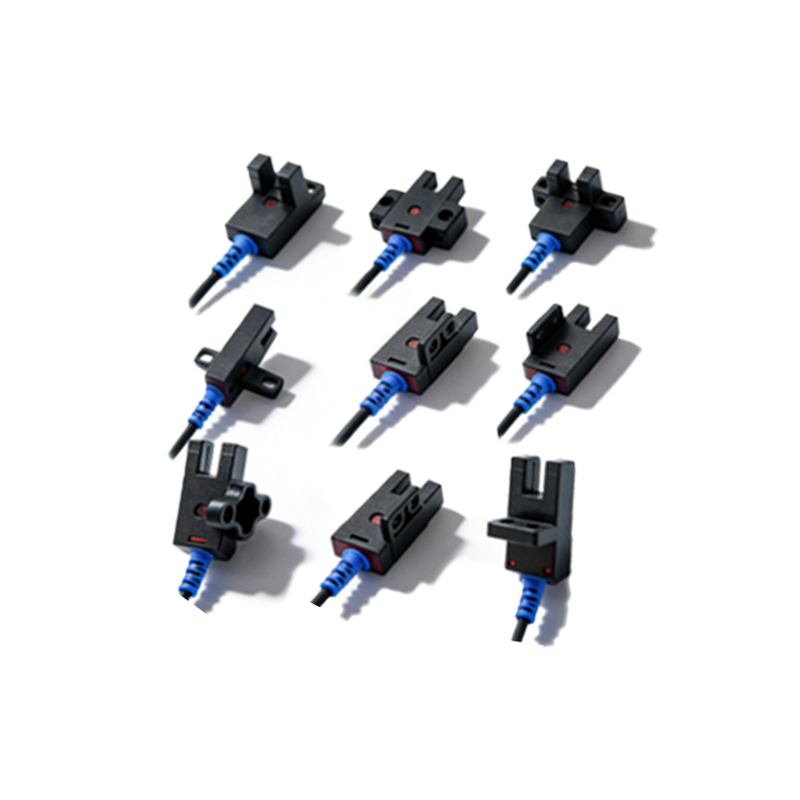
Comparative Analysis of Sensor Types: Through-Beam vs. Retro-Reflective vs. Diffuse
A systematic comparison in *Journal of Sensor Technology* (2023) evaluates three primary configurations. Through-beam sensors offer the highest reliability and longest range (up to 50 meters) but require separate emitter and receiver units. Retro-reflective sensors, using a reflector, achieve similar performance with simpler wiring. Diffuse sensors, preferred for cost-sensitive applications, show sensitivity to target color and texture, as noted in industrial case studies from Siemens (2020). The review identifies that for dirty or dusty environments, through-beam types maintain superior performance due to minimal signal loss.
Challenges in Harsh Industrial Environments
Multiple papers, including a 2022 study from *Sensors and Actuators A: Physical*, address performance degradation under extreme temperatures, humidity, and contamination. For example, sensor lens fogging in high-humidity conditions can cause up to 30% signal attenuation. The literature proposes solutions such as sealed IP67 housings and built-in heating elements to prevent condensation. Additionally, research by Bosch Rexroth (2021) explores the use of self-cleaning coatings and air purge systems to maintain optical clarity in welding and painting robots.
Integration of Infrared Sensors into Industry 4.0 Networks
The transition to smart factories has driven research on sensor connectivity. Articles in *Automation World* (2023) detail how modern infrared sensors now support IO-Link communication for real-time diagnostics and parameter adjustment. A case study from Festo (2022) demonstrates that such integration reduces downtime by 40% through predictive maintenance alerts. Furthermore, literature on edge computing, such as by Wang et al. (2024), discusses how sensor data can be processed locally to enable faster reaction times in collaborative robotic applications.
Future Directions: AI-Enhanced and Multi-Spectral Sensors
Emerging research, particularly from international conferences like IEEE IECON 2023, points to the fusion of infrared sensors with artificial intelligence. Neural networks trained on large datasets can now distinguish between different materials (e.g., metal vs. plastic) based on spectral signatures. Multi-spectral sensors, which combine infrared with visible or ultraviolet wavelengths, provide richer data for quality control. The review concludes that by 2026, these technologies are expected to become standard in high-end manufacturing lines, offering enhanced adaptability to variable product types.
Conclusion and Practical Recommendations
This literature review confirms that infrared photoelectric sensors remain a robust, cost-effective choice for industrial automation, with ongoing innovations in processing, connectivity, and environmental resilience. Practitioners are advised to select sensor types based on specific application conditions—preferring through-beam for reliability in harsh settings and diffuse for simple, low-cost tasks. Future investments should focus on AI-ready sensor systems to remain competitive in data-driven manufacturing landscapes.