Introduction to Full-Coverage Photoelectric Sensors
Full-coverage photoelectric sensors are advanced detection devices designed to monitor a wide area without blind spots. Unlike traditional sensors that rely on a narrow beam, these sensors use an array of emitters and receivers to create a continuous detection field. This technology is critical in industrial automation, where reliable object presence, position, or absence detection is required across large surfaces or conveyor systems. By eliminating gaps in coverage, they enhance safety, efficiency, and accuracy in manufacturing processes.
How Full-Coverage Photoelectric Sensors Work
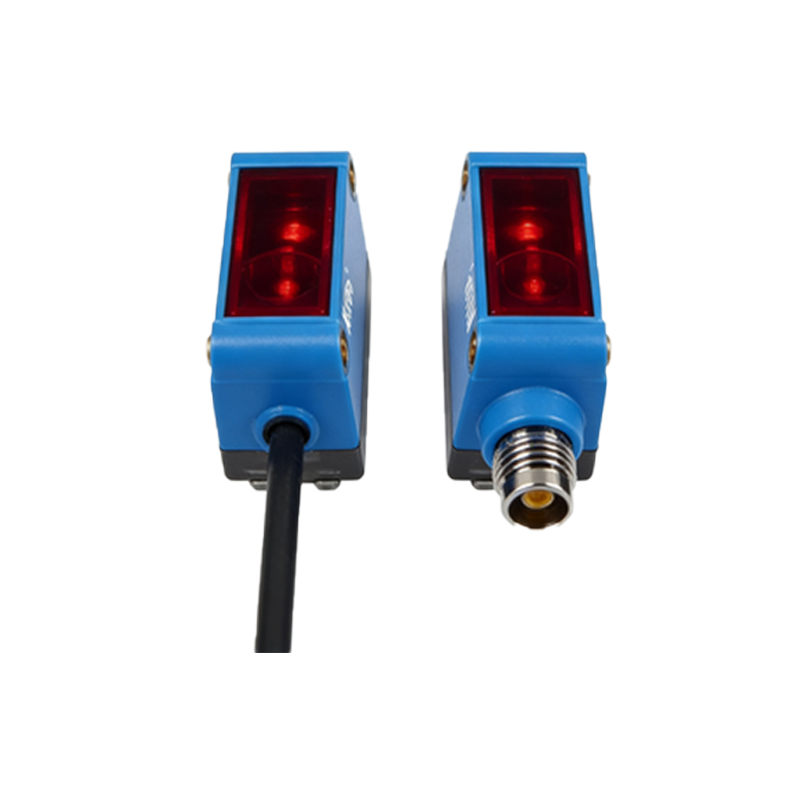
These sensors operate on the principle of modulated light, typically using infrared or visible LEDs. A full-coverage system consists of multiple emitter-receiver pairs arranged in a grid or linear pattern. When an object interrupts the light path, the sensor detects the change in signal strength or timing. Advanced models incorporate time-of-flight (ToF) or phase-shift measurement to determine distance and size. The continuous scanning ensures that no point in the monitored area is left unchecked, making them ideal for irregularly shaped or moving items.
Key Technical Specifications and Performance Metrics
When selecting a full-coverage photoelectric sensor, engineers must consider parameters such as detection range, resolution, response time, and ambient light immunity. Typical ranges vary from 0.1m to 10m, depending on the model and application. Resolution is defined by the spacing between emitter-receiver pairs, often as fine as 1mm. Response times are critical for high-speed lines, commonly ranging from 100μs to 1ms. Environmental factors like dust, fog, or vibration are mitigated through automatic gain control and robust housing rated IP67 or higher.
Common Industrial Applications and Use Cases
In assembly lines, full-coverage sensors monitor product flow on conveyors, detecting gaps, jams, or misalignments. They are essential in automated guided vehicles (AGVs) for obstacle detection and navigation. In packaging, these sensors verify the presence of items in sealed boxes or count products without contact. Additionally, they are used in safety systems for machine guarding, ensuring personnel do not enter hazardous zones. Their ability to cover wide areas reduces the number of sensors needed, simplifying installation and maintenance.
Installation, Calibration, and Troubleshooting Tips
Proper mounting is critical for optimal performance. Align the emitter and receiver arrays parallel to the detection plane, avoiding reflective surfaces that could cause false triggers. Calibration involves setting the sensitivity threshold to reject background noise while reliably detecting target objects. Use the built-in teach-in function if available. Common issues include misalignment due to vibration, which requires periodic re-alignment, and contamination of optical surfaces—clean with isopropyl alcohol and a lint-free cloth. For troubleshooting, monitor the sensor output with an oscilloscope to verify signal integrity.
Future Trends and Integration with Industry 4.0
The evolution of full-coverage photoelectric sensors is driven by IoT and smart factory demands. New models feature built-in IO-Link communication for real-time diagnostics and parameter adjustment from a central controller. Integration with machine learning algorithms allows adaptive thresholding, reducing false positives in dynamic environments. Additionally, miniaturization and lower power consumption enable deployment in compact robotic arms and mobile platforms. As industry standards for safety and efficiency tighten, these sensors will become indispensable in automated systems.