Introduction to Seven-Wire Photoelectric Sensors
Seven-wire photoelectric sensors represent a sophisticated category of industrial sensing devices, designed to provide enhanced functionality and reliability in demanding automation environments. Unlike simpler three or four-wire models, the seven-wire configuration incorporates additional conductors that enable advanced features such as separate power supply lines, dual output signals (e.g., NPN and PNP switching), and diagnostic or control feedback. These sensors operate on the fundamental principle of emitting a light beam—typically infrared, visible red, or laser—and detecting changes in the received light intensity caused by the presence, absence, or characteristics of a target object. The additional wiring allows for greater integration flexibility with programmable logic controllers (PLCs) and other control systems, making them a preferred choice for complex machinery, packaging lines, and material handling systems where precise and fault-tolerant operation is critical.
Internal Circuitry and Wiring Configuration
The core advantage of a seven-wire sensor lies in its internal electrical design. A standard seven-wire sensor typically includes the following connections: two wires for the power supply (often labeled V+ and V- or 0V), two wires for a normally open (NO) output, two wires for a normally closed (NC) output, and one wire for a common reference or shield. This arrangement allows the sensor to provide two electrically isolated switching outputs simultaneously. For instance, one output can be configured as a sinking (NPN) type, while the other operates as a sourcing (PNP) type. This dual-output capability enables direct interfacing with different types of PLC input modules without requiring external signal converters. Furthermore, the separate power and signal lines minimize electrical noise interference, ensuring stable performance in electrically noisy industrial settings. The seventh wire often serves as a case ground or shield drain to enhance electromagnetic compatibility (EMC).
Key Operational Modes and Sensing Types
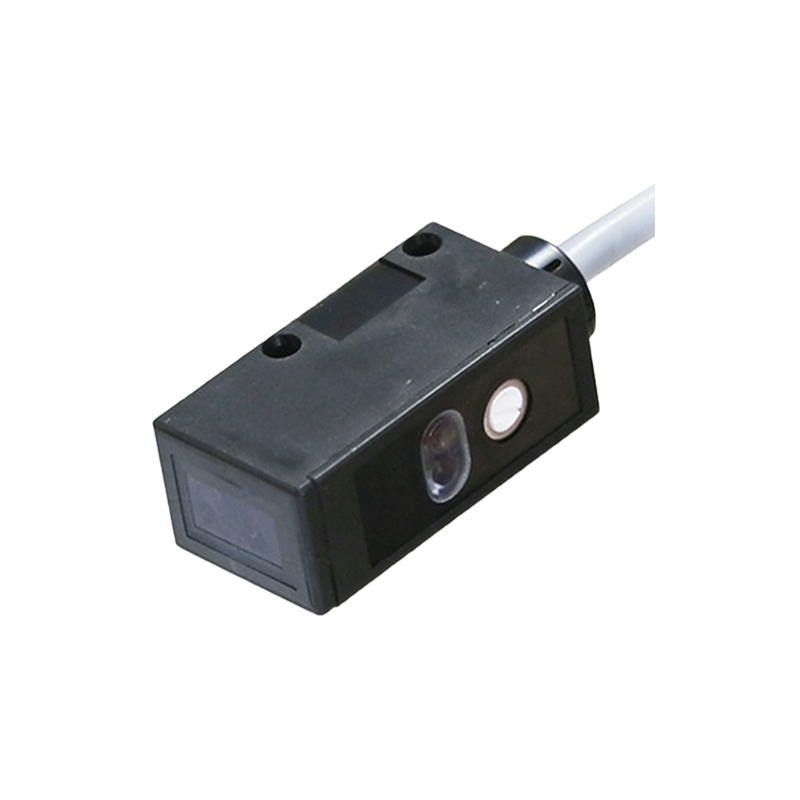
Seven-wire photoelectric sensors are available in all standard sensing modes: through-beam, retro-reflective, and diffuse (proximity) sensing. In through-beam mode, the emitter and receiver are separate units; the sensor detects an object when it interrupts the beam between them. This mode offers the longest sensing range and highest reliability. Retro-reflective models house both emitter and receiver in a single housing, using a reflector to bounce the light back. They are ideal for detecting objects at medium distances. Diffuse sensors rely on light reflected directly from the target object, suitable for shorter ranges and varied surface properties. The seven-wire design enhances these modes by allowing features like programmable sensing distance, background suppression (to ignore objects beyond a set distance), and teach-in functionality for easy setup, all manageable via the additional control lines or integrated pushbuttons.
Application Advantages in Industrial Automation
The deployment of seven-wire photoelectric sensors brings significant benefits to automated systems. Their dual independent outputs can be used for redundant monitoring—sending one signal for process control and another for alarm or safety interlocks. This redundancy improves system safety and uptime. For example, in conveyor belt systems, one output might trigger a sorting mechanism, while the second output sends a "product present" signal to a central monitoring station. The robust wiring also supports advanced diagnostics; some models can transmit status information (like lens contamination warnings or signal strength) via the additional wires, enabling predictive maintenance. Their compatibility with both AC and DC power supplies (depending on the model) and wide operating voltage ranges (commonly 10-30V DC) further increases their versatility across different industrial electrical standards.
Installation, Wiring, and Troubleshooting Guidelines
Proper installation is crucial for optimal sensor performance. When wiring a seven-wire sensor, always refer to the manufacturer's datasheet for the exact pinout diagram. Generally, brown and blue wires are for power (V+ and 0V), black and white for one output channel, and gray and pink for the second output, with the yellow or bare wire as shield/ground. Use shielded cables in high-noise environments and ensure conduits are separate from high-voltage power lines. Mounting must be secure to avoid vibration-induced misalignment. For troubleshooting, a systematic approach is recommended: first, verify power supply voltage at the sensor terminals. Next, use the sensor's built-in LED indicators (present on most models) to check if it detects the target. If the output fails, use a multimeter to test for switching voltage at the output wires. Common issues like optical lens contamination, incorrect sensing distance, or electrical overload on the output can often be resolved by cleaning, re-teaching the range, or checking the load current.
Selection Criteria and Future Trends
Selecting the right seven-wire photoelectric sensor requires evaluating several parameters: required sensing range, object size and material, response time, environmental conditions (IP rating for dust/water resistance), and output configuration needed for the control system. Consider sensors with M12 or M8 quick-disconnect connectors for easier installation and maintenance. Looking ahead, trends are pushing these sensors toward greater intelligence and connectivity. Integration of IO-Link communication is becoming common, allowing the seven wires to carry digital communication for parameter setting, real-time diagnostics, and integration into Industry 4.0 data collection systems. Enhanced laser models offer micron-level precision for semiconductor and electronics manufacturing. As factories become smarter, the robust, feature-rich seven-wire photoelectric sensor will continue to evolve as a critical component for reliable and data-rich object detection.