Introduction to Oscillating Proximity Sensors
Oscillating proximity sensors are widely used in industrial automation for non-contact detection of metallic objects. These sensors operate based on the principle of electromagnetic oscillation, generating a high-frequency electromagnetic field from an internal coil and capacitor circuit. When a metallic target enters this field, eddy currents are induced, causing a change in the oscillation amplitude or frequency. This alteration is detected by the sensor's circuitry, triggering an output signal. Unlike mechanical switches, oscillating proximity sensors offer high reliability, fast response times, and minimal wear, making them ideal for harsh environments with dust, moisture, or vibration. Their ability to detect objects without physical contact ensures longevity and reduces maintenance needs, which is crucial in continuous production lines.
Core Operating Principles
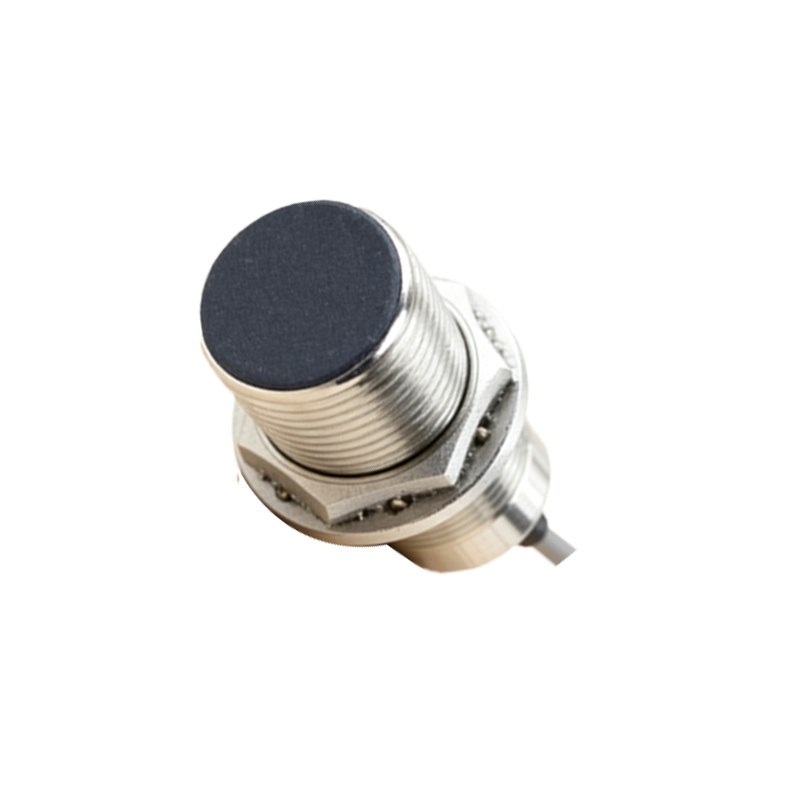
The functionality of oscillating proximity sensors hinges on an LC oscillator circuit, where "L" represents inductance from the coil and "C" denotes capacitance. In the absence of a target, the circuit oscillates at a stable resonant frequency. As a conductive metal object approaches the sensor's active face, eddy currents form on the target's surface, absorbing energy from the electromagnetic field. This energy loss dampens the oscillation, leading to a measurable decrease in amplitude or a shift in frequency. Advanced sensors incorporate feedback mechanisms to monitor these changes precisely, enabling accurate detection even at varying distances. The sensing range depends on factors like target material, size, and shape, with ferrous metals typically offering longer ranges due to higher magnetic permeability.
Key Technical Features
Oscillating proximity sensors boast several distinctive features that enhance their industrial utility. First, they provide high switching frequencies, often up to several kilohertz, allowing for rapid detection in high-speed applications such as packaging or assembly lines. Second, they exhibit excellent repeatability, with minimal deviation in sensing points over millions of cycles, ensuring consistent performance. Third, these sensors are inherently resistant to environmental interference; sealed housings (e.g., IP67 or IP69K ratings) protect against water, oil, and particulate ingress. Additionally, temperature stability is a hallmark, with many models operating reliably from -25°C to 70°C without calibration. Some variants include built-in diagnostics, such as LED indicators or IO-Link communication, for real-time monitoring and predictive maintenance.
Material Sensitivity and Selection
A critical aspect of oscillating proximity sensors is their sensitivity to different metals. Standard models are optimized for ferrous materials like steel and iron, offering the longest sensing distances. For non-ferrous metals (e.g., aluminum, copper, or brass), specialized sensors with adjusted frequencies or enhanced circuitry are available to compensate for reduced detection ranges. Engineers must consider the target's conductivity and permeability during selection to avoid false triggers or missed detections. In mixed-material environments, universal sensors with balanced sensitivity provide a versatile solution, though at the cost of slightly reduced range. It's also important to note that non-metallic objects, such as plastics or liquids, are generally undetectable, which can be an advantage in applications requiring selective sensing.
Installation and Configuration Guidelines
Proper installation is vital for maximizing sensor performance. Mounting proximity sensors requires attention to spacing: adjacent sensors should be positioned to prevent mutual interference, typically with a minimum gap of twice their diameter. Flush-mounted sensors can be embedded in metal surfaces without affecting operation, while non-flush types need clearance around the sensing face. Wiring must follow manufacturer specifications, with shielded cables recommended in electrically noisy environments to prevent false signals. Configuration often involves setting the sensing distance via potentiometers or digital interfaces, with some models offering teach-in functions for easy calibration. Regular testing with actual targets under operating conditions ensures optimal alignment and reliability.
Common Industrial Applications
Oscillating proximity sensors are ubiquitous across various sectors due to their robustness and precision. In automotive manufacturing, they monitor part presence on conveyor belts, detect piston positions in engines, or control robotic welding arms. In food and beverage processing, stainless-steel variants handle sanitary environments, verifying fill levels or counting packages. Logistics and packaging lines rely on these sensors for object counting, edge detection, and jam prevention. Additionally, they play a key role in machine safety systems, such as interlocking guards or position verification in heavy machinery. Their versatility extends to renewable energy, where they monitor turbine components, and pharmaceuticals, ensuring precise tablet counting in blister packs.
Advantages Over Alternative Technologies
Compared to other proximity sensing technologies, oscillating sensors offer unique benefits. Unlike capacitive sensors, which react to non-metallic materials, oscillating types provide selective metal detection, reducing false alarms in cluttered settings. They outperform