Laser beam sensors, often referred to as laser photoelectric sensors or laser through-beam sensors, are a cornerstone of modern industrial automation and security systems. Their operation is elegantly simple yet incredibly reliable, based on the fundamental principles of light transmission and reception. Unlike diffuse reflection sensors that detect light bounced back from a target, the classic laser through-beam sensor consists of two separate units: a laser transmitter and a receiver. These units are positioned directly opposite each other to create a precise, invisible beam of light between them.
The core principle is interruption detection. The transmitter unit emits a continuous, highly focused beam of coherent light—typically from a laser diode. This coherence means the light waves are aligned, allowing the beam to travel long distances with minimal dispersion, maintaining a small, precise spot size. The receiver unit, aligned with the transmitter, is tuned to detect this specific wavelength of light. It contains a photodetector, usually a phototransistor or photodiode, which converts the incoming light energy into an electrical signal. As long as the beam reaches the receiver uninterrupted, the sensor's output remains in a "beam present" state (often a logic HIGH or closed switch).
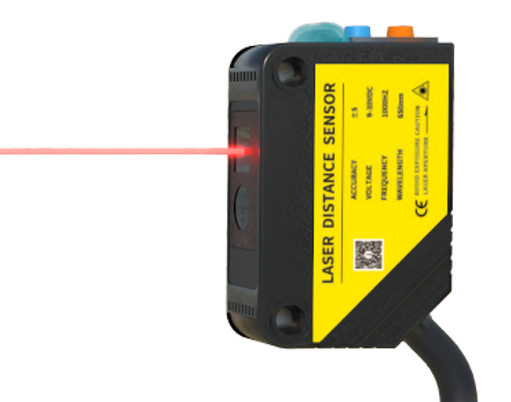
The moment an object passes through the beam, it blocks the light path. The receiver no longer detects the laser light, causing the electrical signal to drop. This change in state is instantly processed by the sensor's internal circuitry, which triggers a predefined output signal. This output can be used to stop a machine, count objects, trigger an alarm, or initiate any number of automated actions. The key to their high reliability is the separation of the light source and the detector. This setup makes the sensor largely immune to factors like the color, reflectivity, or surface finish of the interrupting object; it simply needs to be opaque enough to block the beam. Furthermore, because the receiver is only looking for the specific laser light from its paired transmitter, it is highly resistant to interference from ambient light.
Modern laser beam sensors incorporate several advanced features. To enhance stability against dust or minor misalignment, many use a modulated beam. Instead of a continuous light, the transmitter pulses the laser at a specific high frequency. The receiver's circuitry is then designed to only respond to light pulsing at that exact frequency, effectively filtering out all other light sources. This makes them suitable for even challenging environments. Another critical advancement is the alignment aid, often a visual or audible indicator that helps technicians precisely align the transmitter and receiver over long distances, which can span tens or even hundreds of meters.
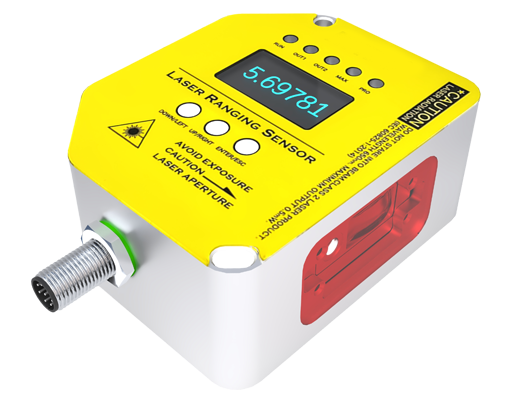
The applications of laser beam sensors are vast. In industrial automation, they are used for precise object detection on high-speed assembly lines, part positioning, and breakage detection in material handling. In packaging, they count bottles or boxes. In security, they form the invisible "tripwire" in perimeter intrusion detection systems. Their long range, high precision, and reliability make them indispensable where other sensor types, like ultrasonic or standard photoelectric sensors, may fall short due to range limitations, target material issues, or environmental factors.
In summary, the working principle of a laser beam sensor is a masterclass in applied optics: generate a focused, stable beam of light, detect its presence with a dedicated receiver, and monitor for the precise moment of interruption. This straightforward mechanism, enhanced by modulation and alignment technologies, provides a robust, accurate, and versatile solution for countless detection and safety challenges across diverse fields. Their ability to perform non-contact detection over long ranges with pinpoint accuracy ensures their continued prominence in technology-driven industries.