Understanding the Core Technology
Invisible beam photoelectric sensors, primarily utilizing infrared (IR) light, represent a cornerstone of modern industrial automation. Unlike visible light sensors, they operate with a light spectrum undetectable to the human eye, typically in the near-infrared range (700nm to 1400nm). This fundamental characteristic provides significant advantages in applications where ambient light interference or aesthetic discretion is a concern. The core principle involves an emitter projecting an invisible modulated light beam towards a separate receiver. The receiver continuously monitors this beam. An object is detected when it interrupts this beam, causing the receiver's output state to change. The modulation of the IR light—often at a specific high frequency—allows the sensor to distinguish its own signal from ambient IR sources, such as sunlight or heating elements, ensuring remarkable stability and noise immunity.
Key Advantages Over Visible Light Types
The primary benefit of using an invisible beam is its immunity to interference from ambient visible light. Factory environments are filled with fluctuating light from windows, machinery indicators, and overhead lamps. A visible red beam sensor can be "blinded" or give false triggers under such conditions. Invisible IR sensors, with their modulated signal, effectively filter this out. Furthermore, the discreet nature of the beam is crucial in applications where a visible light spot might be distracting, such as in consumer electronics assembly or packaging lines for sensitive products. They also generally offer longer sensing distances compared to their visible counterparts for the same power output, as IR light can be focused more efficiently by certain lens materials.
Common Configurations and Sensing Modes
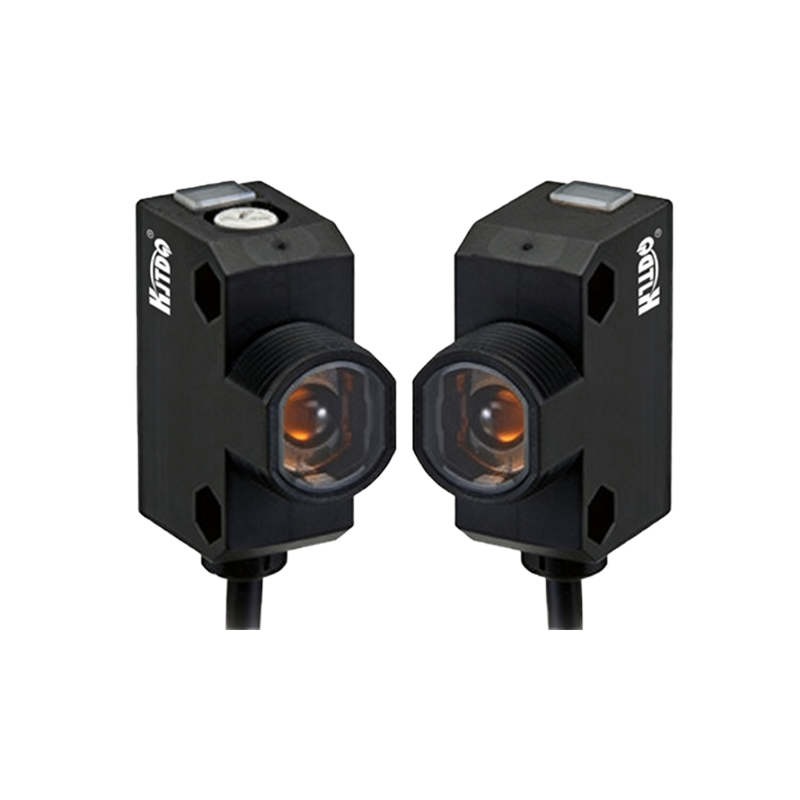
The through-beam (or opposed) mode is the most robust configuration for invisible beam sensors. With the emitter and receiver housed in separate units facing each other, this method provides the longest possible sensing range and the highest reliability for detecting any object that breaks the beam. Another critical configuration is the retro-reflective mode. Here, a single housing contains both the emitter and receiver, and it uses a specialized reflector (corner-cube reflector) to bounce the beam back. The sensor detects an object when it blocks this return path. It's important to note that standard retro-reflective tapes do not work well with modulated IR light; a proper corner-cube reflector is required. This mode offers easier alignment than through-beam but with slightly reduced range and precision.
Critical Application Areas in Industry
These sensors are ubiquitous across manufacturing and logistics. A primary application is object detection on high-speed conveyor systems, counting bottles, cans, or packages without being affected by their color or surface finish. They are indispensable in safety systems, forming invisible safety curtains or light guards around hazardous machinery like presses or robotic cells, ensuring operator safety. In the packaging industry, they precisely detect the presence of a product in a carton or the leading edge of a label. They are also used for edge guiding in web processing (paper, film, textiles) and for detecting the level of opaque liquids or granular materials in tanks through a sight glass.
Essential Selection Criteria
Choosing the correct sensor requires careful analysis of several parameters. First, determine the required sensing distance and add a safety margin; through-beam sensors can span many meters, while retro-reflective models are suitable for shorter ranges. The response time must be fast enough to detect objects moving at the line's maximum speed. Environmental factors are paramount: the sensor's Ingress Protection (IP) rating must withstand dust, moisture, or washdowns. Temperature range, resistance to chemicals, and mechanical vibration tolerance must match the operating conditions. Finally, consider the output type (PNP/NPN transistor, relay, analog) and electrical connection (pre-wired cable or quick-disconnect) to ensure compatibility with the control system.
Installation and Alignment Best Practices
Proper installation is key to reliable operation. For through-beam sensors, ensure the emitter and receiver are securely mounted on stable surfaces to prevent misalignment from vibration. Use alignment tools or the sensor's built-in alignment indicators (often LED status lights) during setup. The beam should be perpendicular to the object's path. For retro-reflective types, ensure the reflector is clean and correctly aligned; even a small angular deviation can significantly weaken the return signal. Avoid mounting the sensor where condensation can form on the lens, and keep the optical path clear of obstructions like dust buildup, steam, or oil mist, which can scatter or absorb the IR beam.
Troubleshooting Common Issues
Most problems stem from alignment, power, or environmental factors. If a sensor fails to detect, first verify the power supply and wiring. Check alignment using the sensor's indicator LEDs; a weak or fluctuating signal often points to misalignment or a dirty lens/reflector. Clean optical components with a soft, lint-free cloth. Intermittent operation can be caused by electrical noise; ensure proper grounding and use shielded cables in noisy environments. If the sensing distance has degraded, inspect the lens for scratches or haze and check for new sources of ambient IR interference nearby. Always consult the manufacturer's datasheet for specific diagnostic procedures.
Future Trends and Innovations
The evolution of invisible beam photoelectric sensors continues toward greater intelligence and integration. Modern sensors now feature advanced diagnostics, such as IO-Link communication, which provides real-time data on signal strength, operating hours, and environmental conditions for predictive maintenance. There is a trend toward miniaturization, enabling their use in tighter spaces within compact machinery. Furthermore, the development of background suppression techniques in a through-beam format allows for more precise detection at a defined distance, ignoring objects beyond the set point. As Industry 4.0 advances, these sensors will increasingly function as smart data points within interconnected industrial networks.