Introduction to Photoelectric Sensing Modes
Photoelectric sensors are fundamental components in industrial automation, utilizing light beams to detect the presence, absence, or position of objects. Among the various operating modes, through-beam (also known as direct or opposed) and retroreflective (a type of diffuse or reflective) are two of the most common and widely applied configurations. Understanding their distinct operational principles, advantages, and limitations is crucial for engineers and system designers to select the optimal sensor for a given application, ensuring reliability, efficiency, and cost-effectiveness in automated systems.
Through-Beam Sensor Operating Principle
A through-beam photoelectric sensor consists of two separate, physically distinct units: an emitter and a receiver. The emitter projects a focused beam of light—typically infrared, visible red, or laser—directly toward the receiver unit. The receiver is positioned precisely opposite the emitter to continuously monitor the intensity of this incoming light beam. Detection occurs when an object passes between the two units, physically interrupting the light path. The receiver detects this complete loss or significant reduction of light signal and triggers an output switch. This method relies on a direct, unassisted optical path between the two components, making it inherently straightforward in its detection logic.
Retroreflective Sensor Operating Principle
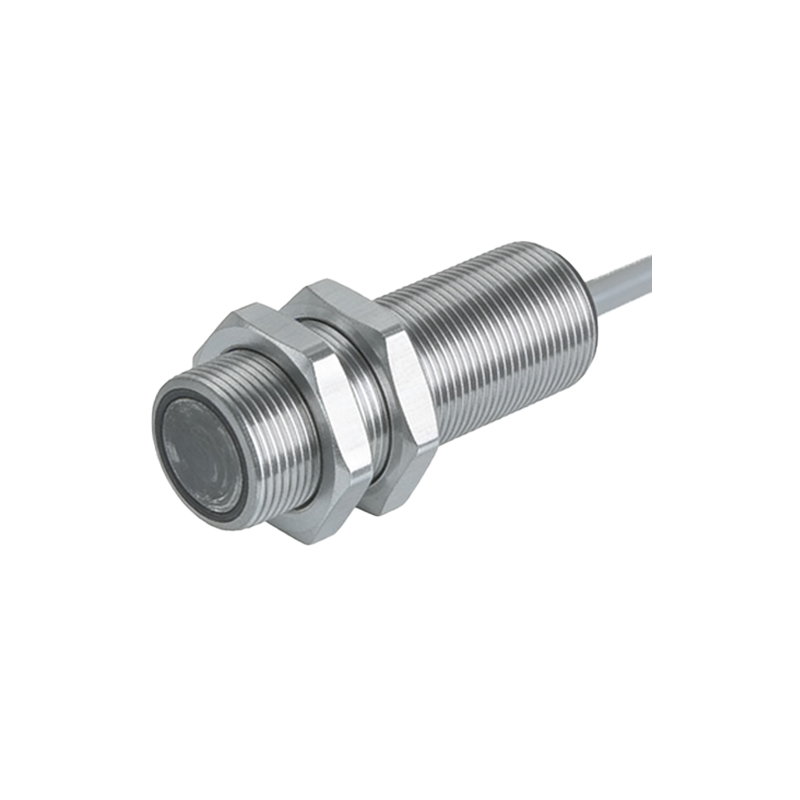
In contrast, a retroreflective sensor houses both the emitter and receiver within a single housing. The emitter projects a light beam towards a specially designed reflector, known as a retroreflector or corner-cube prism. This reflector is designed to return the light beam directly back to its source along the same path, regardless of the angle of incidence. The receiver, co-located in the sensor head, detects this returned beam. An object is detected when it breaks this reflected light path between the sensor and the reflector, causing the receiver to lose the signal. This configuration eliminates the need for separate wiring and mounting for a receiver unit on the opposite side.
Key Performance Comparison: Range and Accuracy
Through-beam sensors generally offer the longest sensing ranges among photoelectric types, often capable of reliable detection over distances of tens or even hundreds of meters. Because the light travels directly from emitter to receiver with minimal dispersion, the beam is very concentrated, allowing for the detection of very small objects and providing high positional accuracy. Retroreflective sensors have a shorter effective range, typically limited to a fraction of the through-beam distance for the same light source power, as the light must travel to the reflector and back, suffering attenuation twice. While suitable for many medium-range applications, their accuracy for tiny objects can be slightly lower due to the broader effective beam at the reflector.
Installation and Alignment Considerations
Installation complexity differs significantly. Through-beam sensors require precise mechanical alignment of two separate units on opposite sides of the detection zone. This can be time-consuming and requires a stable mounting structure to prevent misalignment from vibration or impact, which would cause false triggers. Retroreflective sensors are simpler to install, as only one device and the reflector need to be mounted. Alignment is easier because the sensor only needs to be roughly aimed at the reflector; the retroreflective property ensures the beam returns. However, the reflector must be kept clean, as dirt can diminish the returned signal strength.
Environmental and Object Surface Challenges
Environmental factors affect both types differently. Through-beam sensors are highly immune to the color, reflectivity, or surface finish of the target object because detection depends solely on beam interruption. However, airborne contaminants like dust, steam, or fog can scatter or block the beam, causing false operations. Retroreflective sensors can be fooled by highly reflective objects (like shiny metal or mirrors) that might reflect sufficient light back to the receiver even when present, a phenomenon known as "false reflection." Modern retroreflective sensors often use polarization filters to mitigate this by only accepting light that has been polarized and then depolarized by the specific retroreflector.
Application Suitability and Selection Guidelines
The choice between through-beam and retroreflective hinges on application specifics. Use through-beam sensors for demanding applications requiring long range, high precision, detection of small or transparent objects, or in environments where target surface properties vary widely. Common uses include part counting on high-speed conveyors, break detection in material webs, and safety light curtains. Opt for retroreflective sensors where installation simplicity, reduced wiring, and cost are priorities for medium-range detection of opaque objects. Typical applications include pallet detection in warehouses, door open/close monitoring, and presence sensing on packaging machinery where a clean, stable environment exists.
Conclusion and Best Practice Summary
In summary, through-beam photoelectric sensors provide superior performance in terms of range, accuracy, and reliability against varied object surfaces but at the cost of more complex installation and alignment. Retroreflective sensors offer a practical, cost-effective, and simpler-to-install solution for many standard detection tasks over shorter to medium distances. The best practice is to first define the critical parameters of the application—required sensing distance, object size, environmental conditions, and installation constraints—before selecting the sensor technology. This systematic approach ensures optimal system performance and long-term operational reliability in any industrial automation setting.