Introduction to Photoelectric Sensing Technology
Photoelectric sensors are indispensable components in modern industrial automation, offering non-contact detection of objects based on the presence or absence of light. These devices operate by emitting a beam of light, typically from an LED or laser diode, and detecting changes in the received light signal caused by the presence of an object. The core principle relies on the modulation of light, which allows the sensor to distinguish its own emitted light from ambient lighting, ensuring high reliability and accuracy even in challenging environments. Their versatility, long sensing ranges, fast response times, and ability to detect a wide variety of materials—from metals and plastics to glass and liquids—make them superior to many other sensing technologies like proximity or ultrasonic sensors for numerous applications. From packaging and material handling to automotive assembly and food processing, photoelectric sensors provide the eyes for automated systems.
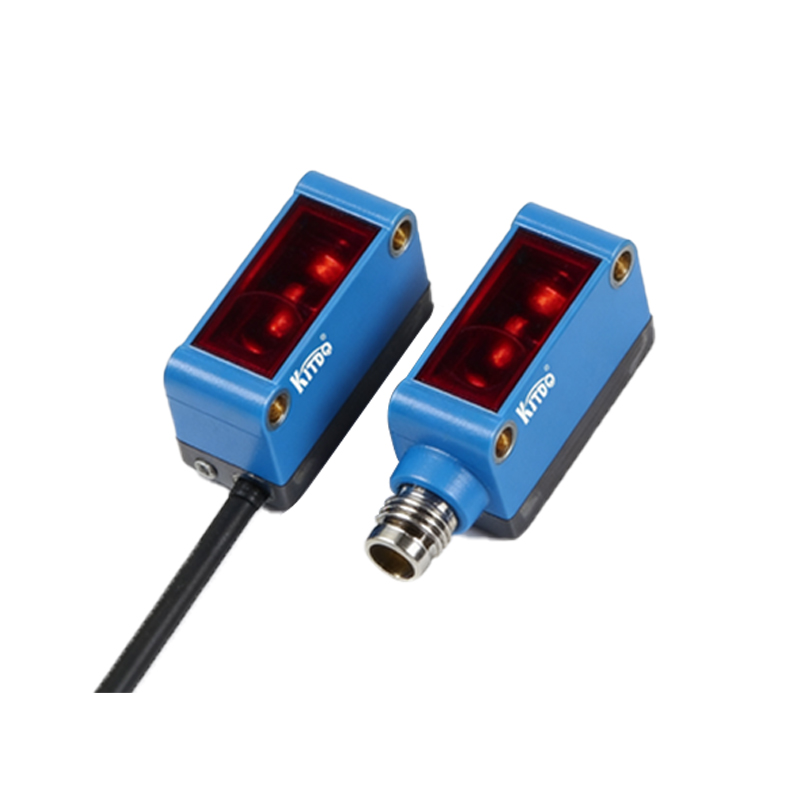
Through-Beam Sensors (Opposed Mode)
Through-beam sensors, also known as opposed-mode sensors, represent the most robust and reliable type of photoelectric sensor. This configuration consists of two separate units: a dedicated emitter and a dedicated receiver, positioned directly opposite each other. The emitter projects a continuous beam of light to the receiver. An object is detected when it physically interrupts this beam, blocking the light path to the receiver. This method provides the longest possible sensing ranges, often exceeding 100 meters, and offers the highest excess gain, meaning it can tolerate significant amounts of dirt, dust, or misalignment. It is exceptionally reliable for detecting opaque objects of any color or surface finish. However, the main drawback is the need to install and align two separate devices, which can increase installation time and cost. Typical applications include object detection on high-speed conveyors, break detection in material webs, and safety curtains where maximum reliability is paramount.
Retroreflective Sensors
Retroreflective sensors combine the emitter and receiver into a single housing, simplifying installation compared to through-beam models. They operate by projecting light toward a specially designed reflector, often a corner-cube or tape reflector, which returns the light beam directly back to the receiver. Detection occurs when an object passes between the sensor and the reflector, breaking the light path. This design offers a good balance of sensing range (often up to 10-15 meters) and ease of wiring. A critical feature of most retroreflective sensors is polarization filtering. The emitter uses a polarized lens, and the receiver has a polarizing filter oriented at 90 degrees. The reflector is designed to rotate the polarization of the light, allowing it to pass through the receiver's filter. This clever design prevents the sensor from being "fooled" by shiny objects like mirrors or polished metal, which could otherwise reflect light directly back and mimic the reflector's signal. These sensors are ideal for pallet detection, door control, and medium-range object presence sensing.
Diffuse Reflective Sensors (Proximity Mode)
Diffuse reflective sensors, or proximity-mode sensors, are the most compact and easiest to install, as they require only a single device and no separate reflector. The emitter and receiver are housed together. The sensor detects an object by relying on the diffuse reflection of its emitted light off the object's surface back to the receiver. Because the light must scatter off the target, the effective sensing distance is shorter, typically ranging from a few centimeters to about one meter, and is highly dependent on the object's size, color, and surface texture. Light-colored, matte surfaces reflect well and are detected at longer ranges, while dark or absorbent surfaces pose a challenge. To combat this, many modern diffuse sensors employ background suppression technology or use a focused, fixed-focus beam to precisely define the sensing field, ignoring objects beyond a set distance. These sensors are ubiquitous in applications like detecting objects on short conveyors, counting bottles, or detecting the presence of a part in a fixture.
Convergent Beam and Fixed-Focus Sensors
This category represents a specialized and precise subset of diffuse sensing. Convergent beam, or fixed-focus, sensors are designed with optical lenses that focus the emitted light to a very specific point at a predetermined distance in front of the sensor. Only objects that are at this exact focal point will reflect a strong, concentrated signal back to the receiver. Objects placed before or beyond this point are effectively ignored. This creates a very precise sensing window or "dead sharp" sensing plane. This technology is invaluable for applications requiring precise positioning, such as detecting the edge of a material, verifying the precise height of an object, or detecting small parts at a specific location on an assembly line. It solves common problems with standard diffuse sensors, like the variation in detection range based on an object's reflectivity, by providing a consistent and accurate detection point regardless of the target's color or finish.
Selecting the Right Sensor for Your Application
Choosing the optimal photoelectric sensor type requires a careful analysis of the application parameters. Key factors include the required sensing distance, the size and characteristics of the target object (material, color, surface finish), the required response speed, the environmental conditions (presence of dust, moisture, vibration, or ambient light interference), and installation constraints. For maximum range and reliability in dirty environments, a through-beam sensor is the best choice. When a moderate range is needed with easier installation, a retroreflective sensor with polarization is recommended. For close-range detection where installing a reflector is impractical, a diffuse sensor is suitable, with a fixed-focus model selected for precision tasks involving small or variably reflective objects. Understanding these four fundamental types—through-beam, retroreflective, diffuse, and convergent beam—provides a solid foundation for implementing effective and reliable object detection in any automated system.