Through-Beam Photoelectric Sensors
Through-beam photoelectric sensors, often considered the most robust type, consist of two separate units: a transmitter and a receiver. The transmitter emits a continuous beam of light, typically from an LED or laser source, which is aimed directly at the receiver unit. The core operating principle is straightforward: an object is detected when it physically interrupts this light beam, causing the receiver's signal to drop. This design offers significant advantages in terms of sensing range and reliability. Because the light travels directly from the emitter to the detector, these sensors can achieve very long sensing distances, often exceeding 100 meters in some high-performance models. They are also highly immune to environmental factors like target color, reflectivity, or surface finish; if the object is opaque and breaks the beam, it will be detected consistently. Common applications include detecting large objects on conveyors, monitoring high-speed production lines, and providing safety curtains for machinery guarding where any beam break triggers an immediate stop.
Retro-Reflective Photoelectric Sensors
Retro-reflective sensors combine the emitter and receiver into a single housing, simplifying installation compared to through-beam models. They operate by directing a light beam towards a specialized reflector, known as a retroreflector or corner-cube prism. This reflector is designed to return the light beam directly back to the sensor's receiver along the same path, regardless of the angle of incidence. Detection occurs when an object passes between the sensor and the reflector, blocking the returning light beam. A key technical feature of these sensors is the use of polarizing filters to overcome a potential challenge. Without such filters, a shiny object could act like a mirror and reflect the light back to the receiver, causing a false "no object" signal. The polarizing filter ensures that only light reflected from the dedicated retroreflector is recognized. Retro-reflective sensors offer a good balance of range and convenience, with typical sensing distances up to 10-15 meters. They are widely used in packaging machinery, material handling, and door control systems.
Diffuse Reflective (Proximity) Sensors
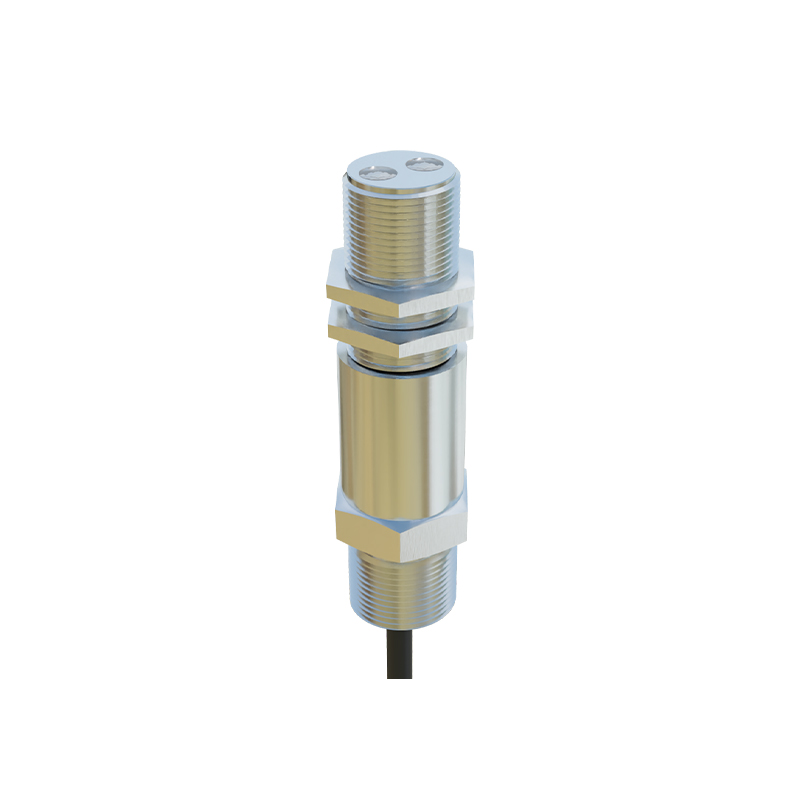
Diffuse reflective sensors, also known as proximity-mode sensors, represent the most compact and installation-friendly design. Like retro-reflective types, the emitter and receiver are housed together. However, instead of using a separate reflector, these sensors detect objects by relying on the diffuse reflection of light from the target's surface itself. The sensor emits a light beam, and a portion of this scattered light bounces back from the object to be detected by the receiver. This mode is highly sensitive to the target's properties, including color, material, texture, and reflectivity. A white, matte surface will reflect much more light than a dark, glossy one, affecting the effective sensing distance. To combat this variability, many modern diffuse sensors incorporate advanced technologies like background suppression (BGS) or true background suppression. BGS uses triangulation principles to measure the angle of the returning light, allowing the sensor to detect an object only within a precise, defined distance window, ignoring more distant backgrounds. Diffuse sensors are ideal for short-range detection, object presence verification, and counting on assembly lines where space is limited.
Comparative Analysis and Selection Criteria
Choosing the correct photoelectric sensor type depends heavily on the specific application requirements. Through-beam sensors are the default choice for maximum range, reliability in dirty environments, and precise detection of any opaque object. Their main drawback is the need for precise alignment of two separate components and higher installation cost. Retro-reflective sensors reduce wiring and alignment complexity to a single point but require a clear line-of-sight to a reflector. They may struggle in environments with heavy airborne contamination that can coat the reflector. Diffuse sensors offer the simplest installation with no separate component, but their performance is intrinsically tied to the target's characteristics. For consistent detection of varied objects, a diffuse sensor with background suppression is often necessary. Factors such as required sensing distance, target size and material, environmental conditions (dust, moisture, ambient light), required response time, and available mounting space must all be evaluated to make an optimal selection for industrial automation tasks.