Laser sensors are widely used in industrial automation, robotics, and safety systems for precise detection and measurement. Among the various operating modes, the retroreflective principle stands out for its reliability and long-range capability. This article delves into the fundamental workings of this technology, explaining the synergy between the laser sensor and a specialized component: the retroreflective tape or target.
At its core, a retroreflective laser sensor operates on a simple optical principle. The sensor unit itself contains both a laser light source (typically a visible red or infrared laser diode) and a photoelectric receiver. The key differentiator from other modes like through-beam or diffuse reflection is the use of a separate retroreflector. This reflector is not a simple mirror. Instead, it is a surface covered with retroreflective material, often in the form of tape, sheeting, or a rigid target. This material is engineered with millions of microscopic glass beads or prismatic structures.
When the sensor is activated, it emits a focused, coherent beam of laser light towards the retroreflector. Upon striking the retroreflective surface, the light is not simply reflected back at an angle equal to the angle of incidence, as with a standard mirror. Instead, the unique microstructure of the material causes the light rays to be returned directly along the same path they came from, with minimal scattering. This phenomenon is known as retroreflection. The photoelectric receiver in the sensor head is precisely aligned to capture this strong, directed return beam.

The detection logic is straightforward. When an object passes between the sensor and the retroreflector, it interrupts the laser beam. The receiver no longer detects the strong retroreflected signal, triggering a change in the sensor's output state (e.g., from ON to OFF). This makes it ideal for presence detection, object counting, and gate monitoring over considerable distances—often several meters or more, far exceeding the range of standard diffuse reflection sensors.
The efficiency of this system hinges on the quality of the retroreflector. High-grade retroreflective tape uses glass bead or cube corner prism technology. Glass bead reflectors work by refracting light through tiny spheres, internally reflecting it, and refracting it back. Cube corner reflectors use a triad of mutually perpendicular reflective surfaces to achieve the same direct-return effect with even higher efficiency. This design ensures that a significant portion of the emitted laser power is returned to the receiver, allowing for stable operation even in environments with ambient light or minor misalignment.
Several critical factors influence performance. Alignment is crucial; although retroreflective materials have a wide effective angular acceptance, precise initial alignment maximizes signal strength. The reflectivity of the target material is specified by a coefficient like RA (Reflectivity Value). A higher RA value means better performance over longer distances. Environmental conditions such as dust, fog, or heavy condensation on the lenses or reflector can attenuate the beam. Furthermore, highly reflective or shiny objects near the beam path can potentially cause false triggers by reflecting light back to the receiver, a consideration during installation.
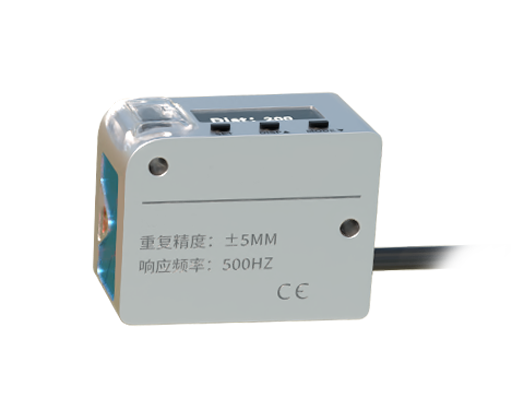
The applications of retroreflective laser sensors are extensive. In manufacturing, they are used for detecting products on high-speed conveyor belts, monitoring robotic arm positions, and ensuring correct part placement. In packaging, they count boxes and control filling levels. For safety, they form the basis of perimeter guarding systems and light curtains, where breaking the beam initiates a machine stop. Their long range and reliable beam-break detection make them superior to diffuse sensors in many long-range or clear-object detection scenarios.
In summary, the retroreflective laser sensor principle leverages the unique physics of retroreflection to create a robust, long-distance detection solution. The combination of a focused laser emitter, a sensitive receiver, and a high-efficiency retroreflective target provides a highly reliable "beam-break" detection method. Understanding the interaction between the sensor and the reflector, along with considerations for alignment, target quality, and environment, is key to implementing an effective and stable sensing solution in demanding industrial applications.