Laser displacement sensors are sophisticated non-contact measurement devices widely used in industrial automation, quality control, and research applications. Their ability to provide high-precision, real-time distance measurements makes them indispensable in modern manufacturing and engineering. Understanding the internal composition of these sensors is crucial for selecting the right tool for a specific application and ensuring optimal performance. At its core, a laser displacement sensor is a system that integrates several key components, each playing a vital role in the measurement process.
The fundamental operation begins with the laser diode, the light source of the sensor. Typically, a semiconductor laser diode emits a focused, coherent beam of visible red light or, for higher precision and stability, a Class 2 laser. The wavelength and power of this laser are carefully chosen to balance safety, visibility, and performance for the target material and environment. This emitted laser beam is then conditioned and directed by optical elements.
The emission optical system is responsible for shaping and focusing the laser beam onto the target object's surface. This system usually comprises collimating lenses that convert the diverging laser light into a parallel beam and a focusing lens that concentrates it into a small, precise spot. The quality of these optics directly affects the size of the measurement spot and the sensor's ability to measure small or intricate features. The focused beam strikes the target, and its light is diffusely reflected back toward the sensor.

The returning light is captured by the reception optical system. This is a critical assembly that gathers the scattered reflected light. It often includes a high-quality lens, such as a telecentric lens, which ensures that only light rays parallel or nearly parallel to the optical axis are collected. This design minimizes measurement error caused by the tilt or angular displacement of the target object, a key feature for many industrial applications.
The collected light is then projected onto a position-sensitive detector (PSD) or a Charge-Coupled Device (CCD) / Complementary Metal-Oxide-Semiconductor (CMOS) imaging sensor. This is the heart of the triangulation-based measurement principle used by most laser displacement sensors. In a PSD-based system, the spot of light creates a photocurrent, and its position on the detector's surface is calculated electronically. In CCD/CMOS-based systems, the light forms an image spot on a pixel array, and its precise location is determined through advanced image processing algorithms. The choice between PSD and CCD/CMOS technologies involves trade-offs between speed, resolution, cost, and resistance to ambient light.
The raw positional data from the detector is processed by the signal processing circuit. This electronic subsystem performs several essential functions: it amplifies the weak signal from the detector, filters out electrical noise and unwanted ambient light interference, and converts the analog signal into a digital format. Sophisticated algorithms within the processor calculate the exact displacement value based on the known triangulation geometry, the fixed baseline distance between the emission and reception lenses, and the detected spot position.
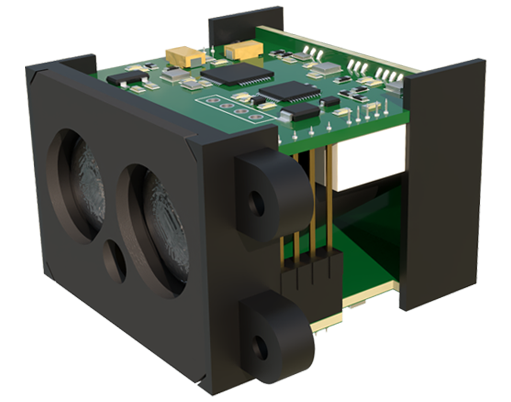
Finally, the processed data is output via the output interface. Modern laser displacement sensors offer various output options to integrate seamlessly into control systems. Common interfaces include analog outputs (e.g., 0-10V, 4-20mA for continuous distance values), digital outputs (e.g., switching signals for tolerance checking), and serial communications (e.g., RS-232, RS-485, or Ethernet/IP for high-speed data transfer and configuration). The housing, typically made of robust metal, protects these delicate internal components from dust, chips, coolant, and mechanical shock, ensuring reliability in harsh industrial environments.
In summary, the laser displacement sensor is a harmonious integration of optoelectronics, precision mechanics, and digital signal processing. From the laser diode and precision optics to the sensitive detector and intelligent processor, each component is engineered to work in concert, transforming a simple beam of light into a reliable and highly accurate measurement signal. This intricate composition enables its remarkable capabilities in diverse fields, from monitoring vibration and thickness to guiding robotic arms and inspecting component dimensions.
