Laser sensors have become indispensable tools across a vast spectrum of industries, from advanced manufacturing and robotics to autonomous vehicles and scientific research. Their ability to provide precise, non-contact measurements of distance, position, displacement, and presence makes them a cornerstone of modern automation and quality control. This guide delves into the fundamental principles, various types, and key application considerations for laser sensors.
At its core, a laser sensor operates by emitting a focused beam of coherent light—typically from a laser diode—towards a target. The sensor then detects the interaction of this light with the target. The specific method of detection defines the primary operating principle and the sensor's capabilities. The most common principles are triangulation, time-of-flight (ToF), and laser confocal displacement.
Triangulation-based laser sensors are renowned for their high resolution and accuracy at short to medium ranges. The emitter projects a laser spot onto the target. The reflected light is focused onto a position-sensitive detector (like a CCD or PSD) at a known angle. As the target's distance changes, the position of the reflected spot on the detector shifts. Using trigonometric calculations, the sensor's processor determines the exact distance. These sensors excel in applications requiring micron-level precision, such as measuring component thickness, warp, or vibration.
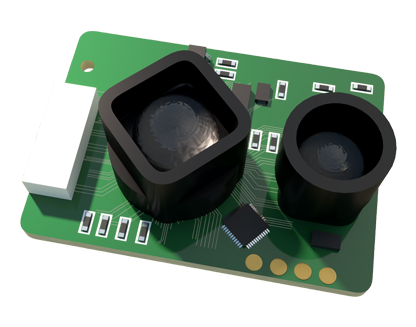
Time-of-Flight (ToF) laser sensors measure the time it takes for a laser pulse to travel to the target and back. Since the speed of light is constant, the distance can be calculated directly from this time interval. ToF sensors are ideal for longer-range measurements, from a few meters to several hundred meters, though with generally lower resolution than triangulation sensors. They are widely used in applications like vehicle LiDAR, bulk level monitoring in silos, and large-scale dimensioning.
Laser confocal displacement sensors utilize a unique optical system where the emitted light and the reflected light pass through the same focal point. By using chromatic aberration, different wavelengths of light focus at different distances. The sensor identifies the wavelength that is most sharply focused on the target, directly correlating it to a specific distance. This technology allows for highly accurate measurements on transparent, mirrored, or multi-layered surfaces where other laser types struggle.
Selecting the right laser sensor requires careful evaluation of several parameters. The measuring range defines the minimum and maximum distances the sensor can handle. Resolution indicates the smallest detectable change in distance. Repeatability is the sensor's ability to consistently return the same measurement for a static target. The spot size of the laser beam is critical when measuring small features or uneven surfaces. Environmental factors like ambient light, dust, fog, or target surface characteristics (color, reflectivity, material) must also be considered, as they can significantly impact performance. Many modern sensors incorporate algorithms and filters to compensate for challenging conditions.
The applications for laser sensors are nearly limitless. In factory automation, they are used for precise part positioning, robotic guidance, fill level control, and weld seam tracking. In electronics manufacturing, they measure component coplanarity and PCB warpage. In the automotive industry, they are integral to assembly line robotics and advanced driver-assistance systems (ADAS). Beyond industrial settings, laser sensors enable 3D scanning for reverse engineering, monitor structural deformations in civil engineering, and facilitate terrain mapping in agriculture.
Successful integration involves more than just mounting the sensor. Proper alignment is paramount. The laser beam must be perpendicular to the target surface for optimal reflection, unless the sensor's design accounts for an angle. Vibration can be a major source of error, necessitating stable mounting. For digital sensors, configuring the output (analog voltage/current, digital interfaces like IO-Link or Ethernet) and setting thresholds or windows correctly within the control system is essential for triggering automated actions.
Regular maintenance, though minimal, ensures long-term reliability. Keeping the lens clean from dust and oil is crucial, as contamination can scatter or absorb the laser beam. Periodic verification against a known reference standard helps confirm calibration. Users should always adhere to laser safety classifications (typically Class 1 or 2 for industrial sensors) and never look directly into the beam.
As technology advances, laser sensors continue to evolve. Trends include miniaturization for integration into smaller devices, increased intelligence with onboard processing for edge computing, and enhanced connectivity for Industry 4.0 data ecosystems. Understanding the principles and selection criteria outlined in this guide provides a solid foundation for leveraging the power of laser sensing technology to solve complex measurement and detection challenges with speed, accuracy, and reliability.