Laser rangefinder sensors, also known as laser distance sensors, are ubiquitous in modern technology, from robotics and manufacturing to surveying and consumer electronics. Their core function is to measure the distance to a target with high precision and speed, without physical contact. Understanding the fundamental principles behind these devices reveals the elegance of applied physics.
The operation of most laser rangefinders is based on one of two primary methods: Time-of-Flight (ToF) or phase-shift measurement. The Time-of-Flight principle is conceptually straightforward. The sensor emits a short, focused pulse of laser light toward the target. A photodetector within the sensor then waits to receive the pulse reflected back from the target's surface. An internal high-speed clock measures the extremely brief time interval between the emission and the reception of the pulse. Since the speed of light (c) is a known constant (approximately 3 x 10^8 meters per second), the distance (d) to the target can be calculated using the simple formula: d = (c * t) / 2. The time (t) is divided by two because the light travels the distance twice—to the target and back. This method is highly effective for measuring long distances, from several meters to kilometers, and is commonly used in terrestrial surveying, aerospace, and some industrial applications. The key challenge lies in accurately measuring nanosecond or picosecond time intervals, which requires sophisticated electronic circuitry.

The second common principle, phase-shift measurement, is often employed for high-precision measurements at shorter ranges, typically up to a few hundred meters. Instead of a single pulse, the sensor emits a continuous laser beam that is modulated with a specific sinusoidal frequency. This modulated light wave travels to the target and reflects back. Due to the travel time, the reflected wave returns with a phase shift relative to the originally emitted wave. The sensor's detector compares the phase of the emitted signal with the phase of the received signal. The amount of phase shift is directly proportional to the distance the light has traveled. By measuring this phase difference, the sensor's processor can calculate the distance with very high resolution, often down to sub-millimeter levels. This method is favored in applications like construction layout, industrial automation for positioning, and precision alignment tasks where minute distance variations are critical.
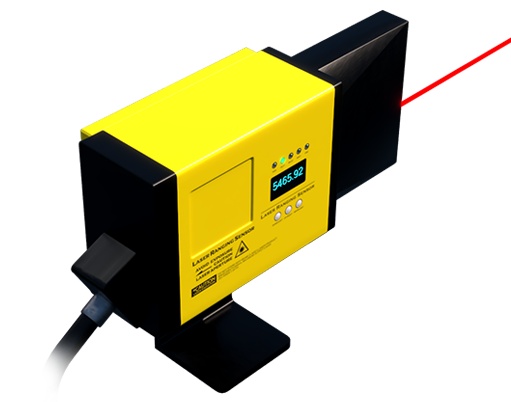
Beyond these core principles, several factors influence the performance and accuracy of a laser rangefinder. The wavelength of the laser is crucial; common wavelengths include 635nm (visible red) for aiming purposes, and 905nm or 1550nm (infrared) for longer-range or eye-safe operation. The target's surface properties significantly affect the signal. A smooth, reflective surface provides a strong return signal, while dark, matte, or absorbent surfaces can weaken it. Angled surfaces can deflect the beam away from the sensor, potentially causing a measurement error or failure. Advanced sensors incorporate algorithms to compensate for varying surface conditions.
Environmental conditions also play a role. While laser beams are less affected by ambient light than other optical methods, extremely bright sunlight can saturate the detector. Atmospheric factors like fog, dust, or heavy rain can scatter and attenuate the laser beam, reducing effective range. For the most demanding applications, such as satellite laser ranging, corrections for atmospheric refraction are necessary.
The applications of laser rangefinder sensors are vast and growing. In industrial automation, they guide robotic arms, control material levels in silos, and inspect product dimensions. Autonomous vehicles and drones use them as LiDAR (Light Detection and Ranging) components to map their surroundings in 3D. In consumer electronics, they enable camera autofocus systems and are integral to the gesture recognition features in some devices. Their non-contact nature, speed, accuracy, and reliability make them indispensable tools across countless fields.
In summary, laser rangefinder sensors translate the constant speed of light into precise distance measurements through precise timing or phase analysis. Whether using the direct Time-of-Flight method for long ranges or the phase-shift technique for high precision at shorter distances, these devices exemplify how fundamental physical principles are harnessed to solve practical measurement challenges in an increasingly automated world.