What is a Proximity Sensor?
A proximity sensor is a non-contact electronic device designed to detect the presence or absence of an object within its sensing range without any physical contact. These sensors are fundamental components in industrial automation, robotics, consumer electronics, and automotive systems. They operate by emitting an electromagnetic field, beam of electromagnetic radiation, or ultrasonic sound waves, and then looking for changes in the field or return signal. The key advantage is their ability to detect objects reliably in harsh environments where physical contact is impractical, such as in dirty, wet, or high-vibration conditions. Their non-contact nature also eliminates mechanical wear and tear, ensuring long operational life and high reliability. Common types include inductive, capacitive, ultrasonic, and photoelectric sensors, each suited for specific materials and applications.
Core Operating Principle Overview
At its heart, a proximity sensor functions by converting information about the presence or distance of a target object into an electrical signal. This process involves three main stages: generation, interaction, and detection. First, the sensor generates a sensing field or signal. When a target object enters this predefined field, it causes a measurable change in the field's properties—such as its amplitude, frequency, or phase. Finally, the sensor's internal circuitry detects this change and triggers a switch in its output state (typically from OFF to ON, or vice-versa). This output signal is then sent to a controller like a PLC (Programmable Logic Controller) to initiate an action, such as stopping a conveyor, counting items, or activating a robotic arm. The specific physical principle behind this change depends entirely on the sensor type.
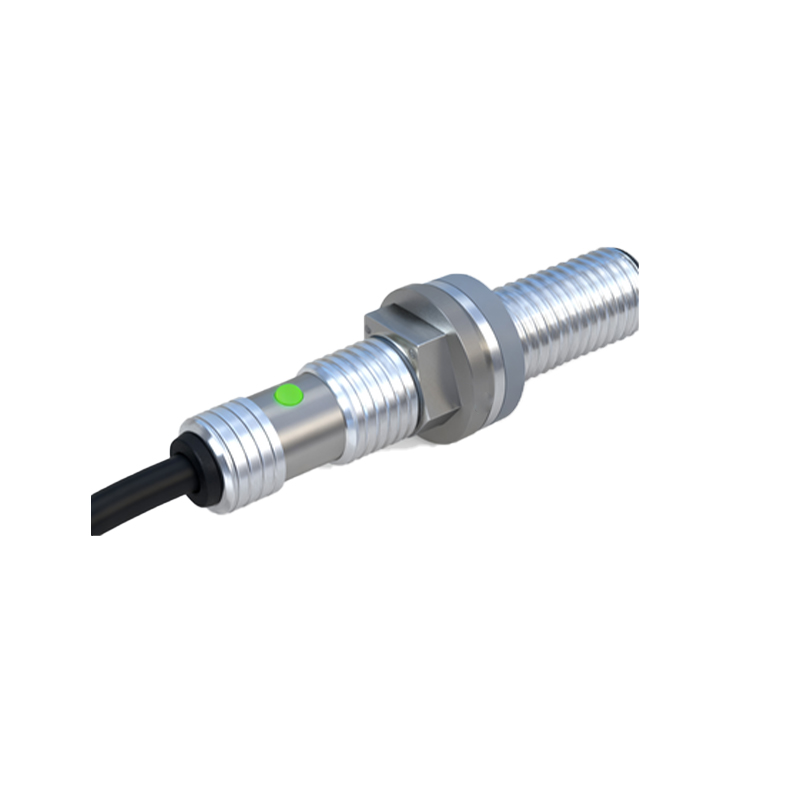
Inductive Proximity Sensor Principle
Inductive proximity sensors are used exclusively for detecting metallic objects, primarily ferrous metals like steel and iron. The core component is an oscillator circuit that generates a high-frequency alternating magnetic field at the active face of the sensor, which is created by a coiled wire wound around a ferrite core. When a conductive metal target enters this oscillating magnetic field, eddy currents are induced on the surface of the metal. These eddy currents draw energy from the oscillator, causing a reduction in its oscillation amplitude. A threshold circuit monitors this amplitude. Once the amplitude drop reaches a set threshold (corresponding to the sensing distance), the circuit switches the sensor's solid-state output. A simple diagram would show the sensor face with concentric magnetic field lines, a metal target disrupting these lines, and the resulting eddy currents on the target's surface, leading to the output signal change.
Capacitive Proximity Sensor Principle
Capacitive sensors can detect both metallic and non-metallic materials, including liquids, powders, plastics, and wood. They operate on the principle of capacitance change. The sensor face acts as one plate of a capacitor, with the ground plane or the sensor housing acting as the other plate. The oscillator circuit charges this capacitive plate, creating an electrostatic field. When any material with a different dielectric constant than air enters this field, it increases the overall capacitance of the system. This increase in capacitance alters the oscillator's characteristics. A subsequent evaluation circuit detects this change and triggers the output switch when the change exceeds a preset level. A diagram for a capacitive sensor would illustrate the electrostatic field extending from the active face, a target object (like a plastic bottle) entering the field, causing a distortion and increase in field density, which is measured as a capacitance change.
Photoelectric Sensor Principle
Photoelectric proximity sensors use light to detect objects. They consist of a light emitter (usually an LED) and a photoreceiver. There are three main modes: through-beam, retro-reflective, and diffuse (proximity) mode. In the diffuse or proximity mode, which is most common for straightforward presence detection, the emitter and receiver are housed in the same unit. The emitter sends a continuous or pulsed beam of light (often infrared to avoid ambient light interference). When a target object is present within the sensing range, it reflects some of this light back to the receiver. The receiver detects this reflected light, and the sensor's electronics process the signal strength. If the received light intensity exceeds a set threshold, the output is activated. A diagram would show the sensor unit with light rays emanating, striking the target, and reflecting back to the receiver, completing the detection loop.
Ultrasonic Proximity Sensor Principle
Ultrasonic sensors measure distance or detect presence using sound waves beyond human hearing. They contain a transducer that acts as both a transmitter and a receiver. The principle is based on the time-of-flight measurement. The sensor emits short, high-frequency ultrasonic pulses. These pulses travel through the air, hit a target object, and are reflected back as an echo to the sensor