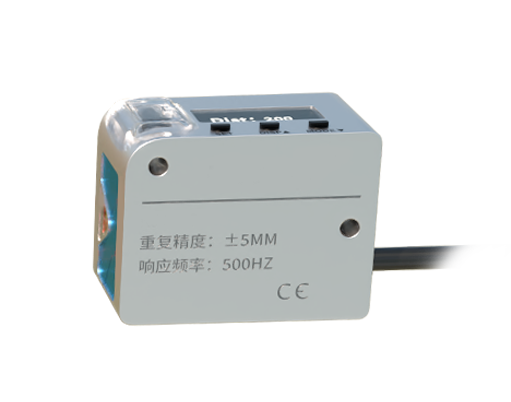
In the realm of industrial automation, quality control, and safety systems, laser detection sensors have emerged as indispensable tools. These devices utilize focused beams of light to detect, measure, or identify objects with exceptional speed, accuracy, and reliability. Unlike traditional mechanical or proximity sensors, laser sensors offer non-contact operation, making them ideal for applications involving delicate materials, high-speed production lines, or harsh environments.
The fundamental principle behind a laser detection sensor involves the emission of a coherent, monochromatic laser beam towards a target. The sensor then analyzes the interaction of this beam with the target. The most common detection methods are based on triangulation, time-of-flight (ToF), or laser light sectioning. In triangulation sensors, a laser diode projects a spot onto the target surface. The reflected light is focused onto a position-sensitive detector (like a CCD or CMOS array). The position of the reflected spot on the detector shifts proportionally to the distance of the target, allowing for precise distance or height measurement. Time-of-flight sensors, on the other hand, measure the time it takes for a laser pulse to travel to the target and back, calculating distance based on the speed of light. This method is excellent for longer ranges.
The applications of laser detection sensors are vast and continually expanding. In manufacturing, they are crucial for precise dimensional gauging, checking part presence or absence, monitoring fill levels in transparent containers, and controlling robot positioning. They ensure that components are within specified tolerances, directly impacting product quality. In logistics and warehousing, laser sensors are used for barcode reading, object counting on conveyor belts, and palletizing guidance. The automotive industry relies on them for assembly verification and weld seam inspection. Furthermore, they play a vital role in safety systems, such as creating protective light curtains around dangerous machinery to halt operation when the beam is interrupted.

Selecting the right laser detection sensor requires careful consideration of several key parameters. The required sensing range and resolution are primary factors. A sensor designed for sub-micron precision in a laboratory setting differs greatly from one monitoring large object passage in a warehouse. The target's properties—its color, material, surface texture (shiny, matte, transparent)—significantly affect the sensor's performance. A diffuse reflective sensor might struggle with a highly reflective surface, whereas a background suppression model would be more suitable. Environmental conditions like ambient light, dust, fog, or temperature extremes must also be accounted for; many industrial sensors feature robust housings and specialized filters to mitigate these interferences. Finally, the output signal type (digital switch, analog voltage/current, or serial data) must be compatible with the existing control system, such as a PLC.
Modern advancements are pushing the boundaries of what laser sensors can achieve. The integration of CMOS technology and smarter onboard processors has led to sensors with advanced functionalities like teach-in programming, multiple switching points, and integrated data logging. The rise of miniaturized laser diodes has enabled the development of extremely compact sensor designs for space-constrained applications. Looking ahead, the convergence of laser sensing with artificial intelligence and machine vision is creating even more intelligent systems capable of complex pattern recognition and adaptive decision-making on the factory floor.
In conclusion, laser detection sensors represent a critical technology driving efficiency, quality, and safety across numerous sectors. Their ability to deliver precise, non-contact measurements at high speeds makes them superior to many alternative sensing technologies. By understanding their operating principles, diverse applications, and key selection criteria, engineers and system integrators can effectively harness their capabilities to solve complex measurement and detection challenges, paving the way for smarter and more automated industrial processes.