In the world of precision manufacturing, automation, and quality control, laser displacement sensors are indispensable tools. These sophisticated devices provide non-contact, high-accuracy measurements critical for processes ranging from semiconductor fabrication to automotive assembly. However, like all precision electronic instruments, they are susceptible to wear, environmental damage, and component failure. When a sensor malfunctions, it can halt production lines, compromise product quality, and lead to significant financial losses. This is where professional laser displacement sensor repair services become essential, offering a reliable and cost-effective alternative to outright replacement.
A common misconception is that a malfunctioning sensor is immediately a candidate for the scrap heap. In reality, many issues are repairable by specialists with the right expertise and equipment. Professional repair technicians begin with a comprehensive diagnostic assessment. This process involves connecting the sensor to specialized calibration and test benches that simulate real-world operating conditions. Technicians analyze key performance indicators such as linearity, repeatability, resolution, and output signal stability. This thorough diagnosis pinpoints the exact root cause, whether it's a faulty laser diode, a misaligned optical system, a damaged CMOS/CCD receiver, issues with the signal processing circuitry, or problems with the communication interface (e.g., Ethernet, IO-Link, analog output).
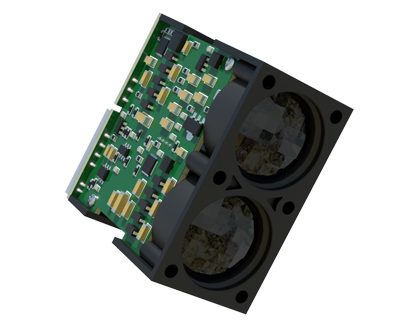
The core of professional repair lies in the technical expertise applied to the sensor's critical components. For optical system realignment, technicians use optical collimators and autocollimators to precisely realign lenses and beam paths, restoring the sensor's original spot quality and measurement axis. Replacing a degraded laser diode is a delicate procedure that requires not just soldering skills but also post-replacement optical realignment and power calibration to ensure the new diode operates within its specified parameters. Repairing the electronic circuitry often involves component-level diagnosis and replacement of damaged integrated circuits, capacitors, or connectors on the sensor's mainboard or power supply board.
Beyond component repair, a full factory recalibration is what distinguishes a professional service. After physical repairs, the sensor is placed on a high-precision calibration station, typically featuring granite reference surfaces and traceable gauge blocks. Its output is compared against a known standard over its entire measurement range. Technicians then adjust the sensor's internal software parameters to correct any deviation, ensuring its accuracy meets or often exceeds the original manufacturer's specifications. This step is crucial; a sensor that is merely "fixed" but not recalibrated is unreliable for precision tasks.

Choosing a professional repair service offers substantial advantages over simply purchasing a new unit. The most immediate benefit is cost savings, often ranging from 40% to 70% of the price of a new sensor, with a significantly faster turnaround time—frequently within days instead of the weeks required for new equipment procurement and delivery. Professional repair is also the sustainable choice, extending the product's lifecycle and reducing electronic waste. Furthermore, a reputable service will provide a detailed diagnostic report and a performance certificate post-recalibration, giving users full transparency and confidence in the repaired unit's capabilities.
To ensure a successful repair outcome, users should select a service provider with a proven track record. Look for technicians certified by major sensor manufacturers, a well-equipped laboratory with clean benches for optical work, and the availability of genuine or high-quality replacement parts. The provider should offer a robust warranty on both parts and labor, typically for six months to a year. Before sending a sensor, users can perform basic troubleshooting: checking cable connections, power supply voltage, and ensuring the target surface is within the sensor's specified range and has suitable reflectivity. Providing the service with the sensor's model number, serial number, and a detailed description of the fault symptoms will expedite the repair process.
In conclusion, professional laser displacement sensor repair is a specialized field that restores critical measurement tools to optimal performance. It combines advanced diagnostics, component-level expertise, and metrology-grade recalibration to deliver a reliable, economical, and eco-friendly solution. For industries dependent on micron-level accuracy, partnering with an expert repair service is not just a maintenance decision; it is a strategic investment in maintaining uninterrupted production, upholding quality standards, and maximizing the return on capital equipment.