Laser lens sensors represent a sophisticated category of optical-electrical devices integral to precision measurement, alignment, and detection systems across various industries. At their core, these sensors operate on the fundamental principles of optics and photoelectric conversion. A typical laser lens sensor system comprises three primary components: a laser diode source, a specialized lens assembly, and a photodetector or receiver unit. The laser diode emits a coherent, monochromatic light beam, which is then conditioned by the lens assembly. This lens, often an aspheric or multi-element design, focuses the laser beam into a precise spot or shapes it into a specific pattern, such as a line or crosshair, depending on the application. The key function of the lens is to control the beam's divergence, diameter, and focal point with high accuracy.
When this conditioned laser light is projected onto a target object, several interactions occur. The light may be reflected, scattered, absorbed, or diffracted. The photodetector, strategically positioned, captures the returning or altered light signal. In a common configuration for distance or displacement measurement, the sensor utilizes the triangulation principle. The laser beam strikes the target, and the reflected light is focused by a receiving lens onto a position-sensitive detector (PSD) or a CMOS/CCD array. Any change in the target's distance causes a shift in the position of the light spot on the detector. This positional shift is converted into an electrical signal, typically a current or voltage change, which is then processed by onboard circuitry to calculate the exact distance or displacement with micron-level resolution.
Another critical operating mode is through-beam sensing, where the transmitter (laser and lens) and receiver are separate units facing each other. The lens collimates the laser beam into a parallel, narrow path. An object interrupting this beam causes a drop in the received light intensity at the photodetector, triggering a detection signal. This mode is highly reliable for object presence detection and counting. Conversely, in diffuse reflection mode, the transmitter and receiver are housed in the same unit. The lens projects the beam, and the receiver lens collects the light scattered back from the target. The intensity of the returned light, which depends on the target's distance, color, and surface texture, is analyzed to determine presence or distance.
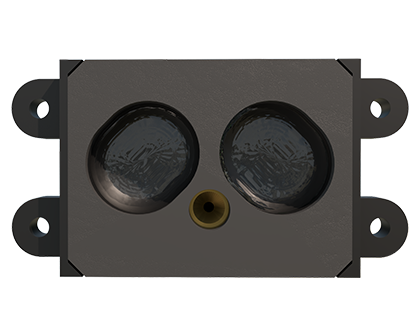
The design of the lens is paramount to sensor performance. Factors such as focal length, numerical aperture, aberration correction (especially spherical and chromatic), and coating (anti-reflective) directly influence the beam's quality, the sensor's working range, and its immunity to ambient light interference. For instance, a lens with a long focal length provides a smaller spot size at a greater distance, enhancing resolution for long-range measurements. Advanced sensors may incorporate dynamic lens focusing or multiple lenses to adjust the measurement field or depth of focus automatically.
In practical electrical and industrial engineering, laser lens sensors are indispensable. They enable non-contact measurement of thickness, vibration, and runout in manufacturing. In automation, they provide precise positioning for robotic arms and guidance for autonomous vehicles. Their high speed and accuracy facilitate quality control on assembly lines, inspecting component dimensions or detecting minute defects. Furthermore, in structural health monitoring, they measure deformation and settlement with exceptional precision. The integration of these sensors with programmable logic controllers (PLCs) and industrial networks like EtherCAT or PROFINET has streamlined data acquisition and process control.
Despite their advantages, challenges such as sensitivity to environmental contaminants (dust, fog), specular reflections from shiny surfaces, and thermal drift require careful system design. Engineers often employ protective housings with air purge options, use filters to block specific wavelengths, and implement temperature compensation algorithms. The ongoing evolution involves integrating smarter features, such as integrated IoT connectivity for predictive maintenance and the use of blue laser diodes, which offer finer spot sizes on varied surfaces compared to traditional red lasers.
In conclusion, the laser lens sensor is a quintessential fusion of optical engineering and electronics. Its principle hinges on the precise manipulation of laser light through lenses and the accurate interpretation of photoelectric signals. As industries demand higher precision and reliability, the development of more advanced lens materials, compact laser sources, and sophisticated signal processing algorithms will continue to push the boundaries of what these versatile sensors can achieve, solidifying their role as a cornerstone of modern electromechanical systems.