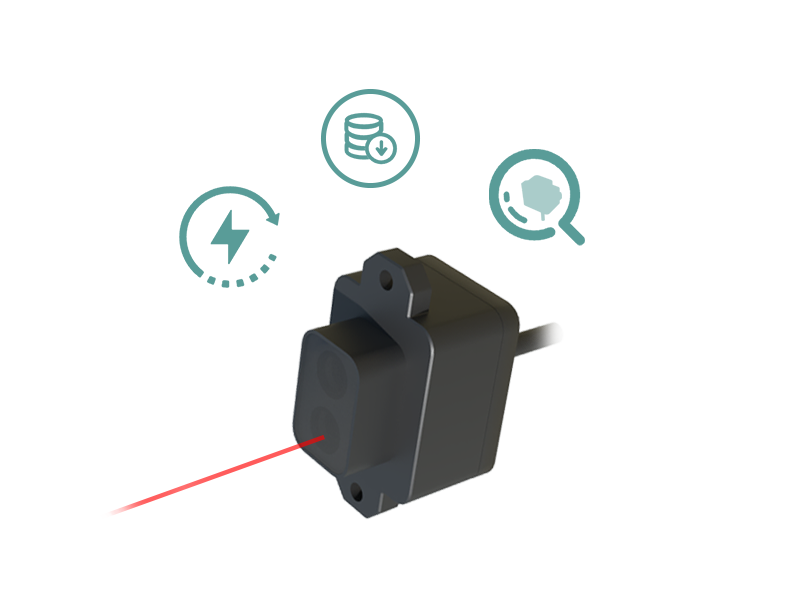
Laser distance sensors, also known as laser rangefinders or LiDAR (Light Detection and Ranging) sensors in specific configurations, represent a cornerstone technology in modern measurement and sensing. Their ability to provide rapid, precise, and non-contact distance measurements has catalyzed advancements across numerous scientific and industrial fields. This paper delves into the fundamental operating principles, explores diverse application domains, and discusses emerging trends and challenges in laser distance sensor technology.
The core principle of most laser distance sensors is based on the time-of-flight (ToF) method. A pulsed or modulated laser beam is emitted towards a target. The sensor then detects the reflected light. By precisely measuring the time delay between emission and reception and knowing the constant speed of light, the distance to the target is calculated with high accuracy. Alternative methods include phase-shift measurement for continuous-wave lasers, which offers high precision at shorter ranges, and triangulation, suitable for very short distances with extreme accuracy. The choice of principle depends heavily on the required range, resolution, environmental conditions, and cost constraints.
Key components defining sensor performance include the laser source, the photodetector, and the timing circuitry. Common laser types are laser diodes emitting in the visible red or near-infrared spectrum, with more advanced sensors utilizing eye-safe Class 1 lasers. Detectors, such as avalanche photodiodes (APDs) or photomultiplier tubes, must be sensitive to the specific laser wavelength. The heart of the system is the high-speed electronic circuit that measures picosecond or nanosecond time intervals, directly influencing the sensor's resolution.
The applications of laser distance sensors are vast and continually expanding. In industrial automation, they are indispensable for robotics, providing guidance for autonomous mobile robots (AMRs), enabling precise pick-and-place operations, and monitoring object presence on conveyor belts. They facilitate non-contact dimensional gauging and quality control in manufacturing. In the construction and civil engineering sectors, these sensors are used for surveying, monitoring structural deformations, and volume calculations in mining. The automotive industry relies heavily on LiDAR systems, a sophisticated array of laser sensors, for advanced driver-assistance systems (ADAS) and the development of autonomous vehicles, creating detailed 3D point cloud maps of the surroundings.

Furthermore, laser sensors play critical roles in aerospace for altitude measurement and docking procedures, in agriculture for yield monitoring and terrain mapping, and in consumer electronics for features like autofocus enhancement and gesture recognition. Their utility in research spans from archaeology, where they map intricate sites, to environmental science, for monitoring glacier retreat or forest canopy structure.
Despite their advantages, laser distance sensors face several challenges. Performance can degrade in adverse environmental conditions such as fog, rain, or dust, which scatter the laser beam. Highly reflective or absorbent surfaces can also cause measurement errors or signal loss. The cost of high-precision, long-range sensors remains a barrier for mass-market adoption in some areas. Safety is a paramount concern, necessitating careful design to comply with laser safety standards, especially for consumer-facing applications.
Current research is vigorously addressing these limitations. The development of solid-state LiDAR, which has no moving parts, promises increased reliability, smaller form factors, and lower costs for automotive and robotics use. Advances in signal processing algorithms, including machine learning techniques, are improving the ability to filter noise and extract accurate measurements from weak or cluttered returns. There is also a strong trend towards sensor fusion, integrating laser data with inputs from cameras, radar, and inertial measurement units (IMUs) to create more robust and comprehensive perception systems. Another frontier is the increase in measurement speed and point cloud density, enabling real-time, high-definition 3D mapping.
In conclusion, laser distance sensor technology has evolved from specialized laboratory instruments to ubiquitous tools driving innovation. Their precision, speed, and versatility make them critical for the ongoing automation and digitization of industry and society. Future progress will hinge on overcoming environmental sensitivities, reducing costs, and enhancing integration with complementary sensing modalities. As these challenges are met, laser distance sensors will undoubtedly unlock new capabilities in fields ranging from fully autonomous transportation to interactive robotics and beyond, solidifying their role as a fundamental enabling technology for the future.