In the realm of industrial automation and control systems, proximity sensors are indispensable components for non-contact detection of objects. Among the various configurations available, the two-wire normally closed (NC) proximity sensor presents a unique and often essential solution for specific safety and control logic requirements. This article delves into the operational principles, wiring, application considerations, and advantages of two-wire normally closed proximity sensors, providing a detailed technical overview for electrical engineers and industry professionals.
A proximity sensor, fundamentally, detects the presence or absence of an object within its sensing range without physical contact. It achieves this through electromagnetic fields (inductive type for metals), capacitance (capacitive type for various materials), or ultrasonic waves. The "two-wire" designation refers to the sensor's simplified wiring scheme: it requires only two wires for both power supply and signal output. This contrasts with three-wire or four-wire sensors that have separate wires for power, ground, and signal. The "normally closed" (NC) terminology describes the electrical state of the sensor's output circuit when no target is present in the sensing field. In an NC configuration, the output switch is closed, allowing current to flow through the sensor. When a target enters the sensing range, the switch opens, interrupting the current flow.
The operational principle of a two-wire NC sensor integrates power sourcing and switching into a single loop. The sensor is connected in series with the load (e.g., a PLC input module, a relay coil, or a pilot light) and the power supply. In its normal state (no target detected), the internal electronic switch is closed, completing the circuit and allowing a small "leakage" or "quiescent" current to flow to power the sensor's internal electronics while simultaneously energizing the load. This current is typically low, just enough to maintain sensor operation but often below the activation threshold of the load, a critical point discussed later. Upon detecting a target, the internal switch opens, breaking the circuit. Current flow ceases, de-energizing the load and signaling the target's presence.
Wiring a two-wire NC sensor is notably straightforward, reducing installation time and potential wiring errors. The two wires are connected in series with the load to the power source. Polarity is crucial for DC sensors; one wire connects to the positive DC supply, and the other connects to the load, which then connects to the negative side (common). For AC sensors, polarity is generally not a concern. A critical design consideration is the voltage drop across the sensor. Even in the "ON" (NC) state, the sensor exhibits a residual voltage drop (typically 2-5V for DC, higher for AC). This voltage drop, combined with the sensor's quiescent current, must be carefully evaluated against the load's minimum operating requirements. If the residual voltage is too high or the current too low, the load may not activate properly. Engineers must consult datasheets to ensure compatibility, often requiring a "minimum load current" to be drawn for stable sensor operation.
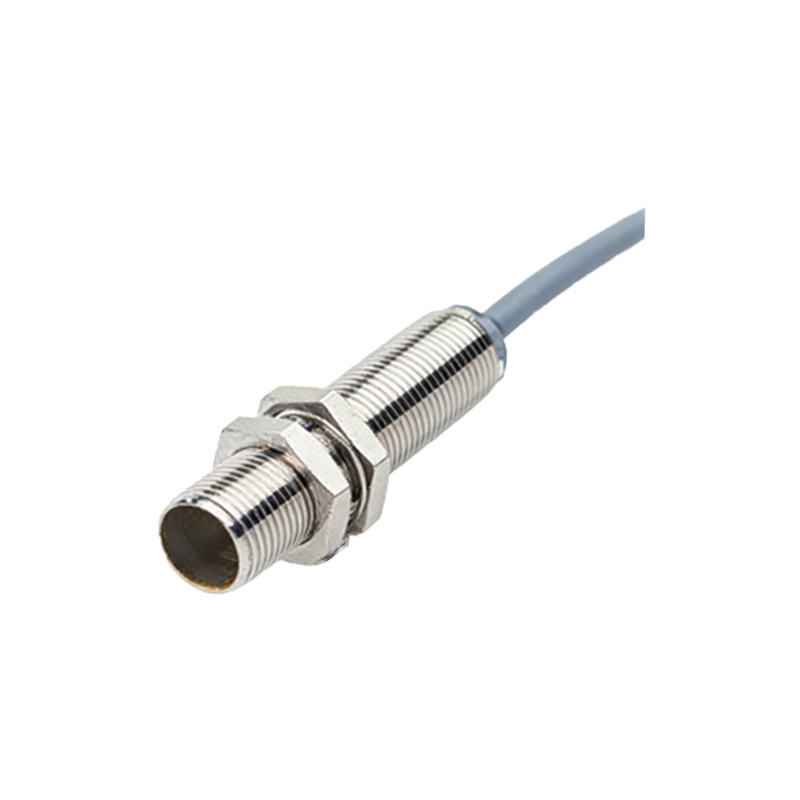
The choice of a normally closed configuration is frequently driven by safety and fail-safe design principles, particularly in machine safety and emergency stop circuits. In a safety circuit, a broken wire, a loss of power, or a sensor failure should cause the machine to enter a safe state (e.g., stop). A two-wire NC sensor inherently provides this feature. If the sensor fails open-circuit (a common failure mode) or if a wire is severed, the circuit is broken, mimicking the "target present" signal and shutting down the process. This is known as a "de-energize to trip" safety philosophy. Conversely, a normally open (NO) sensor would fail dangerously, as a broken wire would not signal a target, potentially allowing a hazardous condition to go undetected.
Applications for two-wire NC proximity sensors are widespread. They are commonly found in conveyor systems to detect jams (a continuous presence breaks the circuit), in guarding systems where the opening of a safety door must stop machinery, and in level detection where an empty state (sensor not covered) needs to maintain a circuit. Their simple wiring makes them ideal for applications with space constraints or where a large number of sensors are deployed, as they reduce wiring complexity and cabinet space compared to three-wire versions.
When selecting a two-wire NC sensor, engineers must specify several key parameters: sensing range, sensing type (inductive, capacitive), housing material (often nickel-plated brass or stainless steel), supply voltage range (e.g., 10-30V DC, 20-250V AC), switching current capacity, and the all-important leakage current in the ON state. Environmental factors like temperature, humidity, and potential exposure to chemicals or washdowns must also be considered, often leading to the selection