3D laser sensors have become indispensable tools across numerous industries, enabling precise measurement, inspection, and data acquisition in three-dimensional space. These advanced devices operate by emitting laser beams toward a target object and analyzing the reflected light to calculate distance, shape, and surface characteristics with exceptional accuracy. Unlike traditional 2D sensors, 3D laser sensors capture depth information, creating detailed point clouds or depth maps that represent the object's geometry in real-world coordinates.
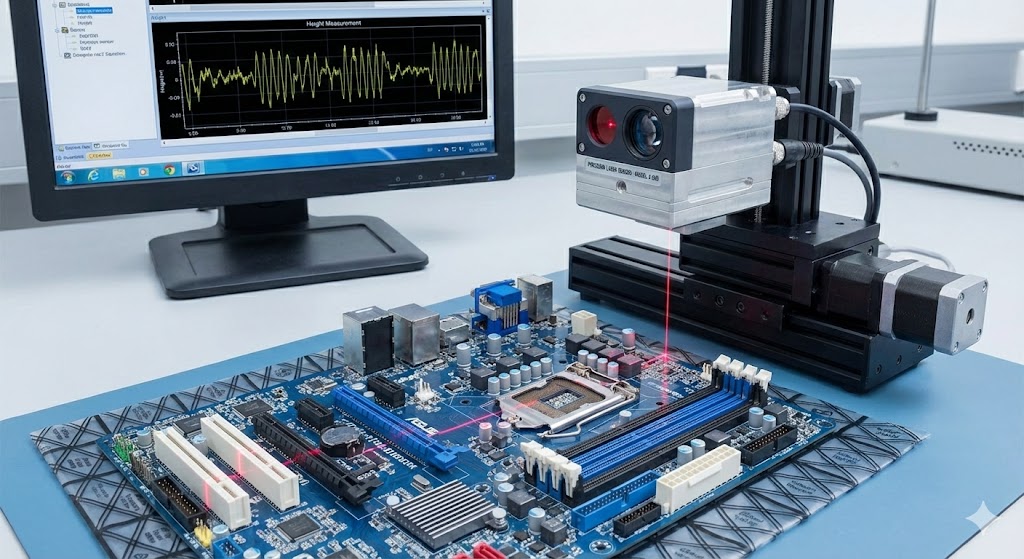
The core function of a 3D laser sensor is based on principles such as time-of-flight (ToF), triangulation, or phase-shift measurement. In time-of-flight systems, the sensor calculates distance by measuring the time it takes for a laser pulse to travel to the object and back. Triangulation-based sensors use a laser emitter, a receiver, and known geometric angles to determine position. These methods allow for non-contact measurement, which is crucial for delicate or moving objects. The collected data is processed to generate 3D models, detect defects, guide robotic arms, or ensure quality control in manufacturing lines.
One of the primary applications of 3D laser sensors is in industrial automation and robotics. They provide robots with spatial awareness, enabling tasks like bin picking, assembly, and welding with high precision. In automotive manufacturing, these sensors inspect body panels for dents or misalignments, ensuring every vehicle meets strict quality standards. The logistics sector employs them for package dimensioning, volume measurement, and automated sorting in warehouses, significantly improving efficiency and reducing errors.

In the realm of metrology and quality assurance, 3D laser sensors perform detailed inspections of components, comparing scanned data against digital CAD models to identify deviations as small as a few micrometers. This is vital in aerospace, where turbine blades and other critical parts must adhere to exact specifications for safety and performance. Additionally, in construction and civil engineering, laser scanners create as-built models of structures, monitor deformation over time, and assist in renovation projects by capturing existing conditions accurately.
The medical and healthcare fields also benefit from 3D laser sensing technology. It is used for custom prosthetics and orthotics design, where sensors scan a patient's anatomy to create perfectly fitting devices. In dentistry, intraoral scanners capture detailed 3D impressions of teeth, replacing uncomfortable traditional molds. Research laboratories utilize these sensors for documenting artifacts, preserving cultural heritage through digital archives, and even in forensic investigations to reconstruct crime scenes.
Emerging applications include autonomous vehicles, where LiDAR (Light Detection and Ranging) systems, a type of 3D laser sensor, map the environment to navigate safely. Similarly, in agriculture, sensors mounted on drones assess crop health, estimate yields, and monitor land topography. The technology's adaptability continues to grow with advancements in miniaturization, speed, and data processing algorithms, making it more accessible for small and medium-sized enterprises.
Despite their advantages, challenges such as handling reflective surfaces, operating in bright ambient light, or managing large data volumes persist. However, ongoing innovations in sensor fusion, combining laser data with camera or inertial measurements, and the integration of artificial intelligence for real-time analysis are addressing these limitations. As industries increasingly embrace digital transformation and the Internet of Things (IoT), the role of 3D laser sensors in providing reliable, high-resolution spatial data will only expand, driving efficiency, safety, and innovation across global sectors.