Laser distance sensors, also known as laser rangefinders or LiDAR sensors in some contexts, are pivotal tools in modern industrial automation, robotics, and surveying. Their core function is to measure the distance between the sensor and a target object with high precision, non-contact, and often at high speeds. Understanding their working principle is key to appreciating their widespread utility.
The fundamental operating principle of most industrial laser distance sensors is based on the Time-of-Flight (ToF) method. This technique involves measuring the time it takes for a laser pulse to travel from the emitter to the target and back to the detector. Since the speed of light (c) is a known constant (approximately 3 x 10^8 meters per second), the distance (d) can be calculated using a simple formula: d = (c * t) / 2, where 't' is the measured round-trip time. The division by two accounts for the to-and-fro journey of the light pulse. Modern electronics are capable of measuring these incredibly short time intervals (nanoseconds for meter-level distances) with great accuracy, enabling distance measurements from a few centimeters up to several hundred meters, depending on the sensor's power and design.
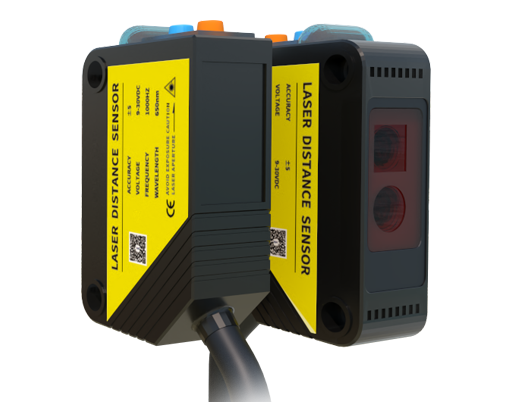
Another common principle, especially for very short-range, high-precision measurements (sub-micron to meter range), is the Triangulation Method. In this setup, the laser emitter projects a focused spot of light onto the target surface at a known angle. A position-sensitive detector (like a CCD or CMOS array), positioned at a different, fixed angle, views this spot. As the target distance changes, the position of the laser spot on the detector shifts. This shift is geometrically proportional to the distance to the target. By calculating the spot's position on the detector, the sensor's internal processor can determine the exact distance with very high resolution. Triangulation sensors are exceptionally accurate but typically have a more limited measurement range compared to ToF sensors.
A third principle, used for extremely precise measurements over short distances, is Interferometry. This method relies on the wave nature of light. The sensor splits a coherent laser beam into a reference beam and a measurement beam. The measurement beam reflects off the target and recombines with the reference beam. The interference pattern created by the superposition of these two beams changes with the optical path difference, which is directly related to the target's displacement. By analyzing the interference fringes, displacements can be measured with nanometer accuracy. This method is common in scientific and metrology laboratories.
The choice of principle dictates the sensor's performance characteristics. Time-of-Flight sensors excel in long-range, fast measurements and are used in applications like autonomous vehicle navigation, drone altimetry, and bulk material level monitoring. Triangulation sensors dominate in industrial automation for tasks like part dimension verification, weld seam tracking, and robotic pick-and-place guidance where precision is paramount. Interferometric sensors are reserved for ultra-precision stages in semiconductor manufacturing or optical testing.

Key components of a typical laser distance sensor include the laser diode emitter (often using visible red or Class 1/Class 2 infrared lasers for safety), the optical system (lenses to collimate and focus the beam), the photodetector (to receive the reflected light), and a sophisticated signal processing unit. The processor filters noise, calculates the distance based on the chosen principle, and outputs the data via digital or analog interfaces.
Environmental factors can influence performance. The target's surface color, reflectivity, and angle can affect the strength of the return signal. Dark, matte, or highly angled surfaces may scatter or absorb too much light, potentially reducing range or accuracy. Some advanced sensors employ adaptive algorithms or multiple detection phases to compensate for these variations. Furthermore, ambient light, dust, or fog can introduce noise, which is why many sensors use modulated laser signals and narrow-band optical filters to distinguish their own light from background interference.
In conclusion, the working principle of a laser distance sensor—whether based on Time-of-Flight, Triangulation, or Interferometry—defines its core capabilities. By emitting controlled laser light and analyzing its return, these sensors provide reliable, non-contact distance data that drives efficiency and precision across countless fields, from factory floors and construction sites to advanced research facilities. Their continued evolution promises even greater integration into the intelligent systems of the future.