In the rapidly evolving landscape of industrial automation and quality control, laser sensor technology has emerged as a cornerstone for precise, non-contact measurement and inspection. A particularly sophisticated and impactful application is laser sensor image reconstruction, a process that transforms raw point cloud data captured by laser scanners into accurate, high-resolution two-dimensional or three-dimensional digital representations of physical objects. This capability is revolutionizing sectors from automotive manufacturing and aerospace to electronics assembly and reverse engineering.
The fundamental principle behind this technology involves the emission of a laser beam—often a structured line or pattern—onto a target surface. A complementary sensor, typically a CMOS or CCD camera, captures the deformation or displacement of this laser pattern. By analyzing this deformation through triangulation algorithms, the system calculates precise distance measurements for thousands, or even millions, of individual points in its field of view. This collection of points, known as a point cloud, forms the raw data set. However, a raw point cloud is often noisy, incomplete, and not immediately interpretable as a coherent image or model. This is where the critical process of image reconstruction begins.
Image reconstruction from laser sensor data is a multi-stage computational pipeline. The first stage involves pre-processing to filter out noise caused by ambient light interference, surface reflectivity variations, or sensor artifacts. Advanced filtering techniques, such as statistical outlier removal and radius-based filters, are employed to clean the data. Following this, registration algorithms align multiple point clouds captured from different angles into a unified coordinate system, essential for creating a complete 3D model.
The core of reconstruction lies in surface modeling. For 3D reconstruction, algorithms like Poisson surface reconstruction or Delaunay triangulation are used to create a continuous mesh surface from the discrete points. This process infers the topology and geometry of the object, effectively "filling in the gaps" between measured points to generate a watertight digital model. For 2D profile reconstruction—common in conveyor-based inspection—the extracted line data is processed to create a precise cross-sectional image of an object, used for dimensional analysis and defect detection.
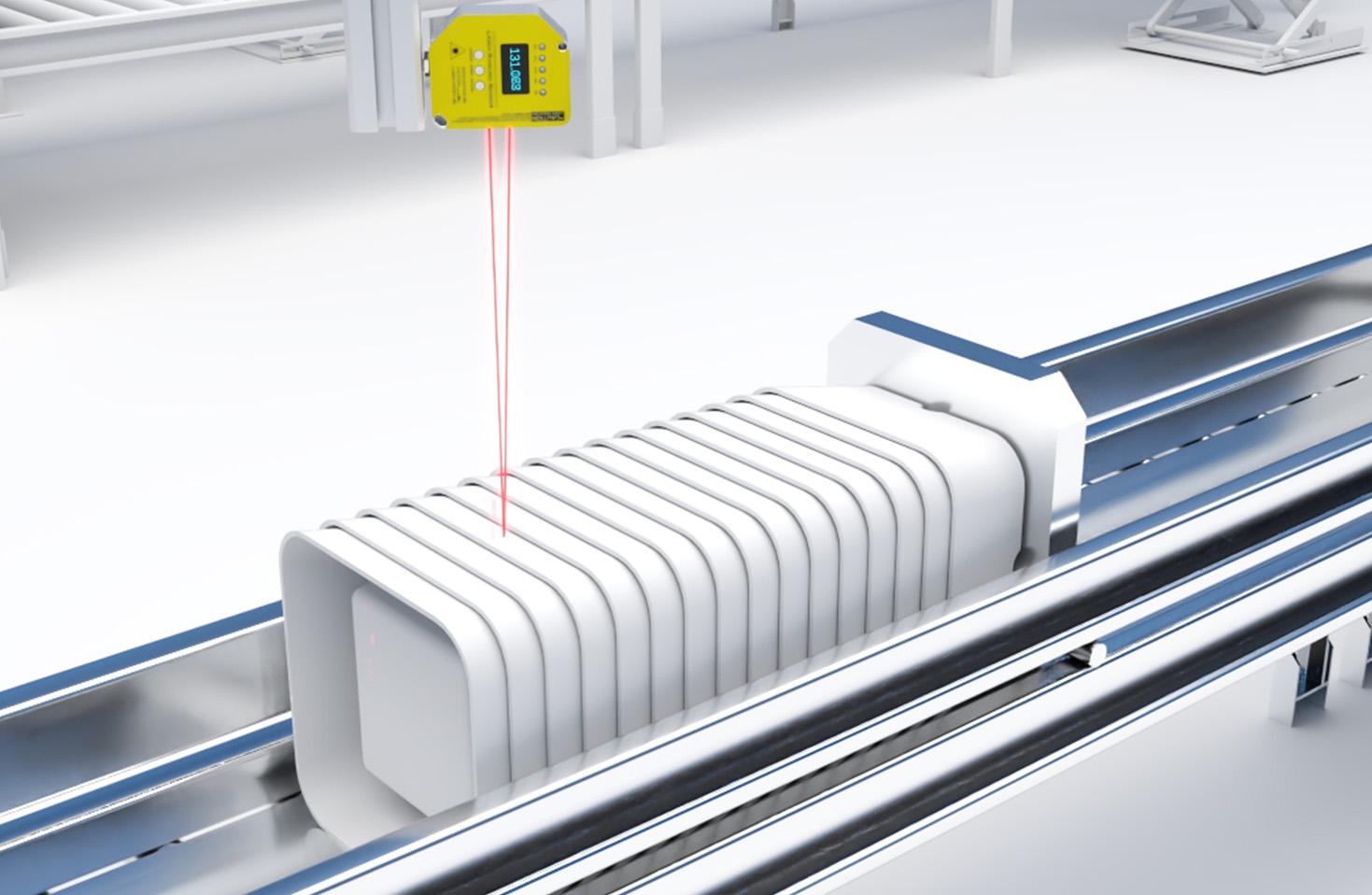
Recent advancements are primarily driven by the integration of artificial intelligence and machine learning. Deep learning models, particularly convolutional neural networks (CNNs), are now being trained to enhance reconstruction accuracy and speed. They can intelligently denoise point clouds, predict missing data due to occlusions, and even classify surface features or defects directly during the reconstruction phase. Furthermore, the development of high-speed laser scanners and real-time processing units has enabled in-line, real-time image reconstruction, allowing for instantaneous feedback in production environments.
The industrial applications are vast and critical. In automotive manufacturing, laser sensors reconstruct entire vehicle body panels to verify dimensional accuracy against CAD models with micron-level precision. In electronics, they reconstruct solder paste profiles or component placements on PCBs. For reverse engineering, a damaged or legacy part can be scanned and reconstructed into a precise 3D CAD model for reproduction. Predictive maintenance also benefits, as periodic scans of machinery can reconstruct wear patterns over time.

However, challenges persist. Highly reflective or transparent surfaces can scatter laser light, leading to data loss. Complex geometries with deep recesses may cause occlusions. The computational demand for high-fidelity, real-time reconstruction remains significant. Future trends point toward hybrid systems that combine laser sensors with other modalities like photogrammetry or spectral imaging, and the continued refinement of AI-powered algorithms to overcome material-based limitations.
In conclusion, laser sensor image reconstruction is not merely a data capture method but a sophisticated synthesis of optics, sensor technology, and advanced computation. It provides the essential digital eyes for modern industry, transforming physical objects into actionable digital data. As algorithms grow smarter and hardware more powerful, the fidelity, speed, and scope of what can be reconstructed will continue to expand, further embedding this technology as an indispensable tool for precision engineering and intelligent manufacturing.
