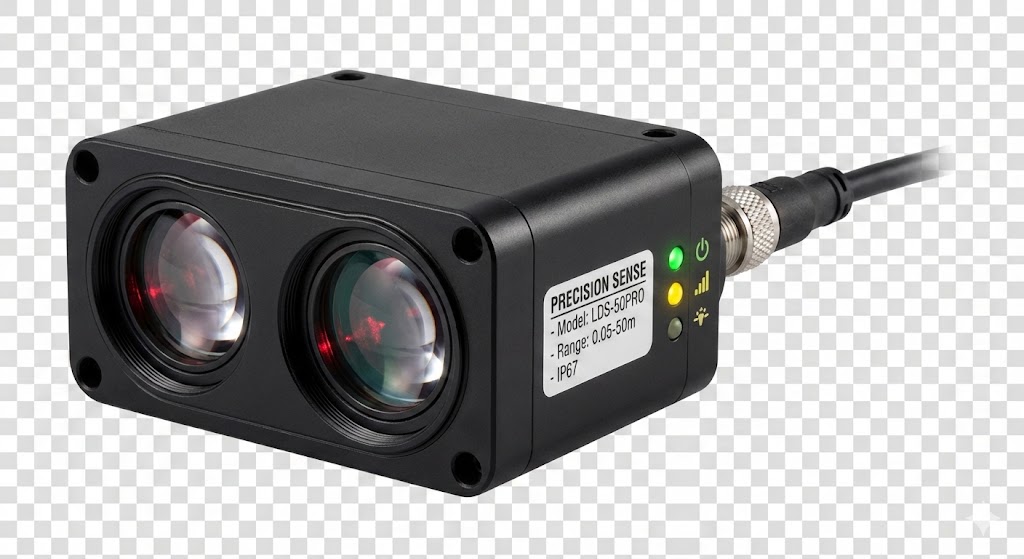
In the realm of industrial automation and precision measurement, laser distance sensors have emerged as indispensable tools, offering unparalleled accuracy, speed, and reliability. These sophisticated devices operate on a fundamental principle: they emit a focused laser beam toward a target object and measure the time it takes for the reflected light to return to the sensor. This time-of-flight (ToF) calculation, often utilizing phase-shift or pulse measurement techniques, is then converted into a precise distance value. The core functionality extends beyond simple distance measurement, enabling a wide array of critical industrial tasks.
The primary function of a laser distance sensor is non-contact measurement. This is crucial in environments where physical contact could damage the sensor, the target object, or where the target is inaccessible or hazardous. For instance, in high-temperature foundries, sensors can monitor molten metal levels from a safe distance. In automated assembly lines, they verify the precise positioning of components on fast-moving conveyors without causing any mechanical interference or wear. The non-contact nature also eliminates measurement errors caused by probe pressure, ensuring data integrity.

Beyond single-point distance checking, these sensors are integral to profiling and contour detection. By scanning a laser line across an object and analyzing the deformation of that line, 2D and even 3D profiles can be constructed. This function is vital in quality control for verifying the dimensions of manufactured parts, detecting surface defects like dents or warping, and ensuring assembly tolerances are met. In the automotive industry, this technology is used to inspect body panel gaps and alignments with micron-level precision.
Another critical functionality is precise positioning and guidance. In robotics and automated guided vehicles (AGVs), laser distance sensors provide real-time feedback on the robot's end-effector position relative to a workpiece or its environment. This allows for adaptive control, such as correcting a robot's path to pick up a part that is not exactly in its programmed location. Similarly, in warehouse automation, sensors guide forklifts and sorting systems by accurately measuring distances to racks and packages.
Level monitoring and control represent a major application area. Whether measuring the fill level of bulk solids in silos, liquids in tanks, or monitoring stockpile volumes in mining, laser sensors provide continuous, reliable data. Their ability to measure long ranges and ignore environmental factors like dust or vapor (with appropriate filtering and technology choices) makes them superior to ultrasonic or mechanical probes in many challenging conditions. This data is fed directly into inventory management or process control systems.
Furthermore, the functionality includes vibration analysis and thickness measurement. By taking rapid, successive distance measurements on a vibrating surface, the sensor can capture oscillation frequency and amplitude. This is used for predictive maintenance on motors, turbines, and pumps. For thickness measurement, two sensors can be arranged opposite each other, measuring the distance to both sides of a material simultaneously; the system's software then calculates the precise thickness by subtracting the sum of these distances from the known total gap between the sensors.
The performance of these functions hinges on key sensor specifications. Measurement range, from a few centimeters to several hundred meters, defines the application scope. Repeatability and linearity determine the precision and consistency of readings. The laser spot size affects resolution, especially on small or textured targets. Response time, often in the microsecond range, dictates suitability for high-speed processes. Environmental ratings for temperature, humidity, and ingress protection (IP ratings) ensure reliability in harsh industrial settings.

Modern advancements have integrated these sensors with smart features. Ethernet/IP, PROFINET, and IO-Link interfaces allow for seamless integration into Industrial Internet of Things (IIoT) networks, enabling remote configuration, diagnostics, and data aggregation for predictive analytics. Built-in algorithms can perform edge computing, such as switching outputs when a measured value crosses a set threshold, or sending processed data directly to a PLC.
In conclusion, the functionality of a laser distance sensor is multifaceted, transforming a simple distance reading into a powerful data point for automation, quality assurance, and process optimization. From ensuring the perfect gap on a smartphone screen to guiding a massive container crane, these sensors provide the critical "eyes" for modern industrial systems, driving efficiency, safety, and quality to new heights. Their continued evolution promises even greater integration and intelligence for the factories of the future.