In the realm of industrial automation and precision measurement, COMS laser sensors have emerged as indispensable tools. These sensors, leveraging the principles of laser triangulation and advanced complementary metal-oxide-semiconductor (CMOS) imaging technology, offer unparalleled accuracy, speed, and reliability for a wide array of applications. This article delves into the core technology, operational advantages, key application sectors, and critical factors for selecting the right COMS laser sensor for specific industrial needs.
At the heart of a COMS laser sensor lies the triangulation principle. The sensor projects a focused laser beam onto the target surface. The reflected or scattered light from this point is then captured by a high-resolution CMOS imaging array positioned at a known angle relative to the laser emitter. By precisely calculating the position of the laser spot on the CMOS array, the sensor's onboard processor can determine the exact distance to the target with micron-level resolution. The use of CMOS technology is pivotal; compared to older CCD (Charge-Coupled Device) sensors, CMOS imagers offer lower power consumption, higher integration (allowing for on-chip signal processing), faster readout speeds, and better resistance to blooming or smear from bright light sources. This makes COMS laser sensors exceptionally robust in dynamic or challenging industrial environments.
The operational benefits of modern COMS laser sensors are significant. They provide non-contact measurement, which is crucial for inspecting delicate, hot, or moving surfaces without causing damage or wear. Their high sampling rates, often in the kilohertz range, enable real-time process control and inspection on high-speed production lines. Furthermore, advanced models incorporate features like automatic background suppression, which filters out ambient light interference, and teach-in functions for easy setup of switching points or measurement windows. The digital output from the CMOS array also facilitates sophisticated data analysis, enabling not just distance measurement but also profile scanning, edge detection, and presence verification of minute features.

Application areas for COMS laser sensors are vast and growing. In the automotive industry, they are used for gap and flush measurement on vehicle bodies, brake disc thickness inspection, and robotic guidance. In electronics manufacturing, they ensure the precise placement of components on printed circuit boards (PCBs) and measure the coplanarity of chip leads. The packaging industry relies on them for fill-level detection, bottle height inspection, and label positioning. Additionally, they play a critical role in logistics for parcel dimensioning, in metalworking for thickness gauging, and in wood processing for monitoring board flatness. Their versatility makes them a cornerstone of Industry 4.0 and smart factory initiatives.
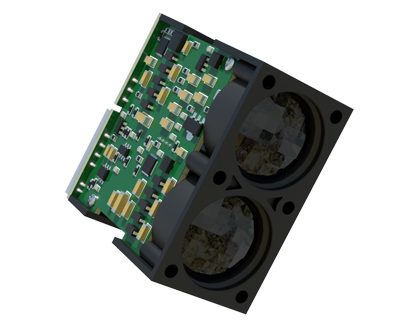
Selecting the appropriate COMS laser sensor requires careful consideration of several technical parameters. The measuring range defines the minimum and maximum distances over which the sensor can operate accurately. The spot size is critical for resolution; a smaller spot allows for measurement on very small targets or sharp edges. Resolution and linearity indicate the sensor's precision and accuracy across its entire range. The sampling rate must match the speed of the application. Environmental factors are equally important: the sensor's housing rating (e.g., IP67 for dust and water ingress protection), its resistance to ambient light, and its operating temperature range must suit the installation conditions. Finally, the output interface (analog voltage/current, digital IO, or fieldbus protocols like IO-Link or PROFINET) must be compatible with the existing control system.
In conclusion, COMS laser sensors represent a mature yet continuously evolving technology that is critical for modern precision engineering and automated quality control. By combining the physical principle of optical triangulation with the digital prowess of CMOS imaging, they deliver fast, accurate, and reliable measurements that drive efficiency, ensure quality, and enable advanced automation. Understanding their working principles, benefits, and selection criteria is essential for engineers and technicians aiming to optimize inspection, measurement, and control processes in an increasingly demanding industrial landscape.