In the realm of industrial automation and precision measurement, dual-beam laser sensors have emerged as a cornerstone technology, offering unparalleled accuracy, reliability, and versatility. Unlike single-beam sensors, which rely on a single light path, dual-beam sensors utilize two precisely aligned laser beams to perform complex measurements and detections. This fundamental design principle unlocks a host of capabilities that are critical for modern manufacturing, quality control, and robotics.
The core operating principle of a dual-beam laser sensor is based on triangulation or time-of-flight measurement, enhanced by the use of two beams. In a typical triangulation setup, one laser beam is projected onto the target object. The reflected light is captured by a receiver at a known angle. The position of the reflected spot on the receiver's sensor shifts proportionally to the target's distance. The introduction of a second beam, often parallel or at a fixed offset, provides a reference point. By analyzing the relationship between the two reflected spots—their separation, intensity, or positional shift—the sensor can calculate not just distance, but also parameters like height differential, edge detection, and precise width or diameter with exceptional immunity to surface color, texture, or ambient light variations. This differential measurement is key to its high precision.
The applications of dual-beam laser sensors are vast and span numerous industries. In automotive manufacturing, they are indispensable for inspecting component gaps and flushness on vehicle bodies, ensuring perfect panel alignment. In electronics assembly, they measure the coplanarity of integrated circuit (IC) leads or the height of solder paste deposits on printed circuit boards (PCBs). The packaging industry relies on them for precise fill-level detection in bottles and containers, regardless of the liquid's transparency or color. In metal processing, they gauge the thickness of sheets or the diameter of wires in real-time during production. Furthermore, in logistics and warehousing, these sensors facilitate object dimensioning for automated sorting and palletizing systems.
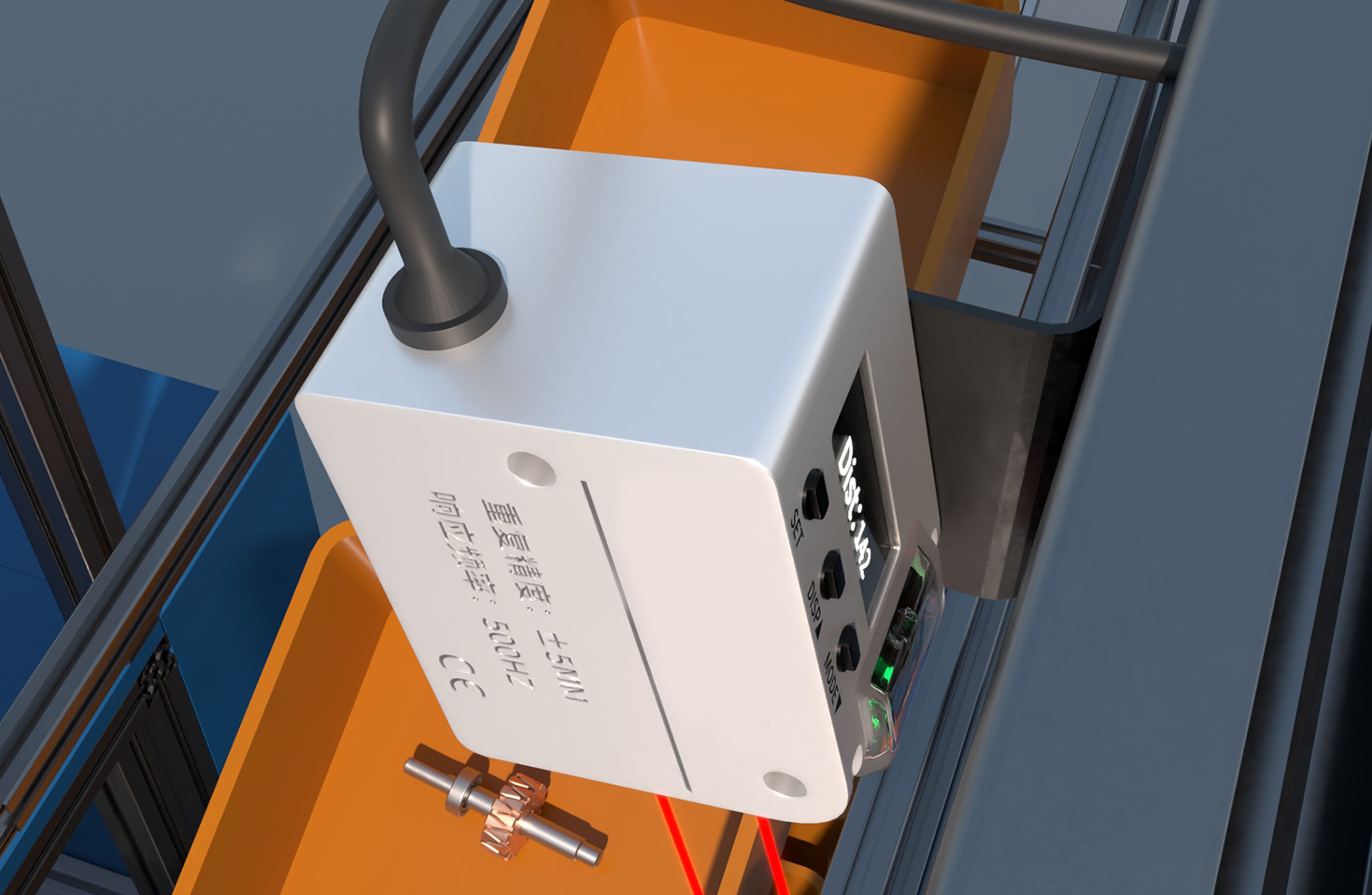
Several key advantages distinguish dual-beam laser sensors from their single-beam counterparts. First is enhanced accuracy and stability. The differential measurement inherently cancels out common-mode errors caused by environmental factors like temperature drift or vibrations affecting the entire sensor housing. Second is superior performance on challenging surfaces. Glossy, reflective, or dark surfaces that often confuse single-beam sensors are handled more effectively as the system compares data from two points, reducing the chance of erroneous readings. Third is the ability to perform differential measurements directly, such as detecting a step height or the presence of an object between the two beams, without requiring complex external referencing.
Recent technological advancements continue to push the boundaries of what dual-beam laser sensors can achieve. Integration with smart sensors and Industrial Internet of Things (IIoT) platforms allows for predictive maintenance, where the sensor can monitor its own health and signal calibration needs. Improvements in laser diode technology and CMOS/CCD receivers have led to smaller form factors, higher resolution, and faster sampling rates, enabling their use in high-speed production lines. Advanced digital signal processing (DSP) algorithms now allow for sophisticated data analysis directly within the sensor, providing not just raw measurement values but also pass/fail judgments and statistical process control (SPC) data output.
When selecting a dual-beam laser sensor for an application, engineers must consider several specifications: measurement range, spot size, resolution, repeatability, response time, and the type of output (analog, digital, or serial communication like IO-Link). The choice of visible red laser or Class 1 infrared laser is also crucial, depending on the material being measured and safety requirements. Proper installation and alignment are paramount, as the precise geometric relationship between the two beams defines the sensor's measurement baseline.
In conclusion, dual-beam laser sensors represent a sophisticated and essential tool in the precision measurement arsenal. Their ability to provide stable, high-accuracy differential measurements in demanding industrial environments makes them a preferred solution for applications where quality, efficiency, and reliability are non-negotiable. As automation evolves towards greater intelligence and flexibility, the role of these robust and capable sensors is only set to expand, driving further innovations in manufacturing and beyond.