In the realm of industrial automation and precision engineering, laser sensors have emerged as indispensable tools for non-contact measurement. Their principle of operation is elegantly precise: they emit a focused beam of coherent light towards a target object. The sensor then analyzes the properties of the reflected light—such as the time it takes to return (Time-of-Flight or ToF), the triangulation angle, or the phase shift—to calculate a specific physical parameter with remarkable accuracy and speed. But what exactly are these sophisticated devices measuring? The applications are vast, but they primarily excel in measuring distance, displacement, and derived dimensions.
The most fundamental and widespread application is distance measurement. Laser distance sensors, often using the ToF principle, provide a single, absolute measurement from the sensor head to a target surface. This is crucial in logistics for warehouse level monitoring, in construction for alignment and surveying, and in vehicle manufacturing for positioning robotic arms relative to a car body. They answer the simple but critical question: "How far away is the object?"
A more nuanced and equally critical capability is displacement measurement. Here, the focus is on detecting minute changes in the position or vibration of an object relative to a reference point. Laser triangulation sensors are masters of this domain. By projecting a laser spot onto a target and imaging the reflection onto a sensitive detector array, they can detect movements as small as micrometers. This is vital for quality control on production lines, measuring the thickness of materials like paper or metal sheets, checking the runout of rotating shafts, and monitoring vibration in machinery for predictive maintenance. It answers: "How much has the position changed from the expected point?"
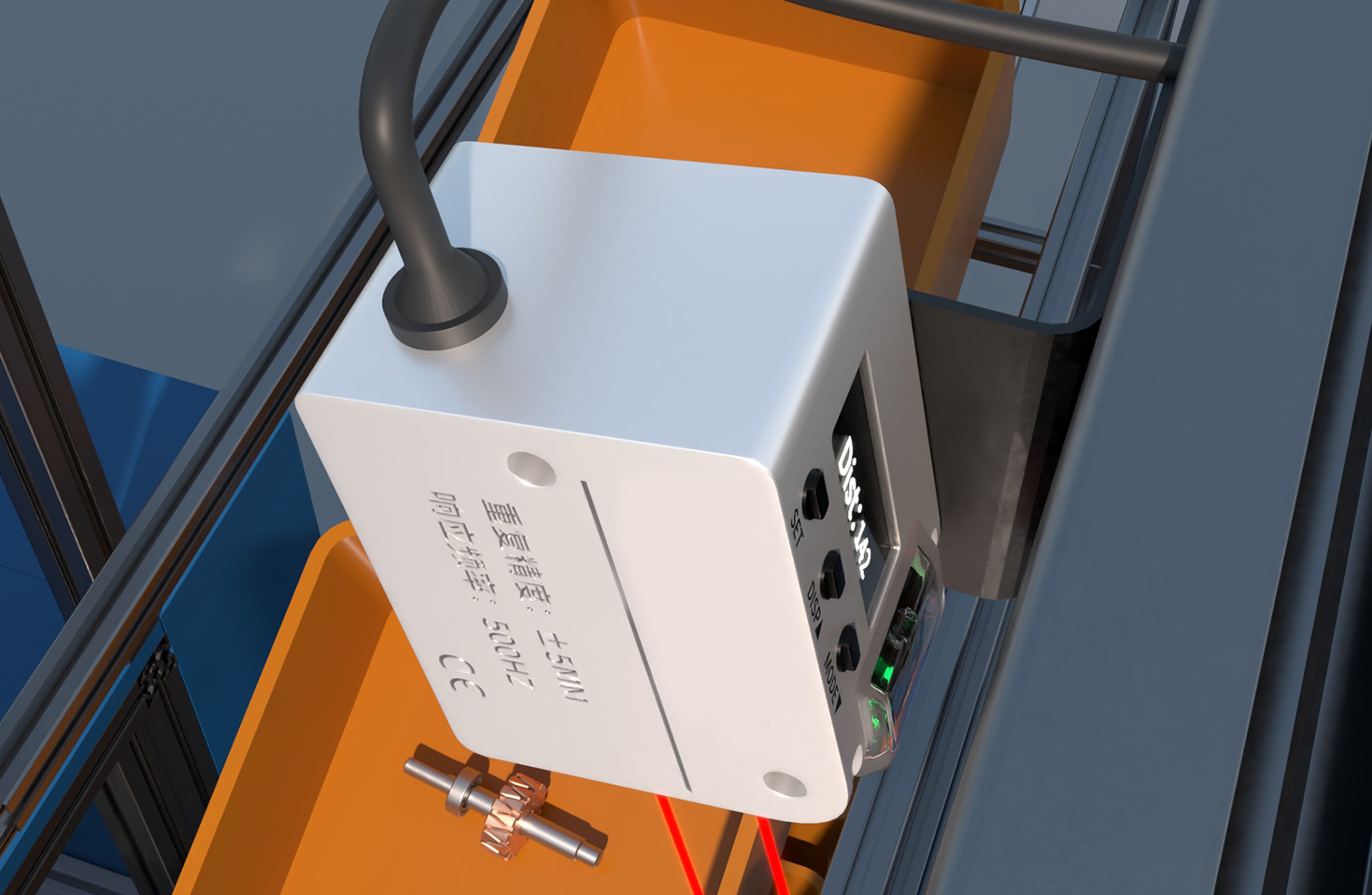
From these core measurements of distance and displacement, laser sensors enable the calculation of other key dimensional parameters. By scanning a laser line across an object or using multiple sensors in a coordinated setup, systems can measure:
* Height and Width: Profiling the cross-section of extruded plastics, rubber, or rolled steel.

* Thickness: Precisely gauging the thickness of transparent films, glass, or opaque materials by using two opposing sensors.

* Diameter: Continuously monitoring the diameter of wires, cables, or pipes during production.
* Contour and Shape: Comparing a scanned 3D profile against a digital CAD model for defect detection.
Beyond dimensions, specialized laser sensors perform presence detection and contrast recognition. They can reliably detect the presence of even highly transparent objects, like glass vials or clear films, which often confound standard photoelectric sensors. Furthermore, they can distinguish between materials or marks based on their reflectivity or color contrast, enabling tasks like label verification on packaging or sorting materials on a high-speed conveyor.
The advantages driving their adoption are compelling. The non-contact nature eliminates mechanical wear and prevents damage to delicate targets. They offer exceptionally high resolution, repeatability, and speed, capable of taking thousands of measurements per second. Modern sensors are robust, designed to withstand harsh industrial environments with varying temperatures, dust, and ambient light interference.
In conclusion, laser sensors are the eyes of modern automated systems, providing critical data on distance, micro-displacement, and a suite of derived dimensions. From ensuring a robotic gripper is perfectly positioned to verifying that a pharmaceutical vial is filled to the exact correct level, their role in enhancing precision, quality, and efficiency across manufacturing, electronics, automotive, and aerospace industries cannot be overstated. As technology advances, their measurement capabilities will only become faster, more accurate, and more integral to the smart factories of the future.