In the realm of industrial automation, process control, and robotics, precise distance measurement is a fundamental requirement. Among the plethora of sensing technologies available, laser distance sensors have emerged as a dominant and versatile solution. Their ability to deliver high-accuracy, non-contact measurements across various ranges and surfaces makes them indispensable in modern engineering. This article delves into the operational principles, key technologies, diverse applications, and critical selection criteria for laser distance sensors.
At its core, a laser distance sensor operates by emitting a focused beam of coherent light—a laser—towards a target object. The sensor then analyzes the reflected light to calculate the distance. The two most prevalent measurement principles are Time-of-Flight (ToF) and triangulation.
Time-of-Flight sensors measure the time it takes for a laser pulse to travel to the target and back. Since the speed of light is a known constant, the distance is calculated using the formula: Distance = (Speed of Light × Time of Flight) / 2. ToF sensors are ideal for long-range measurements, typically from a few meters up to several hundred meters, with accuracy in the millimeter to centimeter range. They are commonly used in applications like vehicle LiDAR, warehouse inventory management, and large-scale surveying.
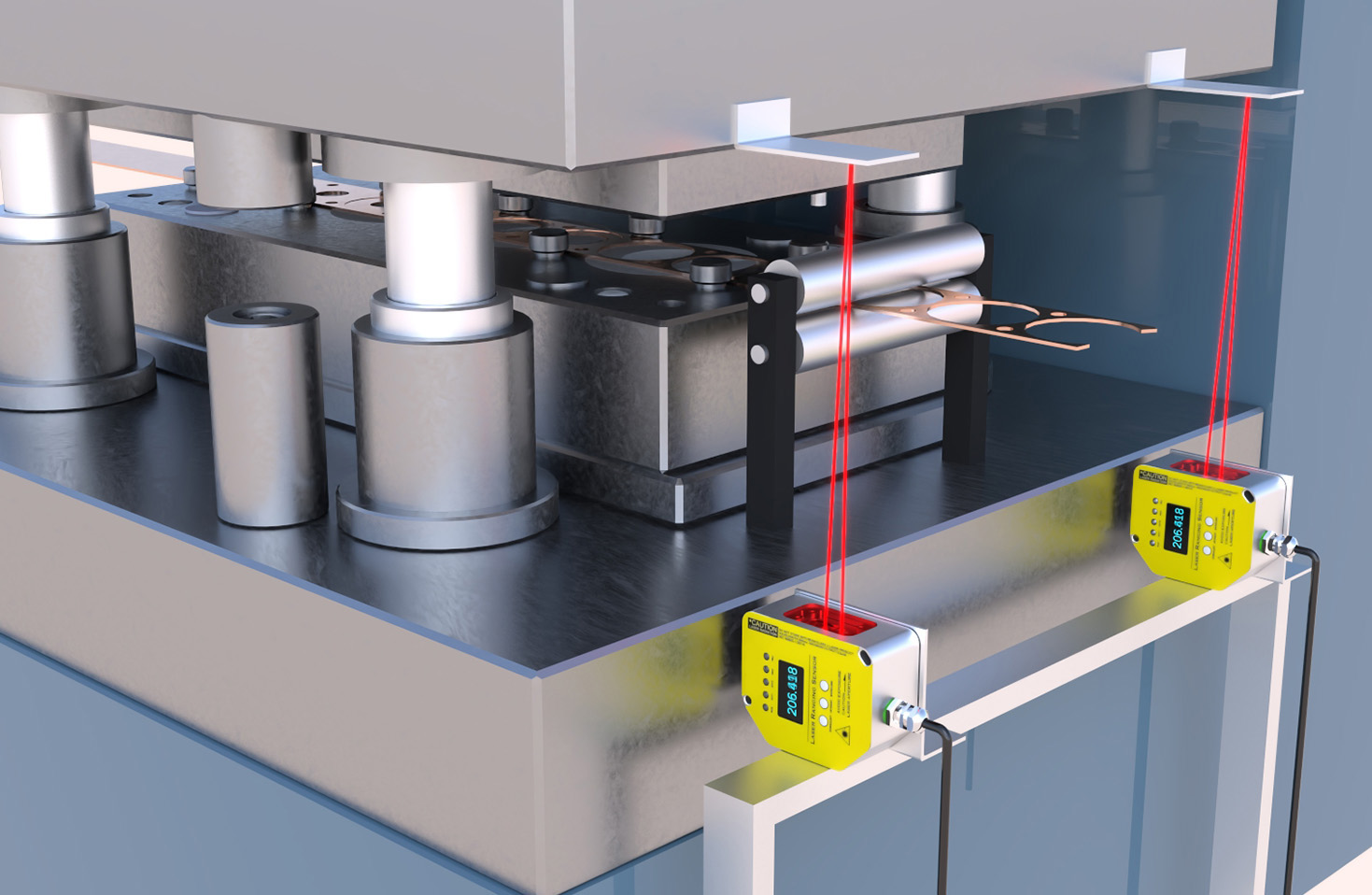
Triangulation-based sensors, on the other hand, are designed for high precision at shorter ranges. The emitter projects a laser spot onto the target. The reflected light strikes a position-sensitive detector (like a CCD or CMOS array) at an angle. The position of the light spot on the detector changes linearly with the target's distance. Using trigonometric calculations, the sensor determines the exact distance. This method offers exceptional accuracy, often in the micron or sub-micron range, but over a limited measuring range (from millimeters to a few meters). It is the go-to technology for quality inspection, thickness measurement, and precision assembly.
Beyond the basic principle, several key specifications define a laser sensor's performance. Measuring Range specifies the minimum and maximum distances over which the sensor can operate reliably. Accuracy and Resolution are often confused; accuracy is the closeness of the measurement to the true value, while resolution is the smallest change in distance the sensor can detect. Linearity indicates how consistently the sensor's output correlates with the actual distance across its entire range. Response Time or sampling rate is crucial for dynamic applications, defining how quickly the sensor can take and output a measurement. Finally, the laser class (typically Class 1 or Class 2) is a vital safety rating indicating the potential hazard of the laser beam to human eyes.
The applications of laser distance sensors are vast and cross-industrial. In manufacturing, they are used for precise positioning of robotic arms, checking part dimensions and profiles, and controlling fill levels in containers. The logistics sector employs them for palletizing, dimensioning packages, and automated guided vehicle (AGV) navigation. In construction and civil engineering, they facilitate land surveying, monitoring structural deformations, and crane anti-collision systems. Emerging fields like autonomous vehicles rely heavily on LiDAR, a sophisticated array of laser sensors, for creating real-time 3D environmental maps.
Selecting the right laser distance sensor requires a careful analysis of the application's needs. First, define the required measuring range and the desired accuracy. A high-precision triangulation sensor is overkill for simply detecting the presence of a large object several meters away. Second, consider the target surface properties. Highly reflective, shiny, or transparent surfaces (like glass or polished metal) can pose challenges by scattering or transmitting too much light, potentially requiring sensors with special filters or algorithms. Dark, matte, or absorbent surfaces reduce the signal strength, which may necessitate a sensor with higher laser power or receiver sensitivity. Environmental factors such as ambient light (sunlight can interfere), dust, fog, temperature extremes, and vibrations must also be accounted for. Finally, the output interface (analog voltage/current, digital RS-232/485, Ethernet, or industrial fieldbus like PROFINET) must be compatible with the existing control system.
In conclusion, laser distance sensors are powerful tools that bridge the gap between the physical world and digital control systems. Their non-contact nature, high speed, and exceptional accuracy empower engineers to solve complex measurement and positioning challenges. By understanding the underlying technologies—ToF for long range and triangulation for high precision—and by meticulously evaluating application requirements against sensor specifications, professionals can effectively harness this technology to drive innovation, improve quality, and enhance operational efficiency across countless industries.