Laser sensor distance measurement technology has become a cornerstone in modern industrial automation, offering unparalleled precision, speed, and reliability. At its core, this technology operates on the principle of time-of-flight (ToF), triangulation, or phase-shift measurement, depending on the specific application requirements. Time-of-flight sensors calculate distance by emitting a laser pulse and measuring the time it takes for the reflection to return. This method is highly effective for long-range measurements, often exceeding several hundred meters, making it ideal for applications such as surveying, autonomous vehicles, and large-scale warehouse management.
Triangulation-based laser sensors, on the other hand, are preferred for short to medium-range measurements with micron-level accuracy. A laser diode projects a spot onto the target surface, and a receiver lens captures the reflected light at an angle. By analyzing the position of the reflected spot on a CMOS or CCD array, the sensor computes the distance through geometric relationships. This approach is widely used in quality control, robotics, and assembly lines where minute deviations can impact product integrity. Phase-shift measurement involves modulating the laser beam's intensity and comparing the phase difference between the emitted and reflected signals. This technique excels in environments requiring high resolution and stability over moderate distances, such as in semiconductor manufacturing or precision engineering.
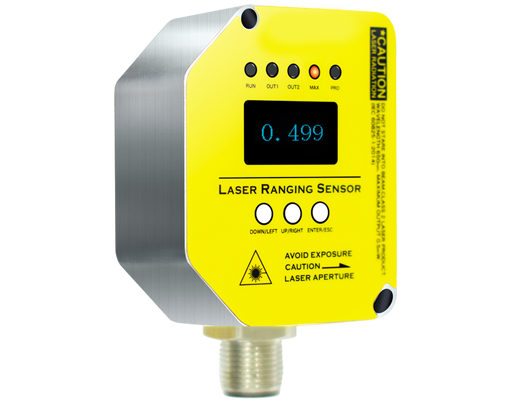
The advantages of laser distance sensors are manifold. They provide non-contact measurement, eliminating mechanical wear and allowing inspection of delicate or moving objects. Their high sampling rates enable real-time monitoring and feedback, crucial for dynamic processes like conveyor belt sorting or robotic guidance. Additionally, laser sensors are largely immune to ambient light interference when equipped with appropriate filters and signal processing algorithms, ensuring consistent performance in varied industrial settings.
However, challenges persist. Surface properties, such as reflectivity, color, and texture, can influence measurement accuracy. Highly reflective or transparent materials may scatter or absorb laser beams, leading to erroneous readings. To mitigate this, advanced sensors incorporate adaptive algorithms or multiple measurement modes. Environmental factors like dust, fog, or temperature fluctuations also pose risks, necessitating protective enclosures or compensation mechanisms.
In practice, laser distance sensors are integral to diverse sectors. In automotive manufacturing, they verify component dimensions and alignments. In logistics, they facilitate inventory tracking and palletizing. In aerospace, they assist in structural inspections and alignment tasks. Emerging trends include the integration of AI for predictive maintenance and the miniaturization of sensors for portable devices. As Industry 4.0 evolves, laser measurement systems are increasingly networked with IoT platforms, enabling data-driven optimization and smarter factory operations.
Looking ahead, advancements in laser diode efficiency, signal processing, and cost reduction will further expand adoption. Research into hybrid systems combining laser with other sensing modalities, like vision or ultrasonic, promises enhanced robustness. Ultimately, laser sensor distance measurement remains a dynamic field, driving innovation and efficiency across global industries.