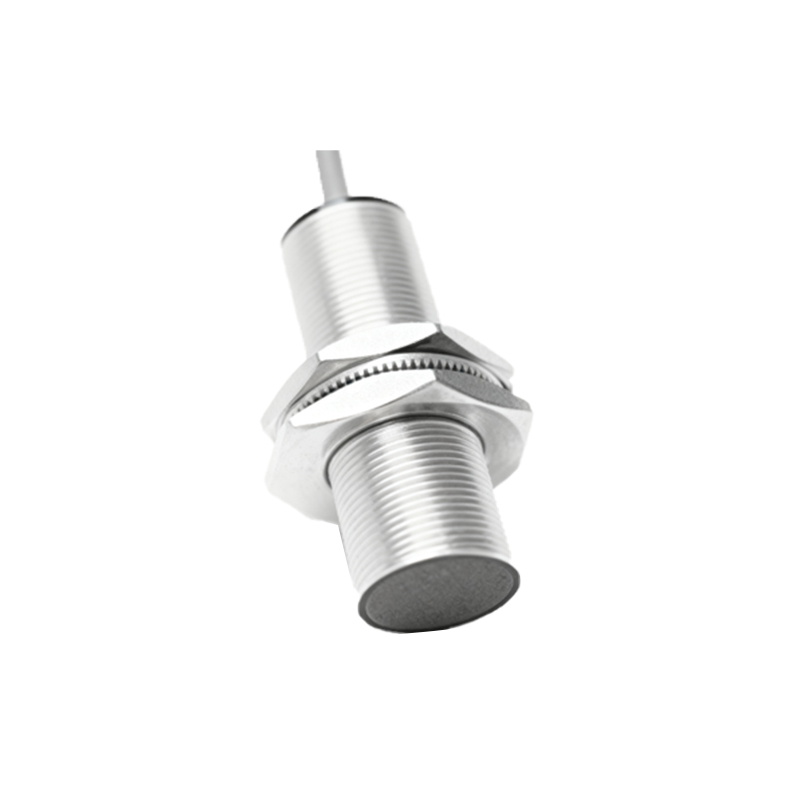
Capacitive proximity sensors are essential components in modern industrial automation, offering non-contact detection of various materials, including metals, plastics, liquids, and granular substances. Unlike inductive sensors, which only detect metallic objects, capacitive models utilize an electrostatic field to sense both conductive and non-conductive targets, making them versatile for diverse applications such as level detection, material handling, and packaging. This article explores key capacitive sensor models, their operational principles, selection criteria, and best practices for integration.
The fundamental working principle of a capacitive proximity sensor involves generating an oscillating electrostatic field from its sensing face. When a target object enters this field, it alters the capacitance, triggering a change in the oscillator's amplitude. This change is processed by the sensor's circuitry to produce an output signal, typically in the form of a switching action. Most capacitive sensors feature adjustable sensitivity, allowing users to fine-tune detection ranges and ignore background interferences, such as container walls or environmental humidity. Common output configurations include DC (NPN/PNP) and AC/DC versions, with options for normally open (NO) or normally closed (NC) contacts to suit different control systems.
Several prominent capacitive sensor models dominate the market, each designed for specific industrial needs. Cylindrical models, such as the CR18 and CR30 series, are widely used for their compact design and robust housing, ideal for mounting in tight spaces or harsh environments. These sensors offer detection ranges from a few millimeters up to 25 mm, with variants in stainless steel or plastic bodies for corrosion resistance. Rectangular models, like the CQ5 and CQ35 series, provide larger sensing areas and extended ranges, often employed in conveyor systems or bulk material monitoring. For specialized applications, flush-mountable sensors minimize dead zones when installed in metal surfaces, while non-flush versions maximize range for non-metallic target detection. Advanced models incorporate IO-Link communication for real-time diagnostics and parameter adjustments, enhancing Industry 4.0 compatibility.
Selecting the appropriate capacitive sensor model requires careful consideration of multiple factors. First, determine the target material and its dielectric constant—materials with higher constants (e.g., water or metals) are easier to detect than low-constant ones (e.g., dry wood or foam). Next, assess the required sensing distance, ensuring it accounts for installation conditions and potential environmental influences like dust or temperature fluctuations. Enclosure ratings, such as IP67 or IP69K, are critical for washdown or outdoor use, while operating voltage (e.g., 10-30 VDC or 20-250 VAC) must match the control system. Additionally, output type should align with the load; for instance, PNP outputs are common in PLC-based setups, while relay outputs suit higher-power circuits. To avoid false triggers, consider sensors with shielding options or temperature compensation features in volatile settings.
Installation and maintenance practices significantly impact sensor performance. Mount sensors away from conductive backgrounds or moving parts to prevent unintended capacitance shifts. For level detection in tanks, position sensors externally on non-metallic walls to avoid direct contact with liquids, or use rod-style probes for internal mounting. Regular calibration of sensitivity is advised, especially when handling varying material batches. Diagnostic tools, like LED indicators or IO-Link interfaces, help troubleshoot issues such as drift or contamination. Common challenges include coating buildup on sensing faces, which can reduce effectiveness—self-cleaning models or periodic wiping mitigate this. In high-noise environments, employing shielded cables and proper grounding minimizes electrical interference.
Capacitive proximity sensors continue to evolve with technological advancements. Recent developments include miniaturized designs for electronics assembly, high-temperature models for automotive processes, and smart sensors with predictive maintenance capabilities. As industries embrace automation and IoT, these sensors will play a pivotal role in enhancing efficiency, safety, and data-driven decision-making. By understanding model specifications and application nuances, engineers can optimize system reliability and adapt to evolving operational demands.