In the realm of industrial automation and electrical engineering, the reliable detection of metallic objects is a cornerstone of process control, safety, and efficiency. While ferrous metals like steel and iron are straightforward targets for inductive proximity sensors, non-ferrous metals, particularly aluminum, present a unique set of challenges. This article delves into the technical intricacies of using proximity sensors for aluminum detection, exploring the underlying principles, sensor selection criteria, and practical application considerations.
The fundamental challenge with aluminum stems from its material properties. Aluminum is a non-ferrous, conductive metal with low magnetic permeability. Standard inductive proximity sensors generate an electromagnetic field. When a ferrous metal enters this field, it significantly distorts it due to its high magnetic permeability, causing a clear and strong change in the sensor's oscillation circuit, which triggers the output switch. Aluminum, however, has a permeability very close to that of air (µr ≈ 1). Its primary interaction with the sensor's field is through eddy currents—electrical currents induced within the aluminum by the changing magnetic field. These eddy currents create their own opposing magnetic field, which dampens the sensor's oscillation. This damping effect is weaker than the permeability-based effect for steel, leading to a critical specification: the reduction factor.
The reduction factor (or correction factor) is paramount when selecting a sensor for aluminum. It indicates how much the rated sensing distance (Sn), typically defined for mild steel (Fe360), is reduced for a specific material. For instance, a sensor with a 10mm sensing distance for steel might have a reduction factor of 0.4 for aluminum. This means its effective sensing distance for aluminum is only 10mm 0.4 = 4mm. Engineers must always consult the sensor datasheet for exact reduction factors, as they vary based on aluminum alloy and sensor frequency. Ignoring this factor is a common cause of installation failure.
To combat the reduced sensing distance, specialized sensors are engineered explicitly for non-ferrous metal detection. Two primary technologies dominate this space:
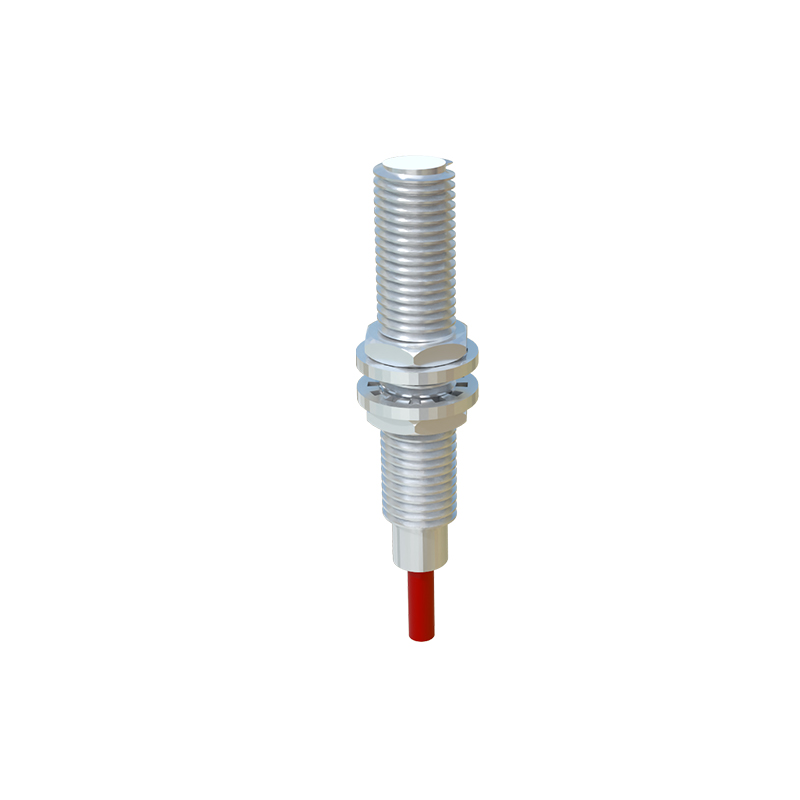
1. Factor 1 Sensors: These are optimized to provide a sensing distance for aluminum, brass, and copper that is approximately equal to their rated distance for steel (i.e., a reduction factor close to 1). They often operate at higher frequencies, which enhances the eddy current response in conductive non-ferrous metals.
2. All-Metal Sensors (Sensitivity Adjustable): These sensors feature a potentiometer that allows the user to adjust sensitivity. They can be tuned to detect any metal—ferrous or non-ferrous—at a similar distance. However, this universality comes with a trade-off: increased susceptibility to false triggers from environmental factors like moisture, dust, or other nearby metallic objects. Shielding is crucial for stable operation.
Beyond sensor type, several application-specific factors demand careful attention:
Target Size and Shape: The standard sensing distance is defined for a square mild steel target of a specified size (often 1.2xSn or 3xSn). For aluminum, the target must be at least as large as this reference to achieve the reduced sensing distance. Smaller or thin-edged targets (e.g., aluminum foil) will further decrease the effective range.
Mounting and Surroundings: Proximity sensors, especially unshielded (non-flush mountable) types, have extended lateral electromagnetic fields. Nearby metallic mounting brackets, machine frames, or even other sensors can influence performance, a phenomenon known as flanking. Always follow the manufacturer's guidelines for minimum clearance from surrounding metals. Using shielded (flush-mountable) sensors mitigates this issue.
Surface Condition and Alloy: Anodized aluminum has a non-conductive oxide layer. The sensor will detect the underlying metal, but the anodizing thickness slightly reduces the effective sensing distance. Different aluminum alloys (e.g., 6061 vs. 1100) have varying electrical conductivities, which can slightly alter the reduction factor.
Environmental Robustness: In harsh environments, such as machining centers with aluminum chips and coolant, sensors with high IP ratings (e.g., IP67, IP69K) and resistance to cutting fluids are essential. Stainless steel housings are preferred for corrosion resistance.
In practice, successful implementation follows a clear workflow: First, define the application parameters (target material, size, required sensing gap, mounting constraints, environment). Second, select a sensor technology—Factor 1 for dedicated, stable aluminum detection or an all-metal type for mixed-metal lines where adjustability is key. Third, calculate the required sensing distance by applying the reduction factor and adding a safety margin (typically 20-30%). Finally, prototype and test the installation under real-world conditions, including temperature extremes and vibration, to ensure long-term reliability.
For electrical engineers, mastering the detection