In the realm of industrial automation, proximity sensors are indispensable components for non-contact detection, object positioning, and process control. Selecting the right sensor for a specific application is a critical engineering decision that directly impacts system reliability, efficiency, and safety. This selection process is governed by a core set of technical parameters. Understanding these parameters in detail is essential for any engineer or technician specifying these devices.
The foremost parameter is the Sensing Distance. This is typically defined as the nominal operating distance (Sn) under standardized conditions. It is crucial to note that the actual usable sensing distance can be affected by factors like temperature, supply voltage, and the target material. Engineers must always apply a safety factor, often derating the nominal Sn by 10-30%, to ensure consistent operation in real-world environments. The required sensing distance dictates the physical size and type of sensor needed.
Closely related is the Target Material and Size. Inductive proximity sensors detect ferrous and non-ferrous metals, but their effective sensing range varies significantly with the type of metal. A standard factor (e.g., steel = 1.0, aluminum ≈ 0.4, copper ≈ 0.3) is used to adjust the nominal sensing distance. Capacitive sensors can detect non-metallic materials like wood, plastic, or liquids, but are sensitive to environmental changes like humidity. Furthermore, the target size must meet the sensor's minimum detectable object specification; a target too small may not be reliably detected at the full nominal distance.
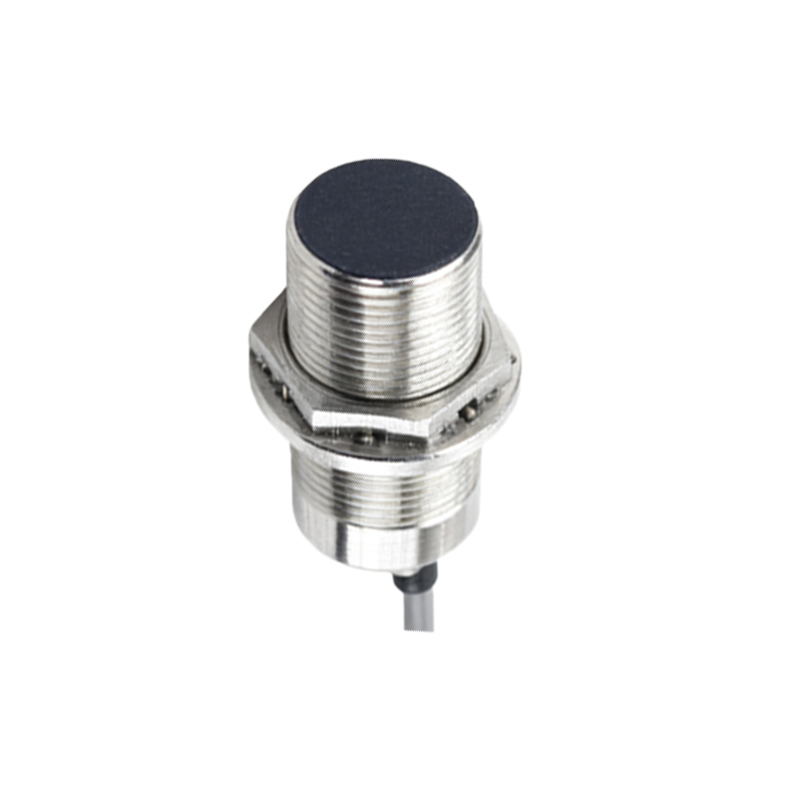
The Output Configuration is a fundamental choice. The primary types are NPN (sinking) and PNP (sourcing) for DC sensors, and AC two-wire or DC three-wire/ four-wire models. NPN is common in Asia, while PPN is often preferred in Europe and North America. The choice must align with the input card of the PLC or controller. Additionally, one must specify Normally Open (NO) or Normally Closed (NC) switching logic. Solid-state (transistor) outputs offer high switching speed and longevity, while relay outputs can handle higher loads but have limited cycle life.
Switching Frequency or response time defines how quickly the sensor can detect objects in rapid succession. Measured in Hertz (Hz) or milliseconds, this parameter is vital for high-speed applications like counting small parts on a conveyor or monitoring encoder pulses. A sensor with a 1 kHz frequency can theoretically detect 1000 objects per second. The sensor's response time must be faster than the minimum time interval between target passages.
Environmental Ratings are non-negotiable for industrial durability. The Ingress Protection (IP) rating (e.g., IP67, IP69K) indicates resistance to dust and liquids. Sensors in washdown areas (food & beverage) require IP69K. The housing material (e.g., stainless steel, PBT plastic) must resist chemicals, oils, or mechanical impact. Operating temperature range is also critical, especially for foundries, cold storage, or outdoor applications.
Electrical Characteristics must match the control system. This includes the operating voltage range (e.g., 10-30 VDC, 20-250 VAC), current consumption, and the maximum load current (short-circuit protected). For DC sensors, the off-state leakage current is important when interfacing with high-impedance PLC inputs, as even a small leakage current might be interpreted as an "ON" signal.
Other vital parameters include Hysteresis: the difference between the switch-on and switch-off points, which prevents chatter when a target is at the sensing edge. Mounting considerations (flush, non-flush, threaded barrel, rectangular) affect the sensing field and installation. Indicator LEDs for diagnostic purposes are highly recommended. For advanced applications, Analog Output or IO-Link communication provides continuous distance measurement and rich diagnostic data, enabling predictive maintenance and finer process control.
In conclusion, a systematic approach to proximity sensor selection involves cross-referencing all these parameters against the application's specific demands: the target, required distance, speed, environmental conditions, and electrical interface. There is no universal "best" sensor; only the most appropriate one for the given task. Consulting detailed datasheets and, when in doubt, prototyping with sample units are best practices that prevent costly downtime and ensure a robust automation solution.