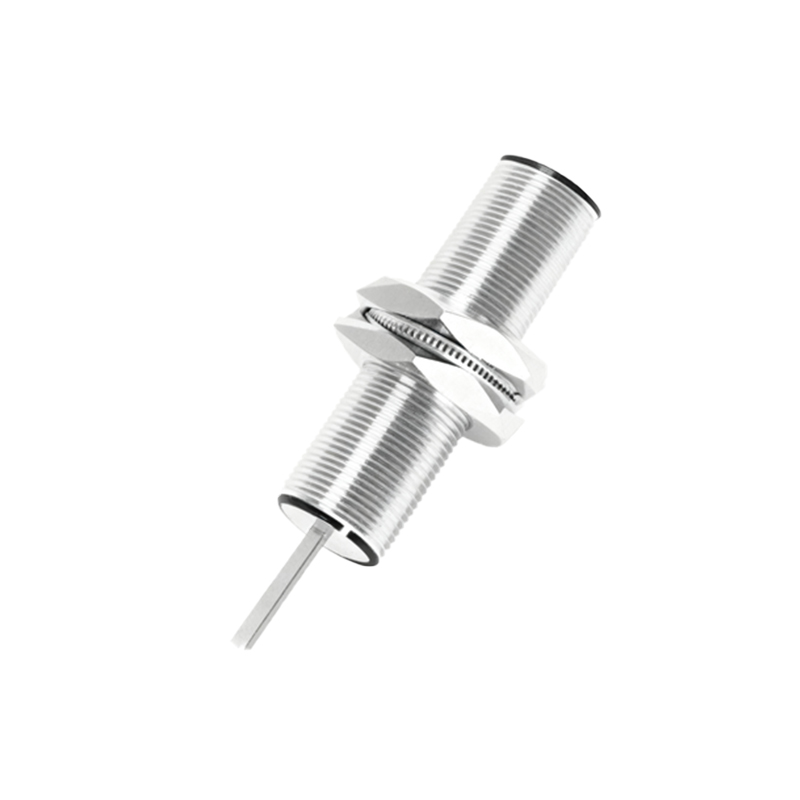
The 30GM50-F2 proximity switch sensor represents a critical component in modern industrial automation, designed to deliver reliable non-contact detection in demanding environments. As a cylindrical inductive sensor, it operates on the principle of electromagnetic induction, generating an oscillating electromagnetic field. When a metallic target enters this field, eddy currents are induced, causing a change in oscillation amplitude. This change is detected by the sensor's internal circuitry, triggering a solid-state output signal. The 30GM50-F2 is engineered with a sensing range of 50 mm, making it suitable for applications requiring medium-distance detection. Its robust housing, typically constructed from nickel-plated brass or stainless steel, ensures high resistance to mechanical stress, oils, and coolants commonly found in manufacturing settings.
One of the key features of the 30GM50-F2 is its flush-mountable design. This allows the sensor to be installed embedded in metal without compromising its sensing capabilities, a significant advantage over non-flush models that require a safety distance from surrounding metal. The sensor operates on a DC supply voltage, commonly 10-30 VDC, and provides a PNP normally open (NO) output configuration, which is widely compatible with programmable logic controllers (PLCs) and industrial control systems. Its switching frequency, typically around 100 Hz, enables it to handle high-speed counting and positioning tasks on production lines.
In practical applications, the 30GM50-F2 excels in various industrial scenarios. It is frequently deployed for position sensing of machine parts, such as verifying the presence of a cylinder rod in hydraulic or pneumatic systems. In conveyor systems, it detects the passage of metal components, enabling precise control of sorting and packaging operations. The sensor's immunity to environmental factors like dust and non-conductive contaminants makes it ideal for use in material handling, automotive assembly, and metalworking machinery. Additionally, its short-circuit and reverse-polarity protection features enhance system reliability, minimizing downtime due to wiring errors or electrical faults.
Installation and maintenance of the 30GM50-F2 are straightforward. Proper alignment with the target object is crucial for optimal performance; the sensor should be positioned perpendicular to the target surface to achieve the rated sensing distance. Regular checks for accumulation of metallic debris on the sensing face are recommended, as such buildup can reduce effective range. When integrating into control circuits, users must ensure the load current does not exceed the sensor's maximum rating, typically 200 mA, and incorporate a suitable surge suppression device if driving inductive loads like relays or solenoids.
Compared to alternative sensing technologies like capacitive or ultrasonic sensors, the inductive 30GM50-F2 offers distinct advantages for metal detection, including higher precision, faster response times, and greater durability in harsh conditions. However, it is important to note that standard inductive sensors are only effective with metallic targets. For detecting non-metallic materials, other sensor types would be required. The 30GM50-F2 also complies with international standards for industrial sensors, such as IP67 ingress protection, ensuring reliable operation in wet or dusty environments.
As Industry 4.0 and smart manufacturing evolve, sensors like the 30GM50-F2 continue to play a vital role in enabling real-time monitoring and data acquisition. Its robust design, consistent performance, and ease of integration make it a preferred choice for engineers seeking to enhance automation efficiency and machine safety. When selecting a proximity sensor for a specific application, factors such as target material, required sensing distance, environmental conditions, and electrical interface must be carefully considered to ensure optimal system performance and longevity.